
In FHIR, referrals are modeled as ServiceRequest for the order combined with Task for fulfillment state, and the primary references for building this out are the BSeR Implementation Guide and the SDOH Clinical Care IG, both of which define direct and indirect workflows alongside the referralStatus terminology. The CMS Interoperability and Prior Authorization final rule adds policy weight behind these patterns for payers building FHIR APIs.
TL;DR:
- Pair ServiceRequest orders with Tasks for fulfillment, link them through basedOn and partOf, and timestamp every status transition for stage duration reporting.
- Choose direct exchange only when both partners support FHIR; otherwise use direct light or intermediary routing, and return only outcome details needed to close referrals.
- Use individual REST calls for single resource updates, bundles when related resources must arrive atomically, and subscriptions for urgent changes; polling adds latency.
- Impacted payers must follow FHIR R4 and US Core requirements, with provisions taking effect January 1, 2026, and certain API requirements by January 1, 2027.
- Track Task history rather than current status alone, and record refusal or cancellation reasons to expose delays, partner capacity problems, and referral outcomes.
Table of Contents
- Key FHIR resources and terminology for referrals
- Referral workflows and use cases from implementation guides
- Practical exchange mechanics: REST interactions, bundles, and subscriptions
- US policy and standards context that affects FHIR referrals
- Practitioner perspective: operational notes on closed-loop referrals
- Common implementation challenges in community health settings
- Data privacy and security considerations for referral workflows
- Performance metrics and KPIs for closed-loop referral systems
- Deployments and what closed-loop referrals look like in practice
- How EquiLoop supports closed-loop FHIR referral workflows
- FAQ
- Sources
Key FHIR resources and terminology for referrals
ServiceRequest carries the referral order itself. Its intent element marks it as an order rather than a plan, basedOn links it to any prior request it fulfills, and requester and performer identify who is sending and who is expected to act. The reasonCode and reasonReference elements carry the clinical or social justification for the referral, and US Core ServiceRequest guidance expects implementers to support both forms since referral sources vary in whether they send coded reasons or references to a Condition or Observation.
Task tracks what happens after the order is placed. Its status values move through requested, received, accepted, in-progress, completed, and cancelled, and each transition should be timestamped so downstream reporting can calculate how long a referral sat at each stage. Task.partOf links a Task back to the ServiceRequest it fulfills, and FHIR’s workflow management guidance is explicit that ServiceRequest alone cannot capture fulfillment granularity. That pairing, ServiceRequest.basedOn and Task.partOf working together, is what closes the loop programmatically.
Several supporting resources show up depending on referral type:
- Condition or Observation when reasonReference points to a clinical or social finding.
- CommunicationRequest when a referral requires a separate instruction to contact the patient.
- Practitioner and Organization to identify requester and performer precisely.
- Patient as the subject, always required but rarely the hard part.
For state terminology, referralStatus is the CodeSystem built specifically to express where a referral stands, and ReferralMethod captures how it was transmitted. Both predate much of current FHIR tooling but still underlie conventions carried forward from HL7 v2 and v3.
Referral workflows and use cases from implementation guides
Which pattern applies depends on what the receiving party can support. The SDOH Clinical Care IG names three, and BSeR adds a bidirectional layer on top.
- Direct, when both parties run FHIR servers: the initiator creates a ServiceRequest and a Task with status requested, the receiver updates Task.status to received then accepted, and both sides poll or subscribe to track progress through in-progress and completed.
- Direct light, when the recipient has no FHIR server: the initiator sends a secure link or a pulled document instead of a live resource, and the recipient posts outcome data back through a lightweight channel rather than a FHIR API.
- Indirect, routed through an intermediary or coordination platform: the intermediary creates a local copy of the referenced resources, issues a filler-order ServiceRequest, and creates Tasks with Task.partOf pointing to the original order, maintaining sync through subscription or scheduled polling.
- BSeR bidirectional, layered on any of the above: the receiving party sends outcome and enrollment data back to the initiator, observing the minimum necessary standard so only the clinical detail required to close the loop crosses the wire, a design constraint BSeR states explicitly.
Pro Tip: Build your Task state machine before your API routes. Most referral integration bugs trace back to a missing or ambiguous status transition, not a broken endpoint.
Intermediary platforms do the heaviest lifting in indirect flows, since they are often the point translating non-FHIR service directories into FHIR-conformant ServiceRequests and Tasks so that light receivers can still participate.
Practical exchange mechanics: REST interactions, bundles, and subscriptions
Most referral traffic runs on discrete REST calls, POST to create a ServiceRequest, PATCH or PUT to update a Task, GET to check status. MessageBundles make sense when an initiator needs to send a ServiceRequest, its supporting Condition, and a CommunicationRequest as one atomic transaction, particularly across intermediaries that batch updates rather than process them one at a time.
- Use discrete REST calls for simple, single-resource updates like a status change.
- Use a MessageBundle when several related resources must arrive together or not at all.
- Expect a 201 Created on a new ServiceRequest or Task and a 200 OK with the updated resource body on a status PATCH.
- Reject or queue requests that arrive with an invalid Task.status transition rather than silently overwriting state.
Subscriptions suit high-volume, time-sensitive referral networks where a receiver needs to know the moment a status changes. Polling suits lower-volume or resource-constrained partners, at the cost of latency between an actual status change and when the initiator learns about it. Many community health deployments run both: subscriptions for partners who can support them, scheduled polling as the fallback for partners who cannot.
Pro Tip: Map every refusal and cancellation path explicitly. A Task that moves from accepted to cancelled needs a reason code attached, or your outcomes reporting will show a gap with no explanation attached to it.
Error handling matters more than happy-path design in multi-partner networks. A referral that silently stalls because of an unhandled status transition is harder to diagnose after the fact than one that fails loudly.
US policy and standards context that affects FHIR referrals
The CMS Interoperability and Prior Authorization final rule, CMS-0057-F, requires impacted payers to stand up FHIR APIs for prior authorization and to expose certain data through Provider Access APIs, with some provisions taking effect by January 1, 2026, and certain API requirements by January 1, 2027. The rule names US Core and FHIR R4 as the baseline standards for these prioritized APIs.
- USCDI is tracking referral as its own data class in draft version 7, treating referrals as first-class data rather than a byproduct of clinical notes.
- US Core’s ServiceRequest profile, including reasonCode and reasonReference, is the floor implementers need to hit for compliance with federally recognized interoperability standards.
- Da Vinci PAS and PDex intersect with referral workflows wherever a referral also triggers a prior authorization decision, since both operate on the same ServiceRequest backbone CMS-0057-F now requires.
None of this is optional for payers in scope, and providers building referral integrations against payer-facing APIs should expect these standards to shape what payers will accept.
Practitioner perspective: operational notes on closed-loop referrals
Running referral infrastructure across a multi-partner network surfaces problems that a single implementation guide section will not. A few patterns show up consistently:
- Intake forms rarely map cleanly to FHIR elements on the first pass. Plan for a mapping layer between your screening questions and ServiceRequest.reasonCode.
- Referral pathways need to be configurable per partner, since clinical partners and community-based organizations rarely share the same acceptance workflow.
- Funder-ready reporting requires tracking Task state history, not just current status, to show follow-through over time.
A coordination platform that can proxy Task and ServiceRequest lifecycles against each partner’s actual capability, FHIR server or not, removes a meaningful amount of this integration burden from any single partner’s shoulders.
Common implementation challenges in community health settings
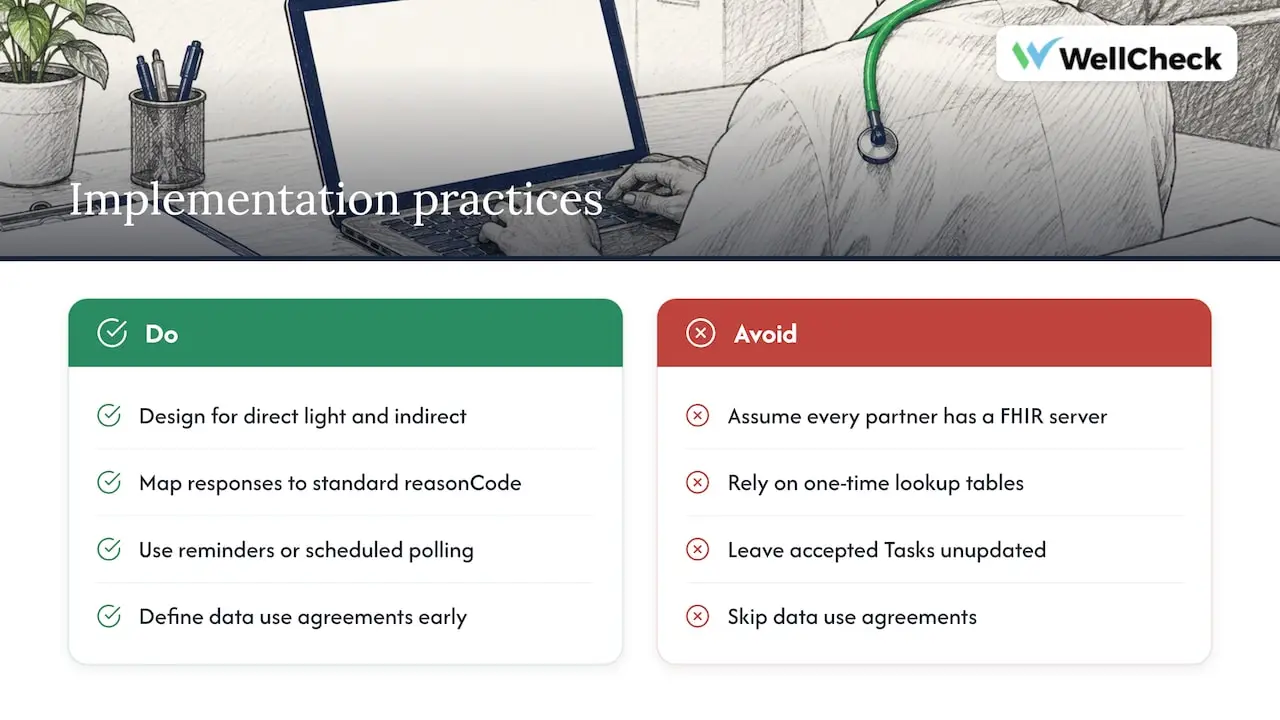
Partner capability is the most persistent problem, and remote services like teleradiology for imaging centers illustrate how clinical services integrate smoothly with referral and scheduling workflows. A referral network spanning a rural hospital, a few FQHCs, and several community-based organizations will have partners at every point on the FHIR maturity spectrum, from full ServiceRequest and Task support down to fax and email. Designing for the direct light and indirect patterns from the start, rather than assuming every partner will eventually have a FHIR server, avoids rework later.
Data quality at intake is the second recurring issue. SDoH screening tools vary in how they phrase questions, and mapping free-text or locally coded responses to standard reasonCode values takes deliberate mapping work, not a one-time lookup table.
Status tracking gaps show up when a Task never gets updated after acceptance. Community-based organizations without dedicated IT staff often lack the workflow discipline to close the loop manually, so automated reminders or scheduled polling against partner systems help catch referrals that would otherwise sit at in-progress indefinitely.
Governance across partners also needs attention early. Each organization sharing or receiving referral data needs a clear data use agreement defining what resources can be shared, consistent with the minimum necessary approach BSeR builds into its design. Skipping this step creates friction later when a partner objects to the scope of data flowing to or from their system.
Data privacy and security considerations for referral workflows
Referral data frequently includes both clinical information and social determinants of health detail, which raises the stakes on access control. Every ServiceRequest and Task exchange should run over authenticated, encrypted channels, typically OAuth 2.0 with SMART on FHIR scopes limiting each partner to the resources relevant to their role.
Minimum necessary sharing, the principle BSeR’s content separation is built around, applies directly to referral payloads. A clinical referral and a social services referral should not automatically share the same data access scope, and intermediaries handling both need to segment what each receiving partner can see.
Audit logging matters more in referral networks than in single-system deployments, since a referral’s data touches multiple organizations with different security postures. Every status change and data access event should be logged in a way that supports a HIPAA accounting of disclosures if a patient requests one.
Partner-level security assessment is also worth building into onboarding. A new community-based organization joining a referral network may not have the same security maturity as a hospital system, and testing their actual configuration, not just their stated compliance, catches gaps before they become incidents.
Performance metrics and KPIs for closed-loop referral systems
Closed-loop completion rate is the core metric: the share of referrals that reach a documented outcome rather than stalling at an intermediate Task status. Time-to-acceptance, measured from Task creation to the first status update past requested, flags partners who are slow to engage. Time-to-resolution, from creation to completed or cancelled, shows whether the network as a whole is moving referrals or accumulating backlog.
Refusal and cancellation rate, broken down by reason code, points to referral pathways that need redesigning, whether that means fixing eligibility criteria upstream or addressing a partner’s actual capacity. Volume by partner and by reason for referral helps funders see not just how many referrals moved but which pathways matter most to the population being served.
None of these metrics are useful as one-time snapshots. Tracked over time, they show whether operational changes, a new partner onboarding, a reworked intake form, a new reminder cadence, are actually improving follow-through rather than just activity.
Deployments and what closed-loop referrals look like in practice
A rural health hub deployment spanning a multi-partner ecosystem of clinical and social services referrals has recorded 22,682 individuals screened, 45,458 services delivered, and a 93.9% closed-loop completion rate.[^1] Those figures reflect what sustained tracking across a referral network looks like once status updates are actually captured rather than assumed.
The pattern behind numbers like these is consistent: screening generates referrals, each referral gets a ServiceRequest and a Task, and the Task status gets updated as partners act on it rather than left at requested indefinitely. The gap between service volume and follow-through, which most programs can report the first but not the second, is exactly what closed-loop tracking is built to close.

[^1]: Rural health hub deployment with a multi-partner ecosystem. Includes both clinical and social services referrals.
How EquiLoop supports closed-loop FHIR referral workflows
We manage the referral workflow end to end: SDoH screening and intake, routing to clinical and community partners, status tracking through to resolution, and outcomes reporting formatted for funders. Our platform is configured around the partner network and reporting requirements a program already has, and built to complement existing EHRs and systems of record rather than replace them. For programs mapping intake data to FHIR elements or tracking referrals across partners at different levels of technical capability, that configuration work is where how EquiLoop’s referral workflow operates becomes concrete. Review the EquiLoop platform details, then book a 30-minute demo to walk through your referral network specifically.
FAQ
What does a referral do in healthcare?
A referral directs a patient from one provider or service to another for care the first party cannot deliver, whether a specialist visit, a diagnostic test, or a social service like housing assistance. In FHIR terms, a referral is represented by a ServiceRequest, the order, tracked through completion by a linked Task.
Is FHIR the future?
FHIR is already the required standard behind major US policy, including the CMS Interoperability and Prior Authorization rule, which mandates FHIR APIs for impacted payers with provisions phasing in by January 1, 2026 and January 1, 2027. That regulatory backing, combined with active implementation guide work like BSeR and SDOH Clinical Care, points toward continued adoption rather than a temporary standard.
What is HL7 in healthcare?
HL7, or Health Level Seven, is the standards organization that publishes the specifications healthcare systems use to exchange data, including FHIR. It maintains terminology systems like referralStatus alongside the resource-based standards that define how referrals, orders, and clinical data move between systems.
What does FHIR stand for?
FHIR stands for Fast Healthcare Interoperability Resources, the HL7 standard for exchanging healthcare data through modular resources like ServiceRequest and Task. It is designed around RESTful web APIs, making it more straightforward for developers to implement than older HL7 messaging standards.
