
A logic model for a health program is a one-page diagram that connects what you invest (inputs) to what you do (activities), what you produce (outputs), and what changes as a result (outcomes). Build it by starting with the outcomes you want, then working backward to the activities and resources that must exist to reach them. This guide shows how to do that for community and rural health programs, including programs that run social needs screening and referrals, where the weakest link is usually what happens after the referral is sent.
TL;DR
- A logic model is a single-page visual of your program: inputs, activities, outputs, and short-, intermediate-, and long-term outcomes, as described in CDC’s program evaluation framework.
- Start from the outcomes you want and work backward. Starting from the activities you already run tends to produce a model that documents volume, not impact.
- In referral-based programs, add the referral loop as its own set of outputs: accepted, delivered, resolved. A referral that was sent is not an outcome.
- Build the model with the staff and community partners who run the work, and revise it when your evidence or environment changes.
- Pilots often need an implementation evaluation first, not a full impact study.
Table of Contents
- What a logic model does for a health program
- The components, defined for community health work
- How to build the model, step by step
- A worked example: a community health referral program
- Putting the referral loop in the model
- Match the evaluation to the stage of the program
- Common mistakes
- Using the logic model for funder reporting
- How EquiLoop supports a logic model in operation
- Frequently asked questions
- Sources
What a logic model does for a health program
A logic model is a map of your program theory. CDC describes it as a graphic depiction of the relationship between a program’s activities and its intended outcomes, showing the sequence of events that brings about change. Its program description step treats the model as a tool for communicating the program to others, not only for internal planning.
For a program director, the model does four practical jobs:
- Planning. It forces agreement on what the program is supposed to change, and for whom.
- Implementation monitoring. It tells you what to measure while the program runs, so you can see whether delivery is happening as planned.
- Evaluation. It identifies which questions an evaluation should answer and which data you need to answer them.
- Reporting. It gives funders and payers a shared reference for what you promised and what you can show.
The AHRQ description of a logic model adds one useful detail: the diagram should show not only the resources, activities, and outcomes, but the pathways through which the intervention is expected to produce its effects. If your model is a list of boxes with no reasoning between them, it is not finished.
The components, defined for community health work
Most templates use the same five parts. The definitions below follow CDC’s guidance, with examples from community and rural health settings.
| Component | What it means | Example in a community health program |
|---|---|---|
| Inputs | Resources the program uses, such as funding and staff | Grant funding, community health workers (CHWs), a screening tool, agreements with referral partners, a tracking system |
| Activities | Strategies the program carries out to effect change | Screening for social needs, routing referrals, following up with clients, training staff |
| Outputs | Direct deliverables of the activities | Number of people screened, referrals sent, follow-up contacts completed |
| Short-term outcomes | Early changes in knowledge, access, or connection | Client connected to a service they needed |
| Intermediate and long-term outcomes | Later changes in behavior, health status, or community conditions | Need resolved and sustained; improved health measures; lower avoidable utilization |
Two parts of the table cause most of the confusion.
Outputs versus outcomes. An output counts what the program did. An outcome describes what changed for the people served. “Screened 500 people” is an output. “People with a food need who received food assistance” is closer to an outcome. Programs often stop at inputs and outputs because outcomes are harder to measure and attribute, a tendency noted in the CDC evaluation framework. Funders and payers, though, increasingly ask about outcomes.
Process side versus outcome side. CDC’s logic model evaluation guide describes a basic model as having two sides: a process side (inputs, activities, outputs) and an outcome side. The process side tells you whether you delivered the program. The outcome side tells you whether delivery mattered. You need both to answer a funder’s question.
How to build the model, step by step
1. Define the problem and the population
Write one or two sentences on the need you are addressing and who experiences it. For a rural program, be specific about geography, service area, and the barriers that are particular to it, such as distance to services or thin partner capacity. The NNLM rural health evaluation pathway places the logic model right after this framing as the second step in designing an evaluation.
2. Start with the outcomes and work backward
CDC’s guidance on describing the program supports a planning habit that pays off in operations: define the long-term outcomes first, then identify the activities and inputs needed to reach them. A model built this way is structured to track actual impact, not only service volume.
Ask these questions in order:
- What should be different for clients or the community in three to five years?
- What must change in the next year or two for that to be plausible?
- What must happen soon after a client contacts the program?
- What does staff or a partner have to do for that to occur?
- What resources and agreements make those actions possible?
3. List activities as they are actually performed
Include the real workflow, not the version in the grant narrative. Engaging community partners and program implementers from the start helps surface barriers to follow-through and keeps the model tied to the real operating workflow, a point the CDC evaluation framework makes about stakeholder engagement. If a referral depends on a partner who answers email twice a week, the model should reflect that.
4. Choose outputs you can count
For each activity, name one output and the data source that produces it. If you cannot name the data source, you cannot report the output. This is the step where many programs discover that they have no record of what happened after a handoff.
5. State outcomes as changes, with timeframes
Write outcomes as changes in people or conditions. Separate short-term from intermediate and long-term, and be honest about which ones your program can plausibly influence and which depend on factors outside your control.
6. Add assumptions and external factors
Most models include a short list of assumptions (for example, that partners have capacity to accept referrals) and external factors (such as Medicaid policy changes or transportation availability). These are where the model shows its reasoning. They also point to risks you should monitor.
7. Keep it to one page and test it
CDC describes the logic model as a one-page graphic. Show it to a front-line staff member and a partner. If they cannot tell you where their work appears on the page, revise it.
A worked example: a community health referral program
The model below is an illustration of structure for a program that screens for social needs and refers clients to clinical and community partners. It is a template, not a report of results. Adapt every row to your own program.
| Inputs | Activities | Outputs | Short-term outcomes | Intermediate and long-term outcomes |
|---|---|---|---|---|
| Funding; CHW and navigator staff; screening tool; partner agreements; referral tracking system | Screen clients for social needs; route referrals to partners; follow up on status; document resolution | Clients screened; referrals sent; referrals accepted by partners; services delivered; referrals resolved | Clients reach the service they were referred to | Identified needs are resolved; partners and program share a reliable record; funders receive outcome data |
Look at the outputs column. A model that stops at “referrals sent” cannot distinguish between a client who received help and a client whose referral disappeared. A peer-reviewed logic framework for evaluating social determinants of health interventions in primary care exists because screening has expanded faster than the ability to evaluate what follows it. A systematic review of screening and referral services of 35 studies found that nearly all had a tendency toward high risk of bias, which is another reason to define your own outputs and outcomes clearly.
Putting the referral loop in the model
In many community health settings, a referral is sent and no one tracks whether it was accepted, delivered, or resolved. Programs can report service volume but not follow-through. That gap shows up in a logic model as a missing set of outputs between “referral sent” and “outcome achieved.”
A closed-loop referral process fills the gap. It records each stage:
- Intake: the screening result and the need identified.
- Routing: the referral to a specific partner, and when.
- Service delivery: confirmation that the partner accepted and delivered the service.
- Resolution: whether the need was met, and the date the referral was closed.
Each stage becomes an output you can count, and the share of referrals that reach resolution becomes a measure of whether your activities produced their intended short-term outcome. WellCheck’s guides on closed loop referral implementation and on the metrics clinics should track go deeper on how to define these stages with partners.
What closed-loop data looks like in practice
WellCheck’s EquiLoop platform manages this workflow, from SDoH screening and intake through routing, follow-up, outcomes dashboards, and funder-ready reporting. In one rural health hub deployment with a multi-partner ecosystem, the platform recorded:
- 22,682 individuals screened
- 45,458 services delivered
- A 93.9% closed-loop completion rate
Rural health hub deployment with a multi-partner ecosystem. Includes both clinical and social services referrals.
These figures map directly onto a logic model: individuals screened and services delivered are outputs, and the closed-loop completion rate shows how many referrals were followed to resolution. Your program will have different numbers. The point is that the model names measures you can actually produce.
Match the evaluation to the stage of the program
Not every program needs a rigorous impact evaluation. AHRQ’s evaluation guidance notes that for pilot programs, an implementation evaluation is often more valuable, because it identifies barriers and facilitators that inform rollout and refinement.
A practical way to use the logic model with that in mind:
| Program stage | Main question | Focus in the logic model |
|---|---|---|
| Pilot or first year | Are we delivering what we planned, and what gets in the way? | Inputs, activities, outputs, including each referral stage |
| Established program | Are clients getting the intended results? | Short- and intermediate-term outcomes |
| Mature program with stable data | What difference does the program make at the population level? | Long-term outcomes, comparison designs, with evaluation support |
A rural program with a small staff will usually be in the first two rows. Collect clean process data first. Outcome and impact claims are only as credible as the process data underneath them.
Common mistakes
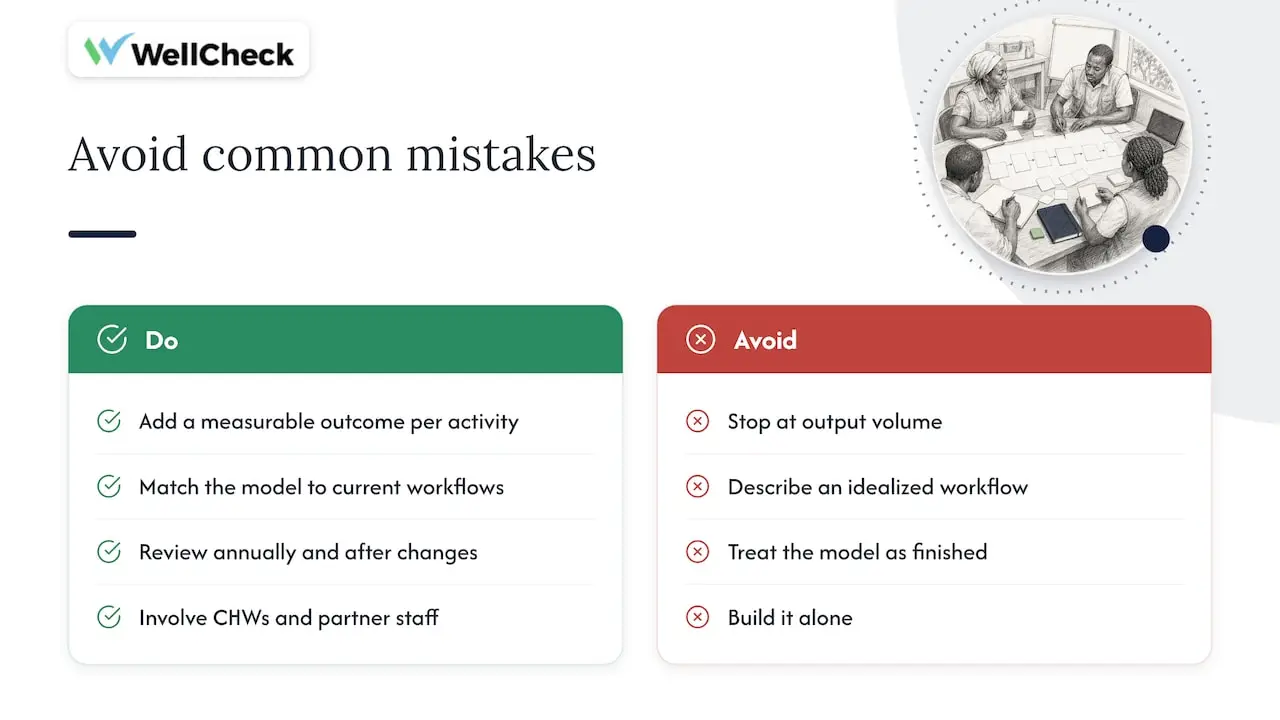
Documenting volume as if it were impact. A model that ends at outputs will answer “how much” but not “so what.” Add at least one outcome you can measure for each major activity.
Describing an idealized workflow. The model should match how referrals, handoffs, and follow-up occur now. Include the steps where handoffs fail, because those are the places to measure.
Treating the model as finished. Logic models are meant to be revised as you learn. CDC’s evaluation guidance treats the model as a living part of the program description, and the CDC logic model guide is useful for how to use it throughout a program’s life. Review it at least annually, and after any change in funding, partners, or requirements.
Building it alone. A model written by one person in a grant-writing sprint rarely survives contact with operations. Include the CHWs, navigators, and partner staff who do the work.
Crowding the page. If the model needs three pages, it is probably several programs. Split it, or keep the one-page version for the program as a whole and add detail in a separate document.
Using the logic model for funder reporting
Funders and payers ask whether the program did what it said and whether it made a difference. A logic model gives you a structure for the answer, if each box has a measure behind it.
- For each output and outcome, write the indicator, the data source, and who is responsible for collecting it.
- Check that the data is captured in the normal course of work. Data that depends on a separate manual process is rarely complete.
- Align the language with the funder’s own framework. Use their term for each element, and show how your model maps to it.
- Report against the model: what was planned, what happened, and what you learned.
For programs with social needs referrals, the data you need often sits across several organizations. A shared record of each referral’s status, kept in a system that complements your existing systems of record, makes the reporting step much easier. WellCheck’s articles on rural health referral tracking and on defining social needs cover the operational details.
How EquiLoop supports a logic model in operation
A logic model on paper does not produce data. EquiLoop is WellCheck’s closed-loop referral and care coordination platform for community and rural health programs. It supports the process side of the model: SDoH screening and intake, referral routing to clinical and community partners, follow-up and status tracking, outcomes dashboards, and funder-ready reporting.
Each deployment is configured around the partner network, referral pathways, and reporting requirements the organization already has, and the platform is built to complement existing systems of record, not replace them. EquiLoop is not a resource directory. Its purpose is workflow and accountability: tracking what happened after the referral was made.
If you are building or revising a logic model and want to see how its outputs and outcomes could be captured in a working referral workflow, learn more about EquiLoop or book a 30-minute demo.
Frequently asked questions
What is the difference between a logic model and a theory of change?
The two terms overlap, and some funders use them interchangeably. A logic model is usually a one-page diagram of resources, activities, outputs, and outcomes. A theory of change tends to put more emphasis on explaining why each step is expected to lead to the next, including assumptions. If a funder asks for one, check their template and follow it.
How long should a logic model take to build?
A first draft can be done in a single working session with the right people in the room. Refining it, agreeing on indicators, and confirming data sources takes longer, often several weeks of part-time effort. Time spent here is recovered later, when reporting questions have clear answers.
Do small rural programs need a logic model?
Yes, and a simple one is enough. Small programs often have fewer staff and tighter budgets, which makes it more important to be clear on what is being measured. A one-page model with a handful of indicators is a reasonable starting point, and the NNLM rural health pathway walks through the process with rural settings in mind.
How often should we update the logic model?
Review it at least once a year, and whenever your funding, partner network, or reporting requirements change. Update it also when implementation shows that a planned activity is not happening as expected. A model that no longer matches the program cannot guide it.
Should referral status be an output or an outcome?
Treat “referral sent” as an output. Treat “referral accepted” and “service delivered” as outputs too, because they measure the program’s and its partners’ delivery. “Need resolved” is closer to an outcome, since it describes a change for the client. Tracking all of these separately shows where referrals stall.
Sources
- CDC Program Evaluation Framework, 2024 (MMWR)
- Step 2: Describe the Program (CDC)
- Developing and Using a Logic Model, evaluation guide (CDC)
- What is a Logic Model? (AHRQ)
- AHRQ evaluation guide for PCMH implementation
- A logic framework for evaluating social determinants of health interventions in primary care (PMC)
- Screening and Referral Care Delivery Services and Unmet Health-Related Social Needs: A Systematic Review (CDC, Preventing Chronic Disease)
- Rural Health Pathway (NNLM)
