
Medicaid social needs reporting is the set of screening, referral and outcome data that state Medicaid agencies, managed care organizations (MCOs) and their provider networks must document to show that health-related social needs (HRSN) were identified and acted on. There is no single national form. Requirements come from state contracts, Section 1115 demonstration terms and quality measures, so the first job for a program director is to find out which of those apply to your organization and what each one asks you to count.
This guide explains what is reported, who carries the obligation, which measures are in play, how often reporting happens, and how to build a referral workflow that produces numbers you can defend.
TL;DR
- Medicaid social needs reporting is set by state: MCO contracts, 1115 demonstration terms and quality measures decide what you submit.
- The core data points are screening rates, positive-screen rates, referrals made and, increasingly, whether the need was met.
- Screening organizations are expected to have a protocol for responding to positive results, not just record them.
- Reporting cadence differs by vehicle. Section 1115 monitoring is moving toward annual reporting, while HEDIS-style measures follow the measurement year.
- The weak point for most programs is follow-through: a referral that is sent but never tracked cannot be reported as resolved.
Table of Contents
- What Medicaid social needs reporting covers
- Who has to screen, refer and report
- The measures that shape what you report
- How often reporting happens
- Where programs struggle: follow-through
- Building a reporting-ready workflow
- How EquiLoop supports this workflow
- Preparing for your next reporting cycle
- FAQ
- Sources
What Medicaid social needs reporting covers
Health-related social needs are conditions such as unstable housing, food insecurity, lack of transportation, unemployment and interpersonal safety. If you need a precise working definition for your own policies, our social needs definition guide separates the clinical and policy uses of the term.
What gets reported varies by state. New York’s HRSN implementation plan is a useful example because it is specific: screening covers housing and utilities, food security, transportation, employment, education and interpersonal safety, and the state tracks screenings, referrals and services provided each month. Other states choose a narrower list, often food, housing and transportation.
Across states, reporting tends to fall into four layers:
- Screening: how many people were screened, with which tool, and how many screened positive.
- Referral: how many positive screens led to a referral, and to which clinical or community partner.
- Follow-through: whether the referral was accepted, whether the service was delivered, and when.
- Outcome: whether the need was resolved or reduced.
Most programs can produce the first layer. The third and fourth are where reporting requirements are tightening, and where data is most often missing.
Z codes and claims data
Some states also look for social needs on claims. Z codes can standardize HRSN information on Medicaid claims, but provider use remains limited, partly because the codes are not tied to provider incentives. If your clinicians document social needs, it is worth understanding the code families involved. Our guides to SDoH Z codes and Z59 codes walk through them. Z codes document that a need exists. They do not show that a referral was completed, so they complement referral tracking and do not replace it.
Who has to screen, refer and report
Responsibility depends on how the state wrote its program. According to the Center for Health Care Strategies, Medicaid screening policies may require or incentivize MCOs, providers or community care hubs to screen, and states can assign screening and reporting duties to different entities. In practice that gives you three common arrangements:
- MCO-driven: the plan’s contract requires screening and referral, and the plan passes data requests down to contracted providers and community partners.
- Provider-driven: primary care practices, FQHCs or hospitals screen at intake and report through their own systems.
- Hub-driven: a community care hub or similar coordinating entity screens, routes referrals and reports for a network.
Scale matters here. A State Health and Value Strategies review found that more than half of Medicaid managed care states build HRSN screening provisions into MCO contracts. If your organization contracts with an MCO, the contract language is the document to read first. For FQHCs, federal reporting adds another layer; see our summary of UDS SDOH reporting for what health centers submit and track.
The response-protocol expectation
One requirement shows up repeatedly and is easy to miss. Under the checklist guidance above, organizations performing screening are expected to have a protocol for responding to positive results, such as assessment, assistance or referral, so that people actually connect to needed resources. Screening alone does not satisfy this. A reviewer or a funder will ask what happened after the screen. For a broader look at how states write these rules, see our overview of SDoH screening mandates.
The measures that shape what you report
Three sets of requirements most often define the numbers.
NCQA’s SNS-E measure
The Social Need Screening and Intervention (SNS-E) measure is the one most MCOs report. NCQA describes it as the percentage of people screened for unmet food, housing and transportation needs, and the percentage of positive screens that received a corresponding intervention within 30 days. It produces six rates, a screening rate and an intervention rate for each of the three domains, and applies across Medicaid, Medicare and commercial lines. The same NCQA page notes that the MY 2026 update allows additional data sources for reporting its components, which matters if your program holds referral data outside the EHR.
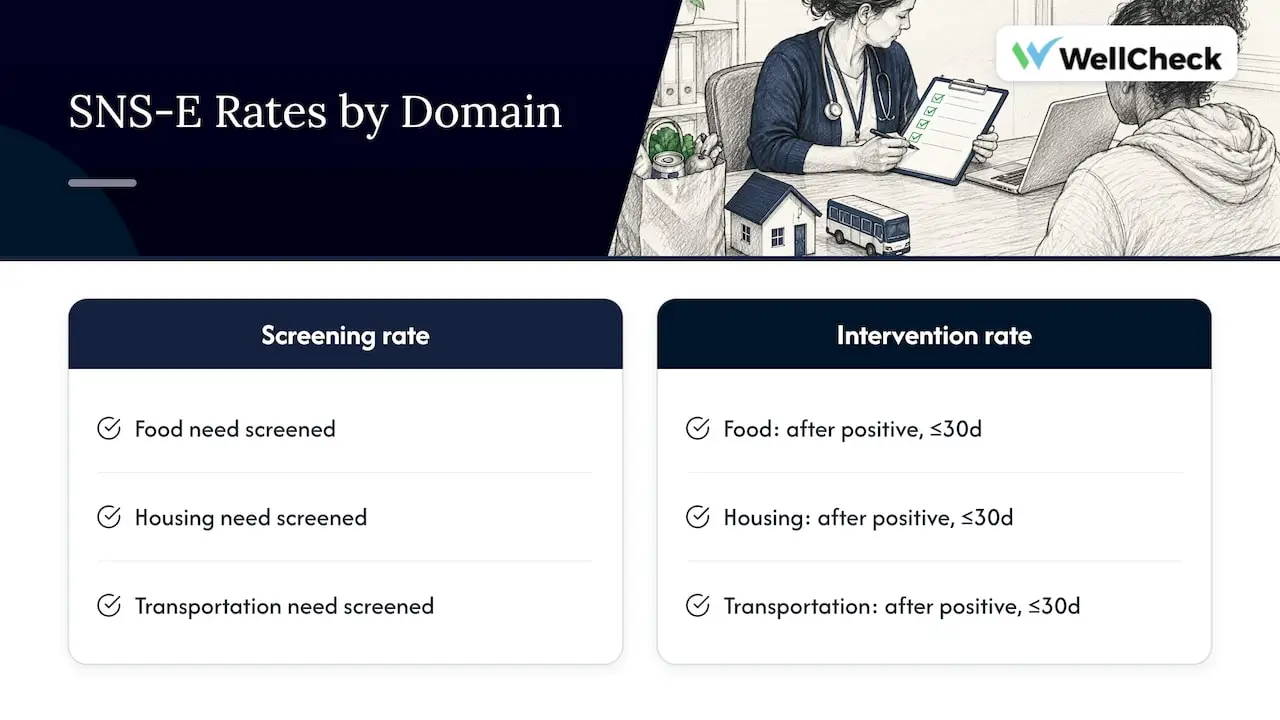
The 30-day window is the practical point for a community program. If a plan needs to report an intervention within 30 days of a positive screen, the plan needs timely, structured information from the partner that delivered the service. A referral that disappears into a fax queue produces no reportable intervention.
State MCO contract requirements
Some states go further than screening. The SHVS review notes that some states require MCOs to track and close the loop on referrals. Closing the loop means documenting the final status of each referral, not only that it was made. Expect these requirements to flow down to any provider or community-based organization (CBO) that receives plan referrals.
CMS hospital measures
For hospital settings, CMS publishes its own Social Drivers of Health measures. These track screening and screen-positive rates, and reporting the rate for each domain informs hospital planning to close health equity gaps. They are not Medicaid-specific, but a rural hospital that serves many Medicaid members will often be reporting under both frameworks and needs one screening dataset that serves each.
Section 1115 HRSN demonstrations
States with Section 1115 HRSN demonstrations report under the terms of their approval. CMS guidance issued in 2023 set fiscal guardrails, including a cap of 3 percent of total computable Medicaid spending on HRSN services and 15 percent of HRSN spending on infrastructure. That informational bulletin was rescinded on March 4, 2025, so state-specific demonstration terms are now the document of record. If your state has an HRSN demonstration, request the current special terms and conditions from your state Medicaid agency rather than relying on older summaries.
How often reporting happens
There is no single deadline, because the vehicles differ.
| Reporting vehicle | Typical cadence | What it usually asks for |
|---|---|---|
| State monitoring (for example, New York’s HRSN program) | Monthly tracking at the state level | Screenings, referrals, services provided |
| Section 1115 demonstration monitoring | Moving toward annual in recent CMS letters | Progress against demonstration goals |
| NCQA SNS-E | Annual, by measurement year | Six screening and intervention rates |
| MCO contract reports | Set by contract, often quarterly or annual | Screening volume, referral status, closed loops |
| Grant or funder reports | Set by award terms | Service volume, follow-through, outcomes |
On the federal side, CMS has been simplifying demonstration monitoring. In a letter to one state, CMS determined that annual monitoring reports, combined with monitoring calls, would generally be sufficient, and removed the monitoring protocol deliverable for several demonstration types, including HRSN. That letter applies to one state’s demonstration, so treat it as a sign of direction, not a national rule. Your own cadence is in your contract or award, and your state Medicaid agency can confirm it.
The operational lesson is the same whatever the schedule: data you collect continuously is far easier to report than data you reconstruct at deadline. Monthly state tracking, 30-day intervention windows and annual measures all draw from the same underlying record of who was screened, who was referred and what happened next.
Where programs struggle: follow-through
Most community health programs can report service volume. Fewer can say how many referrals were accepted, delivered or resolved. That is the gap between what a program does and what a payer or funder now asks it to show.
The gap has several causes:
- Referrals leave the organization with no status path back. The partner may serve the person, but nobody records it.
- Partners use different systems. A food pantry, a housing authority and a clinic rarely share a record.
- Screening data and referral data live in separate places. Totals cannot be tied to individuals.
- Staff time goes to the next intake. Without a defined follow-up step, calls to confirm outcomes do not happen.
Guidance points toward a workable approach. Programs can use care coordination, tech-enabled platforms, or both to follow up and confirm that referred services were rendered. Research also offers a caution worth taking seriously: electronic screening and referral platforms alone may not improve enrollee connections to community resources. Software records and routes; people and agreements make the connection. The programs that report well pair a defined workflow, named staff responsibility for follow-up and a system that keeps the status of every referral in one place.
Building a reporting-ready workflow
The steps below describe a workflow that supports the reporting layers above. They fit a county health department, an FQHC or a rural network.
- Confirm what you owe. List every requirement that applies: MCO contract terms, state program rules, HRSA or other grant terms, hospital measures. Write down each data element, definition and due date. Our note on HRSA grant reporting checks covers one frequent source of payment-hold risk.
- Standardize the screening. Use the tool your state or plan specifies, administered the same way at every site. A digital SDoH assessment keeps responses structured so they can be counted by domain.
- Define the response to a positive screen. Decide who reviews it, within what time, and which partners receive which kinds of referrals. This is the protocol reviewers expect to see.
- Route referrals with a status. Every referral should carry a status such as sent, accepted, delivered, declined or unable to reach, with a date.
- Assign follow-up. Name the role responsible for checking on open referrals and set the interval. For SNS-E-style reporting, plan around the 30-day window.
- Record the outcome. Mark whether the need was met, partly met or not met, and why.
- Review monthly. Run the counts for screening, referral and closure each month so the annual report is a summary and not a rebuild.
- Agree on data sharing with partners. Standardizing data domains can improve interoperability and allow data exchange among states, MCOs and providers. Work out with each partner what is shared and under what consent, and have your privacy officer review the arrangement against HIPAA and any state rules.
A worked example of the counts
Suppose a clinic screens 400 members in a quarter and 120 screen positive for at least one need. The reporting questions are then concrete. How many of the 120 received a referral? How many referrals were accepted? How many people had a service delivered within 30 days? A program that can answer from its own records can fill an MCO request or a funder report in an afternoon. A program that can answer only the first question has to go back through case notes, and some of the answers will not be recoverable.
How EquiLoop supports this workflow
WellCheck builds EquiLoop, a closed-loop referral and care coordination platform for rural and community health programs. It manages SDoH screening and intake, referral routing to clinical and community partners, follow-up and status tracking, outcomes dashboards and funder-ready reporting. Each deployment is configured around the partner network, referral pathways and reporting requirements the organization already has, and it is designed to work alongside existing systems of record rather than replace them.
EquiLoop is not a resource directory. Its purpose is to record what happened after the referral was made.
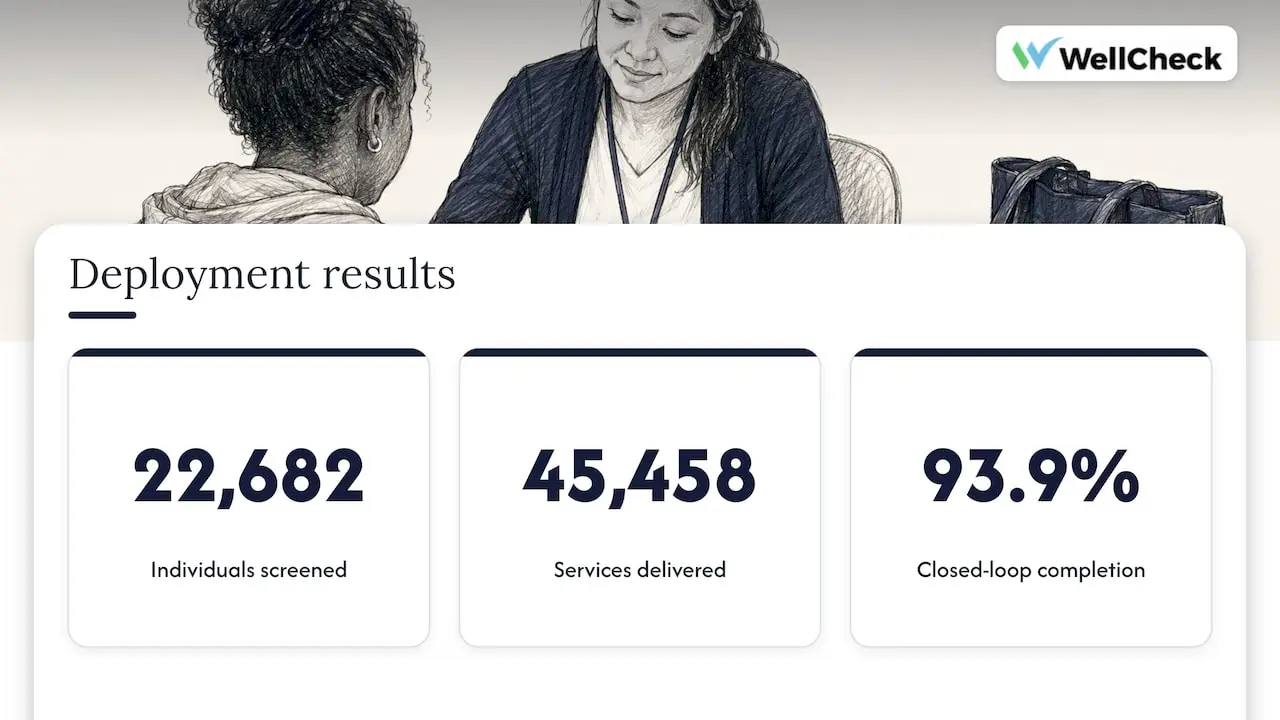
The figures below come from one deployment and show what follow-through tracking can produce: 22,682 individuals screened, 45,458 services delivered and a 93.9% closed-loop completion rate.*
*Rural health hub deployment with a multi-partner ecosystem. Includes both clinical and social services referrals.
These results reflect that deployment’s partner network and are not a forecast for any other program. To see how EquiLoop would map to your contracts and reporting requirements, book a 30-minute demo.
If you also need to train the navigators and community health workers who carry out screening and follow-up, WellCheck’s Workforce Development Academy is a white-labeled LMS for community health workforce training and credentialing.
Preparing for your next reporting cycle
A short checklist helps programs get ahead of requests from plans and funders:
- Get the current reporting requirements in writing from each payer, plan and funder, with definitions.
- Check that your screening tool covers the domains required, at minimum food, housing and transportation for SNS-E.
- Confirm that every positive screen has a documented response.
- Audit a sample of referrals for a recorded final status. The share with no status is your follow-through gap.
- Make sure partners know what status information you need from them, and how quickly.
- Keep definitions stable within a reporting year so rates are comparable.
Reporting rules will continue to change as states revise contracts and demonstrations. The durable foundation is a record that ties each screen to a referral and each referral to an outcome. With that in place, a new definition is a change to a report, not a change to your operations.
FAQ
Is Medicaid social needs reporting required nationwide?
No single federal rule applies to every program. Requirements come from state Medicaid contracts, Section 1115 demonstration terms and quality measures. More than half of managed care states include HRSN screening provisions in MCO contracts, so check your contract and your state agency’s guidance.
What is the SNS-E measure?
SNS-E is NCQA’s Social Need Screening and Intervention measure. It reports the share of people screened for food, housing and transportation needs, and the share of positive screens that received an intervention within 30 days. It produces six rates, one screening and one intervention rate per domain.
Do CBOs have to report to Medicaid?
Often indirectly. States can assign screening and reporting duties to MCOs, providers or community care hubs. A CBO that accepts referrals from a plan or provider may be asked for referral status and service delivery data under that relationship. Check the agreement you hold with the referring entity.
How often is social needs data reported?
It depends on the vehicle. Some states track screenings, referrals and services monthly. NCQA measures follow an annual measurement year, and CMS has moved some Section 1115 monitoring to annual reports. MCO contracts and grants set their own schedules, so confirm each in writing.
Do Z codes satisfy reporting requirements?
Not by themselves. Z codes can record that a social need was identified on a claim, but their use is limited and they do not show whether a referral was completed. Most reporting asks for screening, referral and follow-through data as well.
Sources
- New York Health Related Social Needs Implementation Plan
- Collection of Health-Related Social Needs Data among State Medicaid Programs (NORC)
- Health-Related Social Needs in Medicaid: State Checklist for Screening (CHCS)
- Addressing HRSN Through Medicaid Managed Care (SHVS)
- NCQA: Social Need Screening and Intervention
- CMS Social Drivers of Health (SDOH) Measures
- CMS CIB: Coverage of Services and Supports to Address HRSN
- CMS letter on 1115 demonstration monitoring
