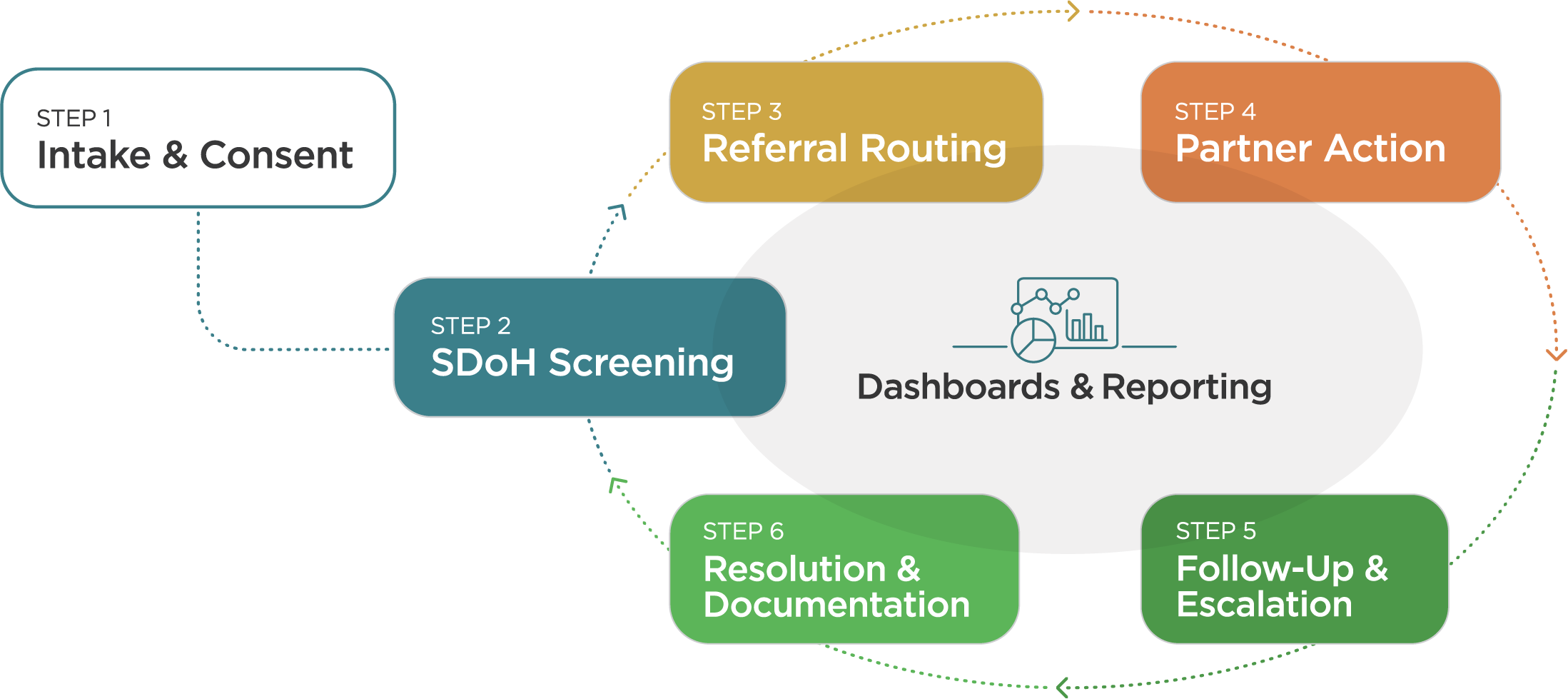
Closed-Loop Care Coordination

Social Prescribing. Connection work the field has always done.

We build the infrastructure and workforce that close the gap between intent and delivery — for FQHCs, local health departments, AHECs, CBOs, and the rural networks they share.

Aligned with frameworks from Social Prescribing USA, the Lancet Public Health (Apr 2025), and the WHO Regional Office for Europe scoping review on digital health equity (Mar 2026).

What it means

The work most clinicians and community health teams already do.

Social prescribing isn't a new practice — it's a name for the work happening every day at the seam between clinic and community. The term frames it as a clinical action and gives it the same operational rigor we expect of medication.

social prescribing
noun · /ˈsoʊʃəl prɪˈskraɪbɪŋ/

A clinical practice in which a healthcare provider identifies a non-medical, health-related need — social, emotional, or environmental — and "prescribes" connection to a community-based resource. A trained worker (a "link worker" in the UK; a community health worker or navigator in the U.S.) supports the person through fulfillment and confirms the outcome. The model has been embedded in NHS primary care since 2019.

Where it came from

The term was popularized by the UK's National Health Service in the 2010s and formalized in 2019 when NHS England funded link workers across primary care networks. The practice draws on decades of community-organizing tradition and is now embedded in NHS clinical pathways.

Where it's going (in the U.S.)

Social Prescribing USA hosts its inaugural national conference in 2026.3 Kaiser Permanente is running pilots. NYC FQHCs have signed partnerships with social prescribing platforms.4 The Lancet Public Health published a major U.S.-focused review in 2025.5 The vocabulary is migrating from policy circles into operational practice.

For FQHCs, local health departments, AHECs, CBOs, and the rural and community health systems where this work happens daily, the practice itself is not new. CHWs, patient navigators, and outreach staff have been doing social prescribing for years — what's been missing is the right name, the right recognition, and the right tools.

The Problem

Screening became a mandate. Closing the loop never did.

Over the past decade, federal agencies, accreditation bodies, and value-based payers have pushed health systems to screen for health-related social needs. PRAPARE, AHC HRSN, and Z-code documentation are now routine across FQHCs, local health departments, and a growing number of CBOs. The screening problem is largely solved.

The closure problem is not. A 2024 Society of Hospital Medicine quality improvement study at a major children's hospital documented a baseline closed-loop SDOH referral rate of 3% — meaning 97 out of 100 referrals had no verifiable outcome. After concentrated improvement work, that number rose to 27%, still well short of the team's 70% target.1

A pharmacist filling 3% of prescriptions wouldn't have a license. In social care, that closure rate is the documented baseline.

Most closure measurement also stops short of the actual outcome — counting a "CBO acknowledged the referral" as success rather than "service delivered." The gap between those two definitions is where most of the operational value of social prescribing lives. Research from the UCSF SIREN network has documented similar patterns: closure rates depend less on technology choice than on network adequacy and a workforce trained to walk a person through fulfillment.2

The pattern is consistent. Screening scales because it lives inside the EHR. Closure is harder because it requires coordination with organizations the EHR cannot see — and a workforce that knows the community well enough to make the connection stick.

The difference between a documented intent to help and a delivered outcome — increasingly, between meeting payer requirements and missing them.

Baseline
3%
Pre-intervention closed-loop SDOH referral rate
SHM, 2024
After QI Work
27%
Post-intervention rate after concentrated improvement
SHM, 2024
The Infrastructure

Two halves of social prescribing infrastructure — built for the realities of community-based care.

Social prescribing fails when one of two things is missing: the technology to close the loop, or the trained workforce to walk the prescription through. We provide both, in one operating model — designed for FQHCs, local health departments, AHECs, CBOs, and the integrated networks they share, with a particular grounding in rural and underserved settings.

EquiLoop™

The closed-loop infrastructure

When intent becomes outcome

EquiLoop is the operational backbone of social prescribing: a closed-loop referral and care coordination platform that tracks every prescription from creation to verified outcome.

  • Configurable referral pathways aligned to PRAPARE, AHC HRSN, and Z-code workflows
  • Bidirectional updates across clinics, health departments, and CBO partners
  • Outcome verification — not just "appointment scheduled," but "service delivered"
  • Audit-ready reporting for HRSA UDS+, CMS, state Medicaid, and value-based contracts
WDA · Workforce Development Academy

The link-worker workforce

Training the social prescribing workforce

CHWs, patient navigators, and community-based outreach staff are the U.S. equivalent of UK link workers. WDA is the LMS that prepares them — and the training pathway that gives systems a credentialed workforce to actually deliver social prescribing at scale.

  • Role-based curriculum for CHWs, patient navigators, and care coordinators
  • Aligned to state CHW certification frameworks where applicable
  • Modular content covering screening, motivational interviewing, and closed-loop documentation
  • Direct integration with EquiLoop workflows — staff trained on the same system they will operate
The Proof

What it looks like when the loop actually closes.

In a single rural deployment we support, the closed-loop completion rate has reached 93.9% — not because the technology is unique, but because the system was designed with rural realities in mind: limited bandwidth, trusted CBO relationships, and a workforce that already knows the community.

Rural deployment, to date6

Cumulative figures from a single anonymous rural health operation working across multiple community partners.

22,682
Individuals screened
45,458
Services delivered
93.9%
Closed-loop completion rate

The number above reflects verified service delivery — not just acknowledged receipt of a referral. That distinction is where most measurement systems lose track of social prescribing's actual value, and where closed-loop infrastructure paired with a trained community workforce makes the difference.

The 93.9% figure is not a benchmark we are claiming for the field. It is what one rural health operation has achieved with the right infrastructure and the right people — and a signal of what is possible when the closed loop actually closes.

Where to next

Two paths from here.

Whether you are evaluating social prescribing infrastructure for your FQHC, health department, AHEC, CBO, or RFP partnership — or building the internal case before you bring it to your team — start in the way that fits your stage.

Talk with our team

Tell us where you are in your social prescribing or closed-loop coordination work, and we'll get back to you with the right person.

Talk with our team

Read the evidence

The six sources we cite on this page are the strongest evidence base for social prescribing in U.S. care delivery — including the Lancet Public Health review, SIREN best practices, and Social Prescribing USA. Start there.

Read the evidence
Evidence Base

The sources behind this page.

Six sources anchor the arguments and figures on this page — from peer-reviewed quality improvement studies to international scoping reviews and U.S. policy commentary. Each link below opens the original source in a new tab.

  1. Society of Hospital Medicine. Increasing Closed-Loop Referrals for Social Determinants of Health. SHM Abstracts, 2024. shmabstracts.org
  2. SIREN (Social Interventions Research and Evaluation Network), UCSF. Social care best practices: Learnings from a technology-enabled closed-loop referral network. 2024. sirenetwork.ucsf.edu
  3. Social Prescribing USA. Roadmap and 2026 Conference. socialprescribingusa.com
  4. Fierce Healthcare. SocialRx teams up with FQHC in NYC to prescribe arts and culture for chronically ill patients. Apr 2026. fiercehealthcare.com
  5. The Lancet Public Health. Social prescribing in the USA: emerging learning and opportunities. Apr 2025. thelancet.com
  6. Single-client deployment, multi-partner ecosystem. Cumulative figures to date.
See how WellCheck helps turn RHT funding into measurable outcomes with closed-loop workflows + reporting.

Find answers here

Hi there! Ask Us a Question We are ready to help

Search