
PCMH referral tracking means proving, with documentation, that a referral was scheduled, completed, reviewed, and folded back into the patient’s care plan. NCQA’s PCMH 5, Element B makes this a must-pass requirement for recognition. If your practice can’t show that today, the immediate fix is simple: name a single owner for every handoff and stand up an aging queue that flags open referrals at 14 to 21 days.
TL;DR:
- Practices must assign a clear owner to each referral step and establish an aging queue with automated alerts at 14 days for routine referrals and 7 days for urgent cases.
- A failure to link scheduled appointments back to the original referral order is the most common breakdown, leading to underreporting of completed referrals.
- External referral data requires signed business associate agreements, role-based access controls, and audit logs to ensure HIPAA compliance and protect patient information.
- Staff training should emphasize standard procedures for referral logging, escalation rules, and timely review of consult notes to prevent tracking gaps.
- Moving beyond spreadsheets to dedicated platforms like EquiLoop can significantly enhance closed-loop referral management for organizations with high referral volume.
Table of Contents
- What Does NCQA Require for PCMH Referral Tracking?
- What Are the Nine Steps of a Closed-Loop Referral?
- Where Does Referral Tracking Usually Break Down?
- Which Metrics Should You Track for PCMH Performance?
- How Do You Build a Referral Tracking Checklist That Actually Sticks?
- How WellCheck Supports Closed-Loop Referral Tracking
- What Privacy and Security Rules Apply to Referral Data?
- What Training Do Staff Need for Referral Tracking?
- What Compliance Rules Beyond NCQA Affect Referral Tracking?
- Where Do You Go From Here on Referral Tracking?
- Sources
What Does NCQA Require for PCMH Referral Tracking?
NCQA ties recognition directly to referral tracking through PCMH 5, Element B, a must-pass element. That designation matters: a practice can score well elsewhere and still fail recognition if it can’t document referral tracking and follow-up.
The requirement isn’t paperwork for its own sake. Referrals that vanish between primary care and specialty care are a patient safety problem, particularly for chronic disease management where a missed cardiology or endocrinology visit delays treatment for months. Payers built value-based contracts around the assumption that referrals close, so incomplete tracking shows up directly in quality reporting and reimbursement.
For health centers, referral tracking obligations intersect with FTCA coverage and HRSA compliance policies, which expect documented tracking policies as part of risk management.
What NCQA actually checks for:
- A documented process for tracking referrals from order to completion
- Evidence that specialist reports come back and get reviewed by the ordering clinician
- A system for identifying and following up on overdue referrals
- Integration of referral outcomes into the patient’s care plan
What Are the Nine Steps of a Closed-Loop Referral?
IHI and NPSF’s “Closing the Loop” guide breaks the referral lifecycle into nine steps. Each one needs a named owner, or it becomes the point where the referral disappears.
- Clinician identifies the need for a referral. Owner: ordering clinician, who documents the clinical question.
- Referral order is entered with reason and urgency. Owner: ordering clinician or clinical support staff.
- Referral coordinator identifies and contacts the specialist. Owner: referral coordinator or front desk staff.
- Appointment is scheduled. Owner: referral coordinator, confirmed against the referral order, not assumed.
- Patient is notified and prepped with instructions. Owner: referral coordinator or care team.
- Patient attends the visit. Owner: patient, supported by reminder calls or texts.
- Specialist sends a consult note back to the referring practice. Owner: specialist’s office, per agreed timeline.
- Ordering clinician reviews the consult note. Owner: clinician reviewer, distinct from whoever logs receipt.
- Care plan is updated and next steps communicated to the patient. Owner: clinician plus care team.
Set escalation at day 14 for routine referrals and day 7 for urgent ones. Anything past that threshold moves into an active outreach queue instead of sitting quietly in an inbox.
Pro Tip: Build a simple RACI for these nine steps: one person Responsible for each step, one Accountable overall (usually the referral coordinator or care coordination lead), and clinicians Consulted and Informed at review points. Most practices skip this and end up with three people assuming someone else owns follow-up.
Where Does Referral Tracking Usually Break Down?
Three failure points account for most of the gap between referrals sent and referrals closed.
The first is the appointment-linkage blind spot. Many EHR systems don’t automatically connect a scheduled appointment back to the original referral order. A specialist’s office can schedule and see the patient, but if that appointment never links back to the referral record in the primary care system, the referral shows as open even after it’s done. That undercounts completions and wastes staff time chasing referrals that already closed.
One large-system analysis found that of 103,737 referral scheduling attempts, only 36,072, about 34.8%, resulted in a documented completed appointment. Some of that gap is real no-shows. A meaningful share is documentation failure, not care failure.
The second is cross-institutional friction. Referrals to specialists outside your EHR network face interoperability gaps and inconsistent communication channels, which raises the risk of a consult note never making it back at all.
The third is internal review backlog. Consult notes arrive but sit unread in a shared inbox because no one is specifically assigned to open, log, and route them to the ordering clinician.
Mitigations that work without a system overhaul:
- Designate one staff role solely for logging incoming consult notes, separate from the clinician who reviews them
- Write collaborative agreements with frequent referral partners specifying note format and turnaround time
- Run a weekly reconciliation between the scheduling system and the referral log
Which Metrics Should You Track for PCMH Performance?
Referral tracking only functions as a management tool if you measure it the same way every month. Five metrics cover most of what NCQA and internal quality committees ask for.
Keep an “open referrals” aging queue as a living worklist, not a report generated after the fact. Flag anything at 14 days for outreach, and anything past 30 days for clinician escalation. Review operational metrics monthly with the care coordination team, and roll completion rate and note-return rate into quarterly quality committee reviews where they connect to PCMH reporting and payer quality contracts.
How Do You Build a Referral Tracking Checklist That Actually Sticks?
Most practices don’t need new software to close the gap between referrals sent and referrals closed. They need a short, enforced process.
- Assign and publish owners for each of the nine steps. Post it where staff can see it, not buried in a policy binder.
- Stand up an aging queue with automated or manual alerts at day 14 for routine referrals and day 7 for urgent ones.
- Standardize your referral order template so every referral includes reason, urgency, and required clinical information up front, cutting the back-and-forth that delays scheduling.
- Negotiate a written agreement with your top five referral partners covering consult-note format, delivery channel, and turnaround, targeting 7 to 14 days for return.
- Pilot with one high-volume specialty first. Cardiology or behavioral health referrals usually generate enough volume to expose problems fast. Measure baseline completion and note-return rates before you expand the process to other specialties.
Pro Tip: Run your pilot for 60 days minimum before judging results. Scheduling lag alone can eat three to four weeks, so a 30-day pilot mostly measures noise, not performance.
Roles, timelines, and templates rarely require IT tickets. The nine-step referral implementation plan walks through sequencing this for community and rural clinics without a heavy technical lift.
How WellCheck Supports Closed-Loop Referral Tracking
EquiLoop, WellCheck’s referral and care coordination platform, handles SDoH screening, routes referrals to clinical and community partners, tracks status until closure and produces outcomes reporting practices can hand to funders or quality committees. It’s built to sit alongside your existing EHR rather than replace it, which matters for practices that already have workflows they don’t want to rebuild from scratch.
Practices that want a structured starting point can review the closed-loop referral implementation guide or explore how EquiLoop’s workflow handles routing and follow-up. Teams also managing navigator or community health worker training can look at the Workforce Development Academy.
1 Rural health hub deployment with a multi-partner ecosystem. Includes both clinical and social services referrals.
What Privacy and Security Rules Apply to Referral Data?
Referral records carry protected health information at every step: diagnosis codes, clinical notes, insurance details, and sometimes social service history if your practice tracks social determinants alongside clinical referrals. That combination raises the stakes above a typical EHR record, because a referral often moves across organizational boundaries where HIPAA business associate agreements need to be current and specific.
Every external partner receiving referral data needs a signed business associate agreement covering exactly how referral information moves between systems, whether by secure fax, encrypted email, a health information exchange, or a shared portal. Fax remains common in referral workflows, which surprises people who assume healthcare has moved past it, but fax lines still require the same access controls and audit logging as any electronic channel.
Access control matters as much as encryption. Not every front-desk staff member needs to see a patient’s full referral history, and role-based permissions should limit visibility to what each job function requires. Audit logs need to capture who viewed or modified a referral record, since that traceability is what protects the practice during a breach investigation or an NCQA audit.

Data retention policies deserve explicit attention too. Referral records tied to social services, behavioral health, or substance use treatment can carry additional confidentiality protections beyond standard HIPAA rules, and staff handling those referrals need to know the difference before they share information across a care team that assumes uniform access.
Build data-sharing agreements into your external partner onboarding process from day one, not as an afterthought once a referral relationship is already running.
What Training Do Staff Need for Referral Tracking?
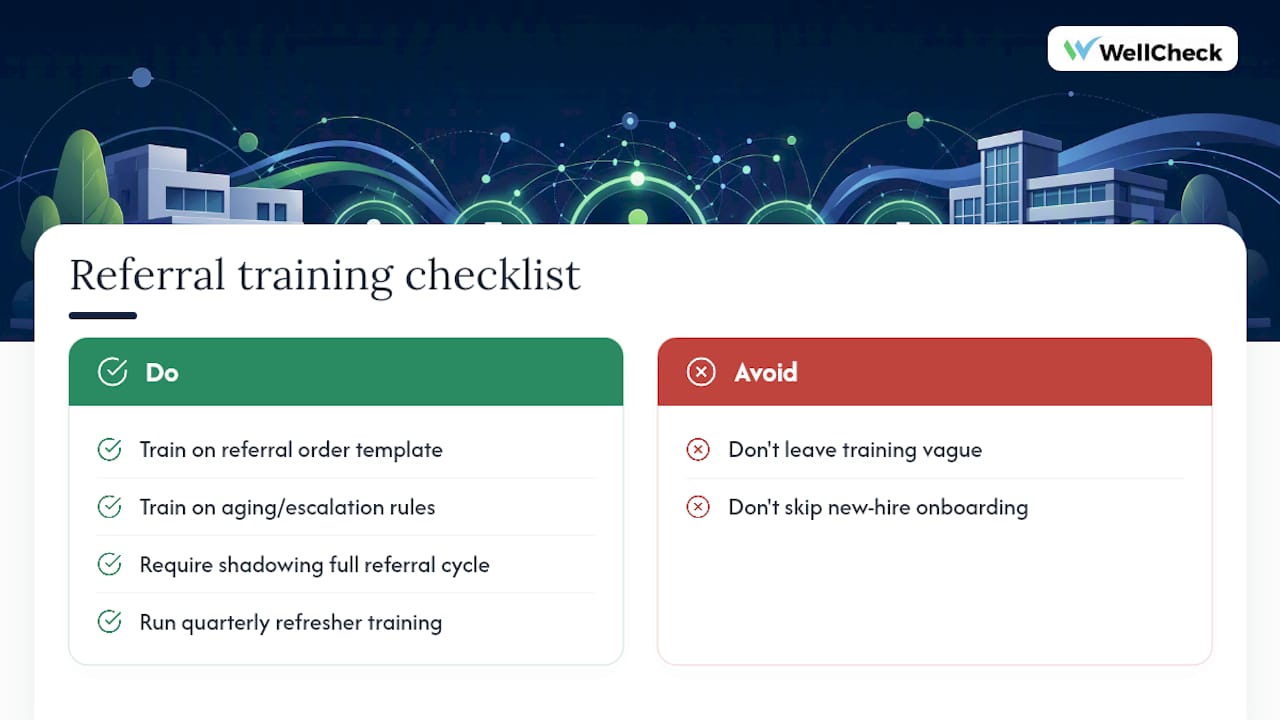
Referral coordinators and front-desk staff need training on three things specifically: the referral order template, the aging queue escalation rules, and what counts as a “completed” referral in your documentation system. Vague training here is the fastest way to end up with inconsistent logging six months later.
New hires should shadow a referral coordinator through a full cycle, order entry through care plan update, before touching the queue independently. That single walkthrough catches most of the confusion that otherwise shows up as missed escalations.
Clinicians reviewing consult notes need a clear standard for turnaround time on their end too. A note that arrives back from the specialist but sits unread for three weeks defeats the purpose of tracking it in the first place. Set an internal expectation, commonly 48 to 72 hours for routine notes, and track it the same way you track the referral itself.
Refresher training matters more than initial training for this workflow. Staff turnover in front-desk and coordinator roles tends to be high, and each new hire who skips proper onboarding on the aging queue becomes a gap in your tracking system. Build a short recurring training cycle, quarterly works for most practices, that reviews current completion rates and walks through any process changes.
For practices building out care coordination or community health worker roles alongside referral tracking, a structured training and credentialing program keeps that workforce development effort separate from, but aligned with, your clinical referral process.
What Compliance Rules Beyond NCQA Affect Referral Tracking?
NCQA sets the recognition standard, but it isn’t the only regulatory layer touching referral tracking. CMS has folded elements of closing the referral loop into meaningful use and broader quality measurement priorities, which means referral completion data increasingly connects to reimbursement beyond just PCMH recognition itself.
Federally Qualified Health Centers carry additional obligations under HRSA’s FTCA coverage requirements, which expect documented tracking policies as part of risk management. A health center that can’t produce a referral tracking policy during an FTCA review faces a real coverage gap, not just a recognition ding.
State Medicaid managed care contracts frequently specify referral timeliness standards separate from NCQA, particularly for behavioral health and specialty care access. Practices participating in multiple payer contracts should check whether referral completion timelines in those contracts differ from the 14 to 21 day thresholds recommended for internal escalation, since payer-specific requirements sometimes run tighter.
HIPAA’s minimum necessary standard also applies specifically to referral data shared with external specialists. Compliance officers should periodically audit whether referral packets sent to specialists include more clinical history than the specialist actually needs for the specific consult, since over-sharing is a common and avoidable violation.
Where Do You Go From Here on Referral Tracking?
Fixing referral tracking usually starts with process, not software. Assigned owners, an aging queue, and a partner agreement or two will close most of the gap on their own. But once your practice has outgrown spreadsheets and shared inboxes for tracking referral status across dozens of partners, that’s the point where a dedicated platform earns its cost.
EquiLoop is built specifically for this: SDoH screening, referral routing to clinical and community partners, follow-up tracking, and funder-ready outcomes reporting in one workflow. For a look at how it compares against other referral management software, or how it fits into a broader care coordination software setup, the product pages walk through the specifics. Practices serving multi-clinic networks may also find value in reviewing how larger clinic networks structure responsibility across sites before scaling a tracking process past one location.
If your practice is past the DIY stage and needs to see how a closed-loop platform would actually sit alongside your current EHR and referral partners, book a 30-minute demo at calendly.com/wellcheck/demo-discuss. Bring your current referral completion numbers if you have them. It makes the conversation concrete instead of hypothetical.
Sources
- Closing the Loop: A Guide to Safer Ambulatory Referrals in the EHR Era (IHI/NPSF)
- Closing the Loop: an analysis of primary care referrals to specialists in a large health system

