
A well-run organizational CHW certification program requires seven non-negotiable elements: a competency framework aligned to C3 or WHO domains, a supervised practicum with documented hours, a written assessment matrix with defined pass criteria, secure digital credentials with an audit trail, formal supervisor readiness training, equity accommodations for language and literacy, and a structured renewal cycle.
Core elements at a glance:
- Competency framework: Role-specific domains mapped to observable behaviors
- Supervised practicum: Documented field hours with supervisor sign-off
- Assessment matrix: Knowledge tests, skills checks, and portfolio review with clear cut-scores
- Digital credential and audit trail: Secure badge issuance and time-stamped records
- Supervisor training: Formal module before program launch, tied to credential maintenance
- Equity accommodations: Language access, literacy supports, and paid field hours where possible
- Renewal cycle: Defined continuing education hours and recertification timeline
Pro Tip: Start this week by drafting a one-page scope statement that names the CHW roles you are certifying, the funder or payer requiring documentation, and the governance body that will own the credential. That document drives every downstream decision.
Key Takeaways
Organizational CHW certification requires a competency framework, supervised practicum, documented assessment, supervisor readiness training, and a digital audit trail that produces funder-ready evidence.
| Point | Details |
|---|---|
| Competency framework first | Map C3 or WHO domains to your specific CHW roles before writing any curriculum. |
| Supervisor training is required | Programs that co-train supervisors show higher CHW retention and integration rates. |
| Digital audit trail is non-negotiable | Funders and payers increasingly require time-stamped credentialing records, not just completion logs. |
| Tier your credentials | Issue a foundational certificate first; add specialty micro-credentials for expanded scope. |
| WellCheck covers both sides | Workforce Development Academy handles credentialing; EquiLoop handles referral evidence and funder reporting. |
Table of Contents
- What do CHW certification requirements actually cover at the program level?
- How do you build a competency framework for CHW certification?
- What curriculum scope and training hours does certification require?
- How should you assess CHWs and issue credentials?
- Why is supervisor readiness a formal certification requirement?
- What must your LMS and credentialing platform actually do?
- How do you budget and timeline a CHW certification pilot?
- Your implementation checklist and pilot plan
- EquiLoop and Workforce Development Academy support your certification program
- Sources
What do CHW certification requirements actually cover at the program level?
Organizational CHW certification is not the same as state-level individual licensure. This article addresses what a program director at an AHEC, FQHC, local health department, or rural health network must build internally to credential their own workforce, satisfy funder documentation requirements, and demonstrate workforce readiness to payers.
The WHO guideline on CHW training and certification conditionally supports competency-based formal certification, while noting that direct evidence linking certification to improved population outcomes remains limited and that equity risks and governance structures deserve explicit attention. That context matters: your program design should be defensible on process grounds, not just outcome promises.
Defining scope, governance, and eligibility
Before writing a single learning objective, define what the credential certifies. Is it outreach, navigation, care coordination, or a combination? Name the tasks, not just the title.
Governance models to consider:
- Employer-owned: The organization issues and maintains the credential internally. Fast to launch; limited portability for the CHW.
- Consortium: Multiple employers or a regional network co-own the credential. Stronger portability; requires a formal memorandum of understanding.
- AHEC or state association partnership: The AHEC partnership model adds external credibility and often brings existing curriculum infrastructure.
A governance checklist should assign roles for curriculum approval, appeals, equity oversight, and credential revocation. Eligibility criteria typically include a high school diploma or GED. A survey of CHW employers found that many required state certification and a high school diploma or GED, with over half identifying ongoing specialty training as a workforce gap. Programs serving candidates with significant lived experience but limited formal education should build a waiver process with documented evidence of equivalent competency.
How do you build a competency framework for CHW certification?
Start with the C3 Project’s core CHW roles or the WHO-recommended domains: promotive and preventive services, referral and health system integration, social determinants of health, psychosocial support, interpersonal communication, and personal safety. Map each domain to your program’s specific roles and local priorities.
| Competency Domain | Observable Behavior | Evidence Source |
|---|---|---|
| SDoH screening | Administers validated screening tool accurately | Observed practicum, supervisor sign-off |
| Referral and follow-up | Closes referral loop within defined timeframe | Digital referral record, audit trail |
| Health education | Delivers culturally adapted education session | Skills lab observation, participant feedback |
| Psychosocial support | Identifies escalation triggers and applies protocol | Case review, supervisor documentation |
| Interpersonal communication | Conducts motivational interview with fidelity | OSCE-style assessment, video review |
Tier your competencies into foundational (required for initial certification) and specialty (issued as micro-credentials for expanded scope). CHCF best practices support this tiered approach, noting that it allows employers to hire to role-specific needs and allows incremental investment in workforce development.
Pro Tip: Limit your initial certification to five to seven high-impact competencies. Adding specialty badges for diabetes navigation, maternal health, or behavioral health integration after initial certification keeps the entry bar achievable and the credential extensible.

What curriculum scope and training hours does certification require?
CHCF best practices recommend a substantial minimum number of hours of foundational training for a certificate of completion, with at least six hours of annual ongoing professional development. That floor reflects practice-based fieldwork as a core element, not just classroom instruction.
Recommended modality mix:
- Didactic instruction (classroom or synchronous online): foundational knowledge, policy, and ethics
- Skills lab: SDoH screening tools, motivational interviewing, documentation practice
- Supervised field practicum: documented hours with a named supervisor
- Asynchronous e-learning: refreshers, protocol updates, specialty content
- Peer learning collaboratives: case review, shared problem-solving across sites
| Competency Type | Best Modality | Notes |
|---|---|---|
| Knowledge and policy | Didactic or e-learning | Accessible asynchronously; good for refreshers |
| Communication skills | Skills lab, role-play | Requires direct observation and feedback |
| Field documentation | Supervised practicum | Must be tied to real caseload with sign-off |
| Specialty content | E-learning + peer collaborative | LMS-based micro-learning is cost-effective |
Accessibility is not optional. Offer training in the primary languages of your CHW workforce, use plain-language materials at a sixth- to eighth-grade reading level, and pay field practicum hours. Unpaid fieldwork is a documented barrier to participation for candidates from the communities programs are designed to serve.
How should you assess CHWs and issue credentials?
Assessment must produce funder-ready evidence, not just a completion record. A defensible assessment mix includes:
| Assessment Type | What It Measures | Pass Threshold Guidance |
|---|---|---|
| Knowledge test | Domain content, policy, protocols | defined pass criteria; two retake attempts |
| OSCE or skills check | Observed skill performance | Competency checklist; assessor-rated pass/fail |
| Supervised practicum | Field application with real caseload | Minimum hours met; supervisor sign-off |
| Portfolio review | Documentation quality, case notes | Rubric-scored; supervisor and program review |

Set cut-scores before the pilot cohort begins. When a candidate does not meet the threshold, document the gap, assign targeted remediation (not a full repeat of the course), and allow a structured retest within 30 days. Every remediation step should generate a time-stamped record.
Credential issuance should produce a secure digital badge, a PDF credential with a unique identifier, and an audit trail entry that captures the assessor, date, competencies met, and version of the curriculum used. That record is what a funder or payer will ask for.
Pro Tip: Build your assessment rubrics before you build your curriculum. Rubrics clarify exactly what “competent” looks like, which makes curriculum design faster and assessor calibration easier.
Why is supervisor readiness a formal certification requirement?
Without supervisor readiness, trained CHWs risk role isolation and reduced impact. A Frontiers study on workforce readiness training documents that programs co-training supervisors alongside CHWs show higher retention and placement rates, and that Organizational Readiness Training (ORT) for supervisors is a distinct and necessary program element.
Supervisor competencies to certify:
- Interpreting CHW caseload data and referral completion rates
- Coaching for scope fidelity (what CHWs can and cannot do)
- Conducting documented performance reviews tied to credential maintenance
- Advocating for CHW roles within clinical team structures
| Supervision Element | Frequency | Documentation Required |
|---|---|---|
| Individual check-in | Weekly (first 90 days), biweekly after | Meeting notes, action items |
| Joint client visit | Monthly | Observation form, supervisor sign-off |
| Performance review | Quarterly | Competency rating, credential maintenance record |
| Escalation review | As needed | Incident log, resolution documentation |
Require supervisors to complete an organizational readiness module before the program launches. That module should cover CHW scope, referral workflow expectations, and how to read the program’s credentialing records. It is not a courtesy offering; it is a prerequisite.
What must your LMS and credentialing platform actually do?
Your platform needs to produce auditable records, not just track course completions. The Workforce Development Academy from WellCheck is built for exactly this use case: white-labeled, with competency mapping, digital badge issuance, supervisor sign-off workflows, and CE tracking built in.
LMS feature checklist:
- Competency mapping tied to learning objectives and assessment results
- Skills assessment upload (video, document, supervisor form)
- Supervisor sign-off workflow with time-stamped approval
- CE tracking with renewal date alerts
- Secure digital badge issuance with unique credential identifiers
- Role-based access control (CHW, supervisor, program admin, funder view)
- CSV export and API for funder and EHR reporting
For programs that also manage referral workflows, EquiLoop’s closed-loop referral platform connects credentialing evidence to referral outcomes, so you can show funders not just that CHWs were trained but what happened after they made a referral. Clear digital records of training and competency evidence are often prerequisites for reimbursement and grant reporting.
How do you budget and timeline a CHW certification pilot?
| Phase | Duration | Key Activities |
|---|---|---|
| Planning and governance | 4–6 weeks | Scope statement, governance MOU, eligibility criteria |
| Curriculum and assessment build | 8–12 weeks | Competency mapping, content development, rubric design |
| LMS setup and supervisor training | 4–6 weeks | Platform configuration, supervisor ORT, assessor calibration |
| Pilot cohort | 12 weeks | Training delivery, practicum, assessment, credential issuance |
| Evaluation and scale decision | 4–6 weeks | Fidelity review, outcome data, scale-up or adjustment |
Primary cost drivers: instructor and facilitator time, paid field practicum hours, LMS licensing, assessment staffing, and credentialing administration. Funding strategies that programs use include braided federal and state grants, Medicaid workforce development allocations, HRSA funding for FQHCs, employer training budgets, and fee-for-service arrangements with partner organizations. WellCheck’s CMS RHT program alignment is one example of how federal funding streams can support this infrastructure.
Demonstrate ROI to leadership with two metric types: process measures (completion rates, competency pass rates, supervisor satisfaction) and outcome measures (referral follow-through rates, caseload documentation quality, CHW retention at 12 months).
Your implementation checklist and pilot plan
- Draft and approve a one-page scope statement (roles, tasks, governance body, funder requirements).
- Convene a competency working group (CHWs, supervisors, clinical partners, community members).
- Map competencies to C3 or WHO domains; select five to seven for initial certification.
- Develop curriculum, assessment rubrics, and pass criteria before content build begins.
- Select or configure your LMS; confirm competency mapping, badge issuance, and audit trail features.
- Complete supervisor ORT before pilot cohort begins.
- Select pilot cohort (8–15 participants recommended for a first cycle).
- Deliver training, conduct assessments, issue credentials, and document every step.
- Collect process and outcome metrics at 30, 60, and 90 days post-certification.
- Review fidelity data and set scale-up triggers before expanding to the next cohort.
| Metric | Definition | Target (Pilot) |
|---|---|---|
| Completion rate | % of enrolled CHWs who complete all training requirements | defined cut-scores |
| Competency pass rate | % passing all assessments on first or second attempt | defined cut-scores |
| Referral follow-through | % of referrals with documented closed-loop resolution | Baseline, then trend |
| Employer satisfaction | Supervisor rating of CHW readiness post-certification | 4/5 or higher |
Scale up when your pilot cohort meets pass-rate and employer satisfaction targets and your LMS audit trail is producing clean funder-ready exports. If attrition is high, examine paid practicum access and language barriers before expanding cohort size.
EquiLoop and Workforce Development Academy support your certification program
Program directors who need both credentialing infrastructure and referral accountability have two distinct problems to solve. WellCheck addresses both.
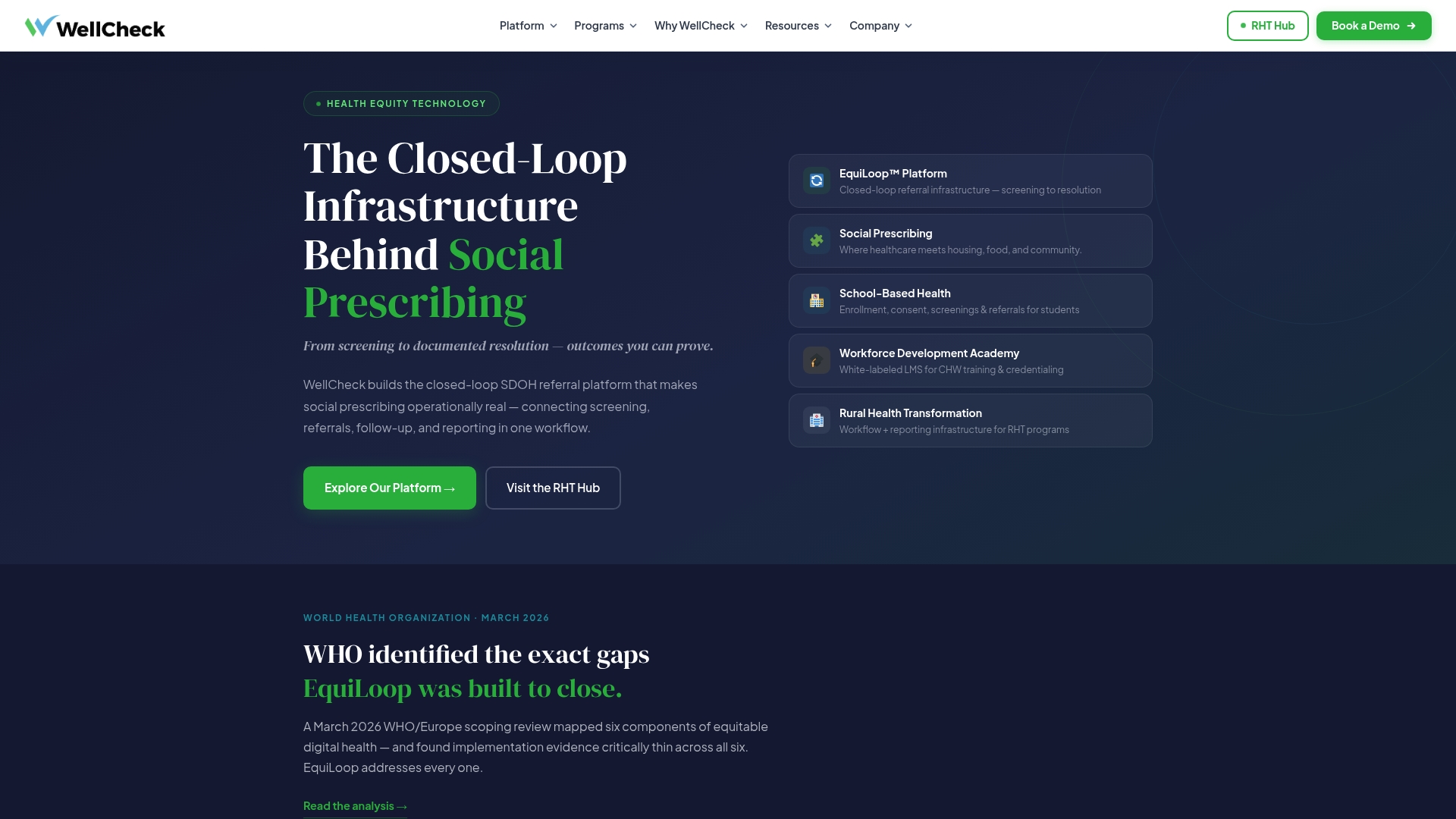
The Workforce Development Academy provides a white-labeled LMS with competency mapping, digital badge issuance, supervisor sign-off workflows, and CE tracking. It is configurable to your existing CHW roles and funder reporting requirements, not a generic training catalog. EquiLoop adds the referral-side evidence layer: closed-loop tracking, outcomes dashboards, and funder-ready reporting that connects workforce credentials to actual service delivery. Together, they let you answer the question funders increasingly ask: not just “were your CHWs trained?” but “what did they do, and did it close?”
Book a 30-minute demo to walk through how the platform maps to your certification checklist.
Sources
- Community Health Worker/ Promotores/Representative Training Program Best Practices
- Workforce Readiness Training: A Comprehensive Training Model That Equips Community Health Workers to Work at the Top of Their Practice and Profession
- CHW employers survey and workforce development needs (PMC article)
- WHO guideline and related policy guidance (chapter on CHW training and certification) — NCBI Bookshelf
When building funder-ready documentation, cite the WHO guideline and CHCF best practices as the evidence base for your program design choices. U.S.-specific employer survey data strengthens the case for certification and continuing education requirements with domestic funders and payers.

