
Patient navigation and care coordination are often used as if they meant the same thing. They do not. Patient navigation is person-facing help: a navigator works with an individual to get through coverage, appointments, and treatment decisions. Care coordination is the organization of care activities among the people and agencies involved, so that information moves and nothing is dropped. Most community health programs need both, and most struggle at the same point: knowing whether a referral was completed.
This article explains how the two functions differ, where they overlap, and how a program director can measure whether either one is working.
TL;DR
- Patient navigation helps an individual overcome barriers to using the health care system. Care coordination organizes activities and information sharing among everyone involved in that person’s care.
- The two overlap heavily in practice, and published research notes there is no single agreed definition for either.
- Programs with a narrow purpose and specific outcomes have performed best in federal evaluation of navigation.
- Neither role proves its value without follow-up data: referrals made, accepted, completed, and resolved.
- Closed-loop referral tracking is the shared infrastructure that makes both roles measurable.
Table of Contents
- What patient navigation means
- What care coordination means
- Patient navigation vs. care coordination side by side
- Where the two roles overlap
- The gap neither role closes on its own
- How to measure whether either one works
- Choosing and combining the approaches
- Tracking navigation and coordination in one workflow
- FAQ
- Sources
What patient navigation means
The National Library of Medicine describes patient navigation as helping patients use the health care system effectively and efficiently when they face challenges such as understanding health coverage, choosing providers, making treatment decisions, and managing care from multiple providers.
The model dates to Dr. Harold P. Freeman’s work in 1990, according to the American Hospital Association’s care delivery brief. The same brief describes navigation as focused heavily on the clinical pathway: guiding patients through the medical system and treatment plan, interpreting medical terminology, monitoring side effects and symptoms, and providing emotional support.
In a community setting, navigation often looks more practical than clinical. A CDC report on hepatitis B linkage among refugees in Minnesota describes navigation activities such as scheduling cab rides, making follow-up calls, and locating patients lost to follow-up, which helped patients attend referred appointments. That is navigation at its most concrete: a person removing the specific obstacle that stands between a patient and an appointment.
Typical navigator tasks include:
- Explaining what a referral is for and what to expect at the visit
- Arranging transportation, interpreter services, or child care
- Helping with coverage and enrollment questions
- Calling patients who miss appointments
- Reporting barriers back to the care team
The patient is the unit of work. Success is measured by whether that person got where they needed to go.
What care coordination means
The Agency for Healthcare Research and Quality (AHRQ) defines care coordination as the deliberate organization of patient care activities between two or more participants to facilitate appropriate delivery of health services. AHRQ also states that no consensus definition exists, and that the lack of one is expected given how many participants are involved.
AHRQ lists the activities that care coordination includes:
- Establishing accountability
- Communicating and sharing knowledge
- Helping with care transitions
- Assessing patient needs and goals
- Creating proactive care plans
- Monitoring and follow-up
Notice the center of gravity. Navigation centers on the patient’s path. Coordination centers on the relationships and information flow among the clinic, specialist, hospital, pharmacy, and community organizations. A coordinator may rarely speak with the patient on a given day and still be doing essential coordination work: confirming that a specialist received records, that a discharge summary reached the primary care office, or that a food assistance referral landed with an organization that can act on it.
This is also where common care coordination functions across providers and settings become visible. For children with complex medical needs, for example, many parties touch the same case, and someone has to keep the plan consistent among them.
The “three C’s” that people search for have more than one answer. In a patient-care model, the three C’s are consistency, continuity, and coordination. The Case Management Society of America uses a different set: collaboration, communication, and coordination. Check which framework a funder or partner means before you adopt the phrase in a program document.
Patient navigation vs. care coordination side by side
The table below reflects how the two functions are described in the sources cited in this article. Real jobs blend these columns, so treat it as a planning aid and not a rule.
| Dimension | Patient navigation | Care coordination |
|---|---|---|
| Main focus | The individual’s path through the system | Activities and information shared among participants |
| Typical question | “What is stopping this person from getting care?” | “Does everyone involved have what they need, and who is responsible?” |
| Typical actions | Appointment help, transportation, explaining the plan, emotional support, calls to patients who are lost | Care plans, accountability assignments, transitions, information sharing, monitoring and follow-up |
| Primary contact | The patient and family | The care team, partner agencies, and the patient |
| Where it often sits | Clinics, community organizations, cancer and chronic disease programs | Primary care, health systems, health departments, regional networks |
| Failure looks like | Patient never reaches the appointment | Appointment happens, but information or accountability is lost between organizations |
Another way to say it: navigation asks whether the patient can get through the door. Coordination asks whether the right people are working from the same plan once the patient is there.
Where the two roles overlap
In practice the line blurs quickly. A federal evaluation of navigation in Medicare, published by the Assistant Secretary for Planning and Evaluation, found navigation staff were often well-integrated into care teams, while coordination across navigation programs within a system, especially communication across teams, was a potential issue. A navigator who works well with one team may still be disconnected from the next.
The academic literature reflects the same blur. A JAMA Health Forum commentary notes that the lack of a common definition has produced separate bodies of literature for navigation, care coordination, case management, and community health workers, even though the constructs clearly overlap. The authors argue that the lack of a standardized construct hinders evaluation, research, and policy decisions, and that the field needs to define the essence of the intervention beyond a list of activities.
For a program director, the practical conclusion is this: do not spend months settling on job titles. Define the function you need performed, name the person accountable, and decide what outcome counts as done. A community health worker who arranges a ride (navigation) and then records that the specialist visit happened and the result returned (coordination) is doing both jobs. For more on that role, see our guide to what a community health worker does.
The gap neither role closes on its own
Both functions depend on one thing that is easy to assume and hard to verify: that a referral led to a completed service.
In many community health settings a referral is sent and no one tracks whether it was accepted, delivered, or resolved. A navigator may know about the cases they personally touched. A coordinator may know what was sent. Neither can answer, for the whole program, how many referrals were completed and how long it took. Programs can report service volume but not follow-through, which is the question funders and payers now ask.
AHRQ-funded work shows the problem is persistent. A project on cross-sector transitional care notes a continuing gap in primary care follow-up and in collaborative cross-sector care planning for the most complex, high-need patients, even where transition tools are effective. The project’s approach is to use health information exchange to share cross-sector care plans during transitions.
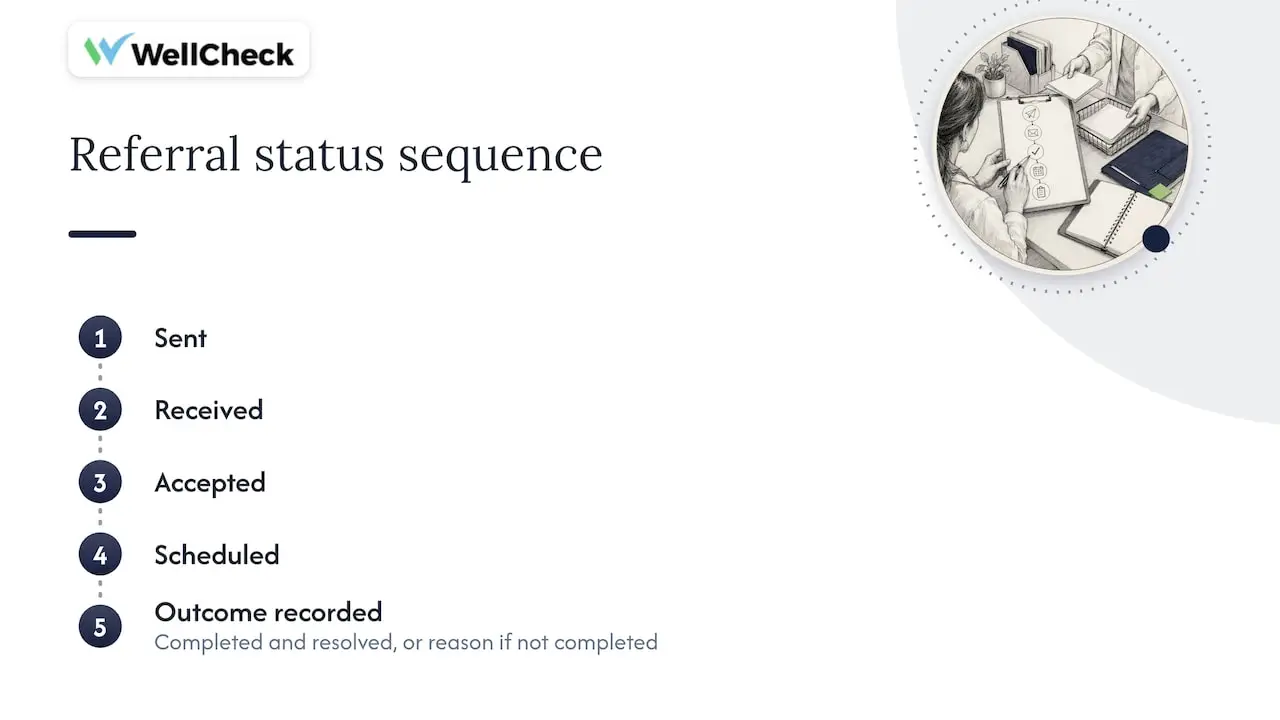
This is why closed-loop referral tracking matters for both roles. A closed loop means every referral has a recorded status: sent, received, accepted, scheduled, completed, and resolved, or documented as not completed with a reason. Navigators use that status to know whom to call. Coordinators use it to see where a handoff stalled. Directors use it to report.
What a closed loop looks like in a rural program
The following is an illustration of a workflow, not a case study.
- A screening at a health fair or clinic visit identifies a transportation need and an untreated chronic condition.
- Two referrals are created: one to a clinical partner, one to a community organization with a ride program.
- Each partner receives its referral and records acceptance or decline.
- A navigator contacts the patient, confirms the ride, and notes any barrier.
- After the visit, the partner records completion. If no completion is recorded by a set interval, the case returns to the navigator’s follow-up list.
- The coordinator reviews open referrals by partner and sees which handoffs are slow.
- The outcome is entered, and the program dashboard updates.
Steps 4 and 5 are navigation. Steps 3, 6, and 7 are coordination. The loop only closes because both happen against one shared record. Our nine-step referral implementation plan walks through how community and rural clinics set this up.
How to measure whether either one works
The American Heart Association’s Community-Clinical Linkages Playbook recommends tracking referral-completion rates, time to follow-up, patient engagement, and outcome measures. A working measurement set for a navigation and coordination program includes:
- Referrals made, by source and by type (clinical or social)
- Acceptance or enrollment by the receiving partner
- Time to follow-up after the referral and after the visit
- Service receipt or completion
- Needs resolved, for example the transportation barrier removed
- Clinical or utilization outcomes, where the program can obtain them
- Stratification by population and geography, so rural counties are not averaged away
On the navigation side, the playbook’s evidence points to documenting navigator contacts, barriers, actions taken, and healthcare utilization. Those records let you show what the navigator did and what changed, not just that contacts occurred.
For reporting examples, the figures below come from one deployment of a closed-loop platform:
- 22,682 individuals screened
- 45,458 services delivered
- 93.9% closed-loop completion rate
Rural health hub deployment with a multi-partner ecosystem. Includes both clinical and social services referrals.
These numbers show what becomes reportable once every referral has a status. They are not a promise of results for another program, which depends on its partners and pathways.
A fuller treatment of the metrics is in our article on five metrics to track for referral closure, and the care coordination dashboard page shows what a program director’s view can contain.
Choosing and combining the approaches
The federal navigation evaluation offers two findings useful for planning. First, narrowly focused programs with clear purposes and specific outcomes, such as increasing procedure rates or reducing rehospitalization, were most successful at improving patient outcomes. Second, leadership buy-in and a program champion contributed to success, and technology helped standardize navigation roles and activities, streamline processes, and collect data to track outcomes.
Turning that into a decision process:
- Name the outcome. “Increase completed colorectal screening referrals” is a program. “Improve access” is a hope.
- Map the barriers. If patients do not attend because of transportation, cost, or fear, you need navigation capacity. If they attend but records never reach the next provider, you need coordination.
- Assign accountability for each referral. AHRQ lists establishing accountability as a coordination activity for a reason. Every open referral needs one named owner.
- Decide where the record lives. Navigators, coordinators, and partners need the same status information, or follow-up becomes guesswork.
- Train for both skills. Navigators need to understand data entry and handoffs. Coordinators need to understand the patient’s barriers. Team communication also affects safety: AHRQ’s patient safety resource recommends TeamSTEPPS to improve team communication.
- Choose what to build on. Existing systems of record, whether an EHR or a state reporting system, should stay in place. The new layer is the workflow connecting them.
Community-based partners can also carry part of the load. CDC describes how community pharmacists can support community-clinical linkages by screening, making referrals, and following up to identify and address barriers. Programs with several partner types should plan for each partner’s role in the loop. For related approaches, see our guide to community case management strategies.
Training the people who do the work
Navigators, community health workers, and coordinators often come from different backgrounds, and role definitions vary by program. Shared training on referral workflows, documentation, and follow-up standards reduces the gaps described above. The Workforce Development Academy is WellCheck’s white-labeled learning platform for community health worker and navigator training and credentialing.
Tracking navigation and coordination in one workflow
EquiLoop is WellCheck’s closed-loop referral and care coordination platform. It manages the workflow from SDoH screening and intake through referral routing to clinical and community partners, follow-up and status tracking, outcomes dashboards, and funder-ready reporting. Each deployment is configured around the partner network, referral pathways, and reporting requirements the organization already has, and it is built to complement existing systems of record, not replace them.
EquiLoop is not a resource directory. Its purpose is workflow and accountability: recording what happened after the referral was made, so navigators know whom to follow up with, coordinators see stalled handoffs, and directors can answer funder questions. Learn more on the EquiLoop page, or book a 30-minute demo to see how it would fit your partner network.
FAQ
Is a patient navigator the same as a care coordinator?
Not exactly. A patient navigator works directly with an individual to overcome barriers to using the health care system. A care coordinator organizes activities and information sharing among the participants in that person’s care. Many programs combine the duties in a single job, and the literature itself notes the definitions overlap.
What are the three C’s of care coordination?
It depends on the source. One patient-care model uses consistency, continuity, and coordination. The Case Management Society of America uses collaboration, communication, and coordination. Confirm which framework your funder or partners reference.
Do small rural programs need both roles?
Usually they need both functions, but not necessarily two people. One community health worker can navigate a patient through a visit and also record the outcome for the coordinator. What matters is that a named person owns each referral and that its status is recorded in one place.
How do we know whether referrals were completed?
Record a status for every referral: sent, accepted, scheduled, completed, resolved, or closed with a reason. Review open referrals on a fixed schedule and report completion rates, time to follow-up, and needs resolved. A closed-loop platform automates the status trail so staff are not reconstructing it from phone calls and spreadsheets.
Sources
- Patient Navigation, National Library of Medicine
- What is Care Coordination? AHRQ Atlas, Chapter 2
- Care Coordination, AHRQ
- Care Delivery Transformation Brief: Care Navigation and Coordination, AHA
- Exploring Patient Care Navigation in the Medicare Program, ASPE
- Patient Navigation: Exploring the Undefined, JAMA Health Forum
- Early Identification and Linkage to Care of Persons with Hepatitis B, CDC MMWR
- Pharmacist Involvement in Addressing Public Health Priorities, CDC
- Implementing Personalized Cross-Sector Transitional Care Management, AHRQ
- Community-Clinical Linkages Playbook, American Heart Association
- Inpatient Transitions of Care: Challenges and Safety Practices, AHRQ PSNet
- Consistency, Continuity, and Coordination, Commonwealth Fund
- Collaboration, Communication, Coordination, Case Management Society of America
