
Referral network management is the work of keeping every referral between clinical and community partners visible from the moment it is sent until it is resolved. It covers who owns each step, how partners accept or decline, how status travels back to the sender, and which measures show whether the network is working. In community health, the hard part is rarely sending the referral. It is knowing what happened afterward.
This guide is written for program directors, care coordination managers, and outreach leads at health departments, FQHCs, AHECs, rural health networks, and community-based organizations. It covers the definition, the workflow stages, how to assign responsibility, what breaks, which measures to report, and how to start.
TL;DR
- Referral network management means owning the full path of a referral: sent, accepted, delivered, followed up, and closed, not just sent.
- Most failures come from missing owners and missing status updates, not from a lack of partners. Federal quality guidance reports that up to 50% of referrals are not completed.
- Write down roles, acceptance rules, and follow-up timelines for each partner before choosing software.
- Report a small set of measures: acceptance, completion, time to close, and referrals declined for lack of capacity.
- Start with a small group of partners, prove the loop closes, then add more.
Table of Contents
- What referral network management means in community health
- The stages of a referral, from screening to resolution
- Assigning responsibility across partners
- What prevents referrals from closing
- Measures that show whether the network is accountable
- How to start: a practical sequence
- How EquiLoop supports referral network management
- FAQ
- Sources
What referral network management means in community health
A referral network is the set of clinical and community organizations that send people to one another: a clinic sending a patient to a food program, a health department sending a family to housing assistance, a hospital sending a discharged patient to a community health worker. Managing that network means treating the connections as a process with owners, rules, and records, not as a list of phone numbers.
Professional guidance on primary care describes the same idea. Practices are expected to act as the hub for patients’ services, be accountable for time-sensitive referrals, and develop trusted networks, staff roles, workflows, and information systems that track referrals and support timely information flow in both directions.
Three things separate managing a network from simply having one:
- Ownership. Each referral has a named person or role responsible for it until it closes.
- Shared expectations. Partners agree on what counts as accepted, how fast they respond, and what they send back.
- Evidence. The program can show what happened to referrals, not only how many were made.
It also helps to separate two tools that are often confused. A resource directory lists services. A referral management workflow tracks what happens to a specific person’s referral. Community referral platforms are commonly designed to offer an up-to-date directory filtered by geography, services, and eligibility and to track referral outcomes, including whether people used the service and what resulted. A directory helps find a partner. Network management makes sure the partner followed through.
The stages of a referral, from screening to resolution
A managed referral moves through defined stages. The names vary by organization, but the sequence is consistent.
Screening and intake
The referral begins with a need identified through SDoH screening, a clinical visit, a community health worker contact, or a self-referral. Intake records the need, consent, and contact details. Errors here travel downstream: a wrong phone number or missing consent can stall a referral for weeks.
Routing
The need is matched to a partner based on service, geography, eligibility, and current capacity. In a well-run network, routing rules are agreed in advance so staff are not deciding from memory.
Acceptance
The receiving partner accepts or declines. A silent referral, one that is neither accepted nor declined, is the most common hidden failure. A useful rule is that every referral has a response deadline and an escalation step when the deadline passes.
Service delivery
The person is contacted, scheduled, and served. The partner records that the service happened, or that the person could not be reached, declined, or no-showed.
Follow-up and resolution
The sender receives status, schedules a check-in if needed, and closes the referral with a recorded reason. Clinical and community partners can send status updates to each other, record them in the person’s chart, and schedule follow-up screenings and visits as appropriate.
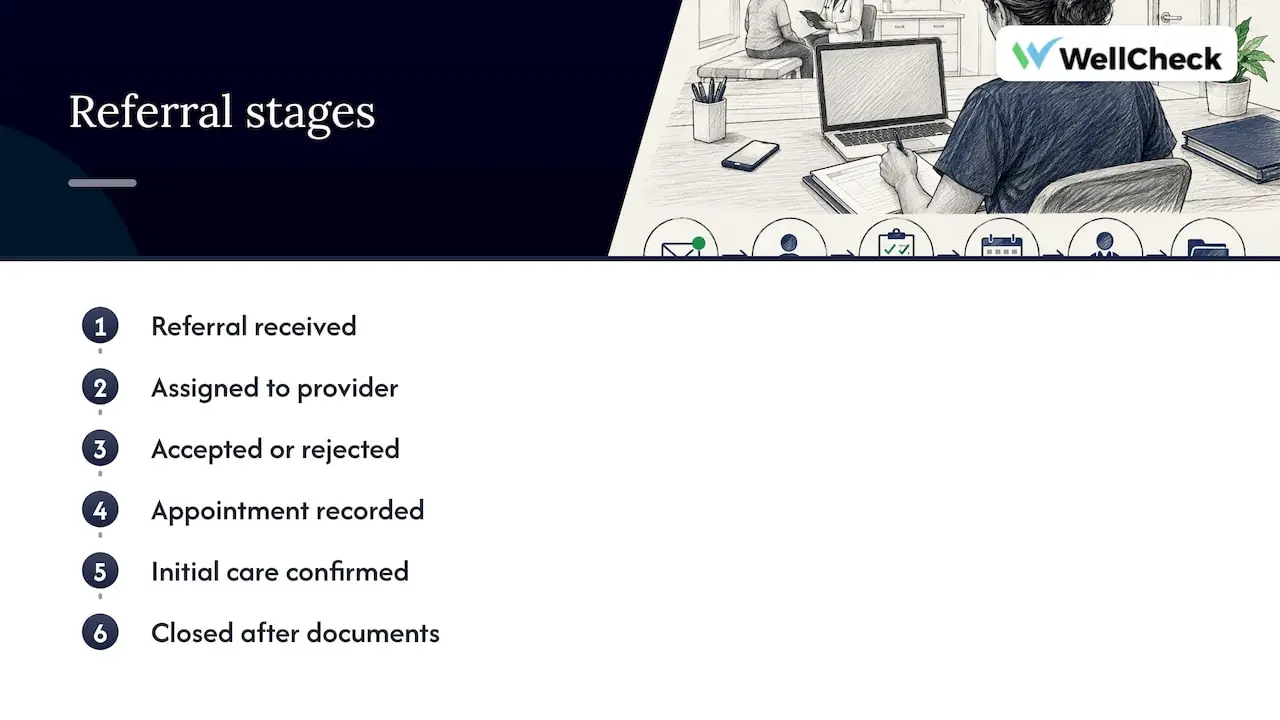
Healthcare systems with formal referral tools use the same logic. In the VA’s community care referral system, a referral is received, assigned to a community provider, accepted or rejected, recorded as an appointment, confirmed as initial care given, and closed when final documents are received. The stages are different in a rural health network, but the principle holds: a referral is not closed because it was sent.
Federal guidance on loop closure frames this as a safety and coordination practice that depends on two-way information sharing. Without it, referring providers may not learn about new diagnoses or changes in care.
Assigning responsibility across partners
Most referral problems trace back to a task that belongs to everyone and therefore to no one. Assigning responsibility is the core of network management.
National Council on Aging guidance recommends that referral workflows explicitly outline roles for scheduling, patient outreach and enrollment, data entry, tracking participation and completion, and following up on no-shows or drop-outs. A simple role table makes this concrete.
| Task | Typical owner | Question to settle |
|---|---|---|
| Screening and consent | Outreach coordinator or CHW | Who confirms contact details and consent? |
| Routing | Care coordinator | What rules decide the partner? |
| Acceptance | Receiving partner intake lead | What is the response deadline? |
| Outreach to the person | Receiving partner | How many attempts, by what channel? |
| Status update to sender | Receiving partner | What is the required update, and when? |
| No-show follow-up | Referring team | Who re-engages, and after how long? |
| Closure and reporting | Program manager | Who confirms the closing reason? |
A practical example comes from Denver Health, where the referring practice’s care team of clerks, medical assistants, and patient navigators was given responsibility to follow up on no-shows, cancellations, and patients still unscheduled after 30 days. The point is not the specific threshold. It is that a named team owned the follow-up and had a defined trigger.
Partner agreements
For community partners, a short written agreement is usually enough. It should state the services offered, who is eligible, the response time for new referrals, the status updates the partner will return, and a contact for escalation. Keep it to a page. Partners with small staffs will use a page and ignore a packet.
For a step-by-step look at starting small with a few partners, see our guide to rural partner network management.
What prevents referrals from closing
The same failure points appear across settings.
- No tracking process. Federal guidance notes that referrals go incomplete when practices lack established tracking and loop-closing processes, when patients are lost in scheduling, and when notes are not returned to the referring practice.
- Silent referrals. Without a response deadline, the sender does not know whether the partner saw the referral.
- No status path back. Partners may serve the person but have no simple way to tell the sender.
- Capacity gaps. A partner may decline because it is full, and unless declines are recorded with a reason, the network cannot see where demand exceeds supply.
- Mismatched definitions. One partner counts a referral as complete when the person is contacted, another when the service is delivered.
NCQA’s review of community referral platform implementations found challenges across 10 categories, including trust and relationships, engagement, data availability, goal and workflow alignment, system integration, privacy, and education. Most of these are people and process problems that software alone does not solve.
Privacy and consent
Privacy is the challenge program directors raise most often once partners are involved. Community partners may not be covered entities, consent practices differ, and staff need clear rules on what can be shared. Build consent capture into intake, limit shared fields to what the partner needs, and review your approach against current HIPAA guidance. A HIPAA checklist for AI tools is a useful reference if your network is adding automated features and needs audit trails.
Measures that show whether the network is accountable
A referral network that cannot report follow-through cannot answer funder and payer questions. The research on referral measurement points to a short list.
The Northwestern University measurement playbook for health and human services referral systems identifies indicators including first-contact acceptance, time to match and close, referrals rejected for lack of capacity, provider engagement, and demographic differences in demand and outcomes.
An older but still useful framework, the MEASURE Evaluation referral systems toolkit, defines three core indicators: the proportion of clients referred, the proportion who complete the referral, and the proportion seen back at the referring service with complete information. The third, counter-referral completion, is the one most programs skip and the one that shows whether the loop actually closed.
A starter dashboard might include:
- Referrals sent, by need category and partner.
- Percent accepted on first contact.
- Percent completed (service delivered).
- Median days from sent to closed.
- Referrals declined for capacity, by partner and service.
- Referrals closed with a status update returned to the sender.
The capacity measure deserves attention. The playbook recommends that platforms report referrals rejected due to provider capacity, because it tells directors where to add resources instead of only where referrals fail.
Reporting also needs to reach the people who can act on it. Denver Health used visual management boards, clinician scorecards, and newsletters to report referral performance at system, clinic, and clinician levels. Smaller programs can do the equivalent with a monthly one-page summary for partners.
For more on picking measures, see 5 metrics to track to close referral tracking and the care coordination dashboard overview.
Data limits to plan for
Reporting is only as good as the underlying records. Two practices help. First, use a recognized service taxonomy such as Inform USA/AIRS, which the playbook raises as a question to ask of any referral system. Second, use persistent identifiers so a person’s referrals can be analyzed across tables over time. Note also that the MEASURE toolkit monitors referral frequency, completion, service types, access, and follow-up, and is not intended to judge clinical appropriateness. Network metrics show process, not clinical quality, and reports should say so.
How to start: a practical sequence
Programs that try to onboard every partner at once tend to stall. A narrower path works better.
- Map current referrals. List the five to ten most common referral types and where they go. Note which have any tracking today.
- Pick a small group of partners. Choose three to five with high referral volume and a willing intake contact.
- Define the loop. Agree on statuses (sent, accepted, declined, scheduled, served, closed), response deadlines, and closing reasons.
- Assign owners. Fill in the role table above for each partner.
- Run it for a defined period. Review a sample of referrals weekly: which were never accepted, which closed without evidence of service, which stalled.
- Fix, then expand. Adjust rules, then add partners.
Our 9-step referral implementation plan and closed loop referral implementation guide lay out this sequence in more detail for community and rural settings.
Choosing tools
Spreadsheets and shared inboxes work at very low volume, but they do not send reminders, escalate silent referrals, or produce reports. When you evaluate software, ask these questions:
- Does it track status after the referral is sent, or only record that it was sent?
- Can it be configured to your partner network and referral pathways, rather than requiring you to adopt a fixed one?
- Does it work alongside your electronic health record or case management system instead of replacing it?
- Can it produce the reports your funders already require?
- How does it handle consent and limit what partners see?
How EquiLoop supports referral network management
EquiLoop is WellCheck’s closed-loop referral and care coordination platform for rural and community health programs. It manages SDoH screening and intake, referral routing to clinical and community partners, follow-up and status tracking, outcomes dashboards, and funder-ready reporting. Each deployment is configured around the partner network, referral pathways, and reporting requirements the organization already has, and it is built to complement existing systems of record. It is not a resource directory. Its purpose is workflow and accountability: tracking what happened after the referral was made.
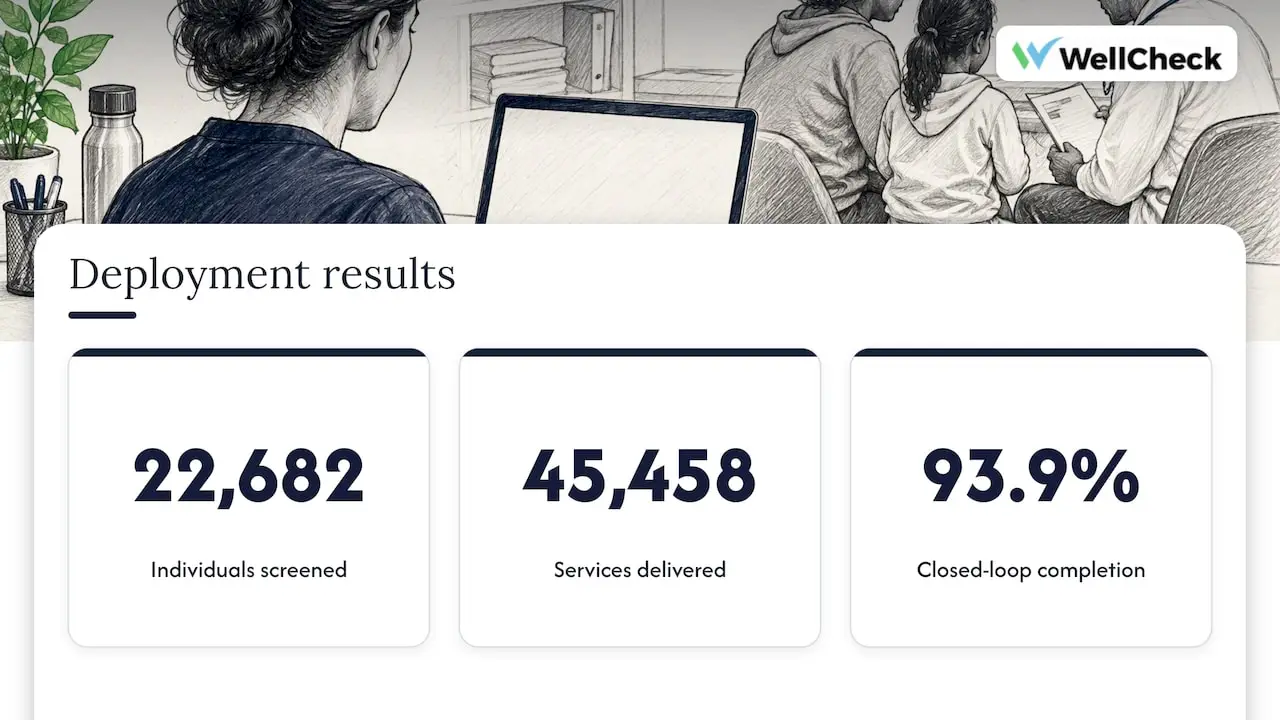
In one rural health hub deployment with a multi-partner ecosystem, the platform recorded 22,682 individuals screened, 45,458 services delivered, and a 93.9% closed-loop completion rate.*
*Rural health hub deployment with a multi-partner ecosystem. Includes both clinical and social services referrals.
If you want to see how this would fit your partners and reporting needs, book a 30-minute demo or read more about EquiLoop.
FAQ
What is a referral network?
A referral network is the group of clinical and community organizations that send people to one another for care and services. In a managed network, partners share expectations about response times and status updates, and the program tracks outcomes rather than only referrals sent.
How do you create a referral system?
Map your most common referral types, choose a few partners, and define statuses, response deadlines, and closing reasons. Assign an owner to each task, run the process with a small group, and review stalled referrals weekly. Add partners and software support once the loop closes reliably.
What skills does a referral coordinator need?
A referral coordinator needs clear communication with clients and partner staff, accurate data entry, persistence in follow-up, and knowledge of local services and eligibility. Familiarity with consent and privacy rules is also important. Training for community health workers and navigators can build these skills, and WellCheck’s Workforce Development Academy supports workforce training and credentialing.
How do you know if a referral network is working?
Look at acceptance on first contact, completion, time to close, and referrals declined for capacity. Add the share of referrals where status returned to the sender. If you cannot produce these numbers, the network has a tracking gap before it has a performance problem.
Sources
- Referral Management, Improving Primary Care Team Guide
- Implementing a Community Referral Platform: Recommendations, NCQA
- CCRA HSRM Community Provider Quick Reference Guide, VA
- Best Practices Toolkit: Community-Clinical Linkages, Colorado Health Institute
- Closing-the-Loop, CMS
- How to Build Referral Systems for Community-Integrated Health Networks, NCOA
- HHS Referral Systems Measurement and Evaluation Playbook, Northwestern University
- Referral Systems Assessment and Monitoring Toolkit, MEASURE Evaluation
- HIPAA 90 Day Checklist for Privacy Officers
