
Deliver a competency-based curriculum covering empathic inquiry, motivational interviewing, trauma-informed practices, cultural responsiveness, role definition and triage, structured outcome fields, and credentialed sign-off through a learning management system. Pair that curriculum with a 90-day rollout and a capacity check before you buy or expand a closed-loop referral platform.
Your immediate next step: run a 30-minute capacity and partner-readiness assessment. Look at current staffing, existing workflows, and whether your community-based organization (CBO) network actually covers the referral types your screening tool surfaces. Then schedule a stakeholder alignment meeting before writing a single training module.
- Recommendation: competency-based curriculum + 90-day rollout + capacity check
- Immediate action: 30-minute readiness assessment, then stakeholder alignment
- Evidence base: SIREN’s closed-loop referral research, 2026 training-topic guidance, and Oregon’s written-policy requirement
Statistic to know: When five implementation must-haves are in place, including consistent training and support, SIREN’s research found end users gained 13 minutes of efficiency per referred case, along with a statistically significant drop in burnout.
Key Takeaways
Effective referral workflow training combines a competency-based curriculum, structured outcome data fields, and a 90-day rollout, and it produces measurable gains only when paired with consistent supervisor support and network adequacy.
| Point | Details |
|---|---|
| Core curriculum is fixed | Empathic inquiry, motivational interviewing, trauma-informed practices, and cultural responsiveness are the four non-negotiable modules per 2026 guidance. |
| Training moves specific KPIs | Track initiation completeness, acceptance rate, patient contact, enrollment, receipt of services, and need resolution. |
| Consistency drives efficiency | Programs with consistent training and support alongside other must-haves saw a 13-minute efficiency gain per referred case. |
| Written policy is required | Share a documented training policy listing required topics with every CBO partner conducting screening or referrals. |
| Build or buy the platform layer | WellCheck’s EquiLoop and Workforce Development Academy offer a turnkey option for programs that want training and closed-loop tracking wired together. |
Table of Contents
- Which KPIs should referral workflow training actually move?
- What should the core training curriculum cover?
- How should you deliver and credential this training?
- How does training connect to daily referral workflows?
- How do you keep training tied to real outcomes over time?
- What’s the 90-day rollout checklist and module sequence?
- A turnkey path if you’d rather not build this from scratch
- Where to go for source documents and toolkits
- Sources
Which KPIs should referral workflow training actually move?
Training that doesn’t change a measurable outcome is just a checkbox. Pick four to six KPIs before you build a single slide deck, because the curriculum content should be chosen to move these numbers, not the other way around.
- Referral initiation completeness: percentage of positive SDoH screens that generate a documented referral within 24 hours.
- Referral acceptance rate: percentage of sent referrals a partner organization confirms receiving and accepting.
- Patient contact within 7 days: percentage of accepted referrals where the partner reaches the patient within a week.
- Enrollment rate: percentage of contacted patients who enroll in the service.
- Receipt of services: percentage of enrolled patients who actually receive the service (not just sign up).
- Need resolution: percentage of cases where the original social or clinical need is documented as resolved or improved.
That’s the kind of field-level tracking your staff need to be trained to enter consistently, not just understand conceptually. When the five implementation must-haves are in place, that consistency is exactly what produces the 13-minute efficiency gain per referred case documented in the SIREN research, along with fewer staff reporting burnout from chasing untracked cases.
What should the core training curriculum cover?
Guidance released in 2026 names four skills as essential for anyone conducting social needs screening or referral work: empathic inquiry, motivational interviewing, trauma-informed practices, and cultural responsiveness. Build your curriculum around those four, then add the operational layers that turn a soft-skills training into a closed-loop-capable workforce.
Here is a workable eight-module structure, with a learning objective and an assessment example for each:
- Empathic inquiry — Objective: conduct a screening conversation without leading or judgmental language. Assessment: observed structured assessment using a standardized screening script.
- Motivational interviewing — Objective: use open-ended questions to help a patient identify their own next step. Assessment: role-play scored against a brief fidelity checklist.
- Trauma-informed practices — Objective: recognize signs of distress and adjust pacing and tone accordingly. Assessment: written case-scenario quiz plus supervisor observation.
- Cultural responsiveness — Objective: adapt screening language and referral options for language, literacy, and cultural context. Assessment: return-demonstration with a peer reviewer.
- SDoH screening basics — Objective: administer the screening tool correctly and code responses to the right data fields. Assessment: task-based sign-off on a sample intake.
- Referral initiation and documentation — Objective: enter a referral with complete required fields on the first attempt. Assessment: documentation audit against a completeness checklist.
- Referral follow-up and closing the loop — Objective: apply structured closure categories (Services Received, Member Declined, Eligibility Denied) instead of leaving cases open indefinitely. Assessment: quiz on closure taxonomy plus a live case walk-through.
- Role-specific workflows — Objective: know exactly which triage and follow-up steps belong to your role (CHW, navigator, social worker, clinical staff). Assessment: workflow map sign-off with a supervisor.
Tailor delivery, not content, for different learner groups. Clinical staff need the same closure categories as CHWs, just mapped to EHR fields instead of a standalone tracking sheet. CBO partners need the same triage logic, translated into their intake process rather than yours.
Pro Tip: Build your competency checklist before you write a single training slide. If you can’t describe what “competent” looks like in observable behavior, the training content will drift toward information delivery instead of skill-building.
How should you deliver and credential this training?
Three delivery models cover most organizations, and the right one depends on staff geography and how much live coaching your team can absorb without falling behind on caseloads.
An LMS-first model with self-paced modules and a final competency sign-off works well for larger networks with dispersed staff and limited trainer bandwidth. A blended cohort model, combining online modules with a live observed skills check, fits mid-sized programs that want consistency but still need a human checkpoint before sign-off. An onsite intensive makes sense for smaller CBO partner networks where you’re onboarding a handful of new partner staff at once and want everyone calibrated on the same day.
| Timeline phase | Focus | Milestone |
|---|---|---|
| Days 1–30 | Prep and capacity assessment | Curriculum customized, LMS access provisioned |
| Days 31 to 60 | Core rollout | All staff complete core modules 1–6 |
| Days 61 to 90 | Competency sign-off | Baseline KPIs recorded, credentials issued |
| Ongoing | Quarterly refresh | KPI review triggers targeted retraining |

Credentialing through a white-labeled LMS typically comes in three tiers: a completion certificate for finishing modules, a competency badge for passing an observed assessment, and a role credential (CHW, navigator, care coordinator) tied to a documented skills checklist. A simple sign-off template works: name, role, modules completed, assessment method used, assessor name, and date. Keep it that plain. It doesn’t need to be more complicated to hold up in a funder audit.
How does training connect to daily referral workflows?
Training only pays off when it’s mapped to who does what, in what order, every single day. Screening staff identify the need. A navigator or CHW triages and determines urgency. A designated role sends the referral with complete data fields. A follow-up role, sometimes the same person, tracks status until the loop closes.
- Screener: administers SDoH tool, documents positive findings in structured fields.
- Navigator or CHW: triages by urgency, selects the appropriate partner, initiates referral.
- Care coordinator or social worker: manages complex cases requiring warm handoffs.
- Follow-up owner: tracks acceptance, contact, enrollment, and closure status.
Partner onboarding checklists should include a written training policy shared with every CBO partner. Oregon’s SDoH screening and referral guidance requires exactly this: a documented training policy covering topics like empathic inquiry and trauma-informed care, shared with any partner conducting screening or referral work. Add data-sharing expectations, a documented escalation path for urgent cases, and clear MOU language on response-time commitments.
Pro Tip: Before you sign a new CBO partner, ask what percentage of referrals they can accept and staff for within 30 days. Network adequacy isn’t about partner count, it’s about matched capacity by service type.

How do you keep training tied to real outcomes over time?
Measurement can’t stop at the sign-off ceremony. Set a reporting cadence: baseline report at day 90, monthly reviews through year one, then quarterly after that once your numbers stabilize.
- Run a QA checklist during live case observation: correct closure coding, complete documentation, appropriate escalation when needed.
- Trigger targeted retraining when a specific KPI, like patient contact rate, drops for two consecutive reporting periods.
- Hold monthly partner performance reviews during year one to catch onboarding gaps early.
- Treat your training policy as a living document, updated whenever a new closure category or workflow step gets added.
Referral toolkits recommend defining closed-loop outcome categories clearly and note that follow-up within 30 days materially improves the odds a referral actually succeeds. That 30-day window is worth building directly into your workflow reminders, not just your training slides.
What’s the 90-day rollout checklist and module sequence?
A 90-day plan keeps momentum without rushing competency sign-off.
- Week 1 to 2: Governance, assign training ownership and a supervisor for sign-off.
- Week 2 to 4: Run the capacity and partner-readiness assessment.
- Week 4 to 6: Customize the eight-module curriculum for your role mix.
- Week 6 to 9: Launch a pilot cohort, ideally one team or one site.
- Week 9 to 12: Complete competency assessments and issue credentials.
- Week 12: Record your first KPI baseline report.
- Module 1, empathic inquiry: 2 hours, deliverable is a scored screening role-play.
- Module 2, motivational interviewing: 3 hours, deliverable is a fidelity-checked case recording.
- Module 3, trauma-informed practices: 2 hours, deliverable is a written case-response quiz.
- Module 4, cultural responsiveness: 2 hours, deliverable is a peer-reviewed return-demonstration.
- Module 5, SDoH screening basics: 1.5 hours, deliverable is a sample intake sign-off.
- Module 6, referral documentation: 1.5 hours, deliverable is a completeness audit.
- Module 7, closing the loop: 2 hours, deliverable is a closure-taxonomy quiz.
- Module 8, role-specific workflows: 1 hour, deliverable is a signed workflow map.
Before you purchase any closed-loop platform, confirm it can integrate with your EHR, support CBO partner onboarding without custom development, export funder-ready reports, and bundle or connect to training services rather than leaving credentialing as a separate project.
A turnkey path if you’d rather not build this from scratch
Everything above can be built in-house with an existing LMS, a whiteboard, and a lot of coordinator hours. If your team doesn’t have the bandwidth for that build, or you want the training and the referral tracking wired together instead of running as two separate projects, WellCheck runs both halves as one system.
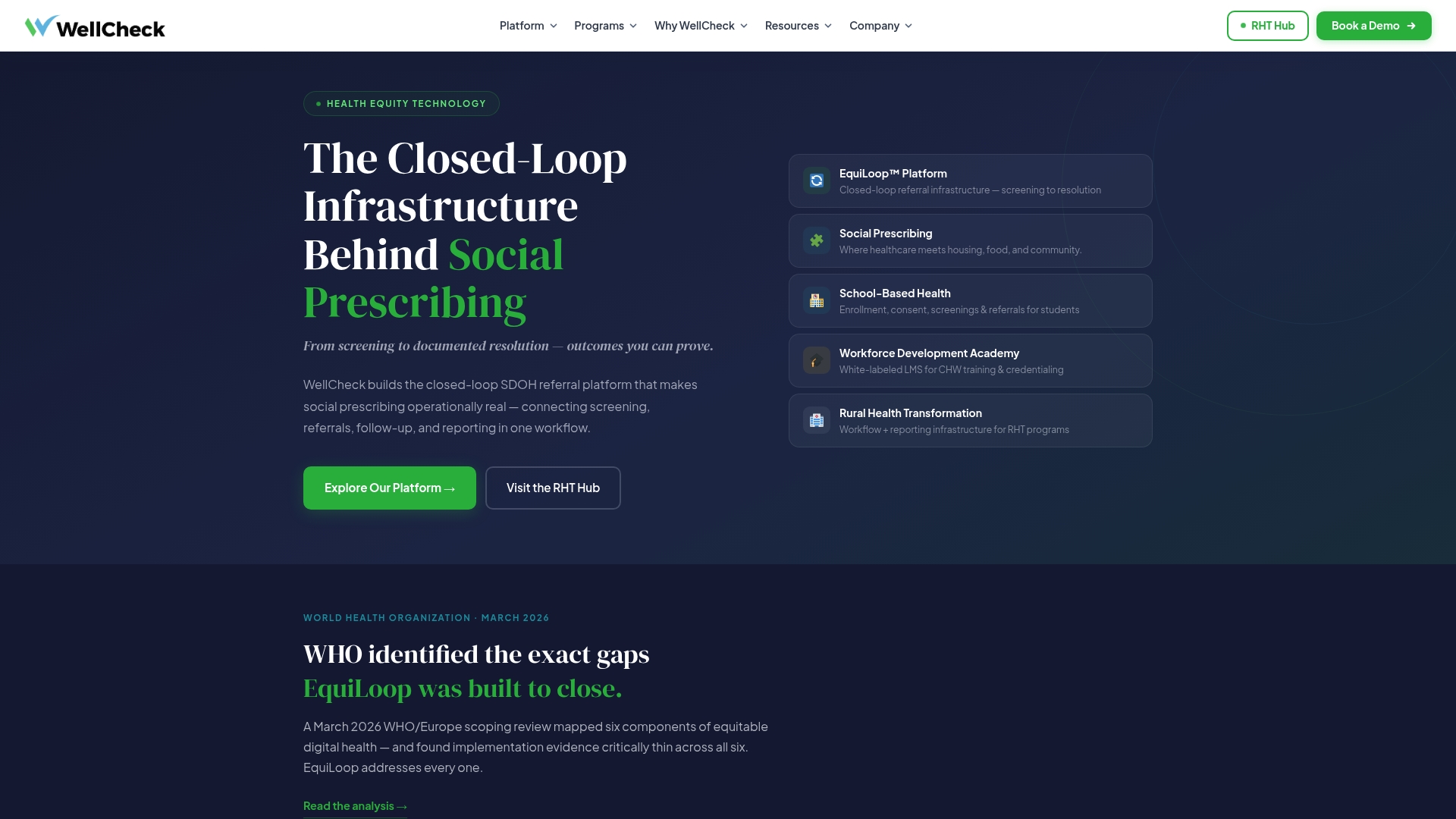
WellCheck’s EquiLoop platform handles SDoH screening, referral routing to clinical and community partners, follow-up tracking, and funder-ready reporting, configured around the partner network and reporting requirements your organization already has. The Workforce Development Academy is the credentialing half: a white-labeled LMS built for CHW, navigator, and care-coordination training, with competency sign-off built into the workflow instead of tracked in a separate spreadsheet. Three things matter most to program directors evaluating this path: configurable workflows that match your existing referral pathways, competency sign-off tracked directly in the LMS, and reporting exports built for funder and payer requirements from day one.
Building in-house makes sense if you already have LMS infrastructure and a coordinator with time to own it. A turnkey approach makes more sense if you’re standing up closed-loop referral tracking and workforce credentialing at the same time and don’t want them to drift out of sync with each other. WellCheck’s rural health hub deployments, including one built around a multi-partner ecosystem covering both clinical and social services referrals, have screened many individuals and delivered tens of thousands of services, achieving a high closed-loop completion rate.
If you want to see how the training and platform pieces fit your specific partner network, schedule a 30-minute demo.
Where to go for source documents and toolkits
Start with SIREN’s closed-loop referral network research for the implementation must-haves and the 13-minute efficiency benchmark. Pair it with the 2026 training-topic guidance and Oregon’s written-policy requirement for the exact topic list regulators expect.
- SIREN closed-loop referral research — implementation must-haves and efficiency data
- 2026 HRSN training-topic guidance — module content and structured data field requirements
- Oregon SDoH training-policy requirement — written policy standard for partner-shared training
- Referrals and closing the loop toolkit — outcome category definitions
- How EquiLoop’s workflow maps to training for teams weighing a turnkey discovery conversation
Sources
- Social care best practices: Learnings from a technology-enabled closed-loop referral network | SIREN
- HealthBegins_HRSN-Session-6.pdf
- SDOH Screening and Referral Metric: Social Needs Training Resources
- Module 3: Referrals & Closing the Loop

