
Closed-loop referral tracking means every referral gets a documented outcome, not just a sent date. For a rural program, the fastest path forward is to pick three KPIs, structure a simple status field for each referral, and pilot the workflow with one to three partners. Success in the first 90 days looks like measurable referral closures and outreach that starts within 30 days of the referral being sent.
TL;DR:
- Structuring referral data with clear outcome fields and tracking KPIs like time to first contact and closure rate is essential to measure true program success.
- Launching a pilot with three partners within the first month allows for early adjustments before expanding network-wide.
- Address staffing roles to ensure dedicated ownership of outreach, follow-up, and weekly reconciliation, which significantly reduces stalled referrals.
- Building workflows around a 30-day outreach window increases the likelihood of completing referrals and meeting quality standards.
- Most rural programs can effectively implement closed-loop referral tracking using existing EHR modules or simple spreadsheets, gradually adopting interoperability standards over time.
Table of Contents
- What Is Rural Health Referral Tracking and Why Does It Matter?
- Core Components of a Referral Tracking Workflow
- Which Metrics Should You Track First?
- What Data Systems Work for Low-Resource Rural Programs?
- Who Runs Referral Tracking Day to Day?
- Why Do Rural Referrals Stall, and What Fixes That?
- How Do You Start Closing the Loop in 90 Days?
- How WellCheck Fits Into a Closed-Loop Referral Program
- Sources
- FAQ
What Is Rural Health Referral Tracking and Why Does It Matter?
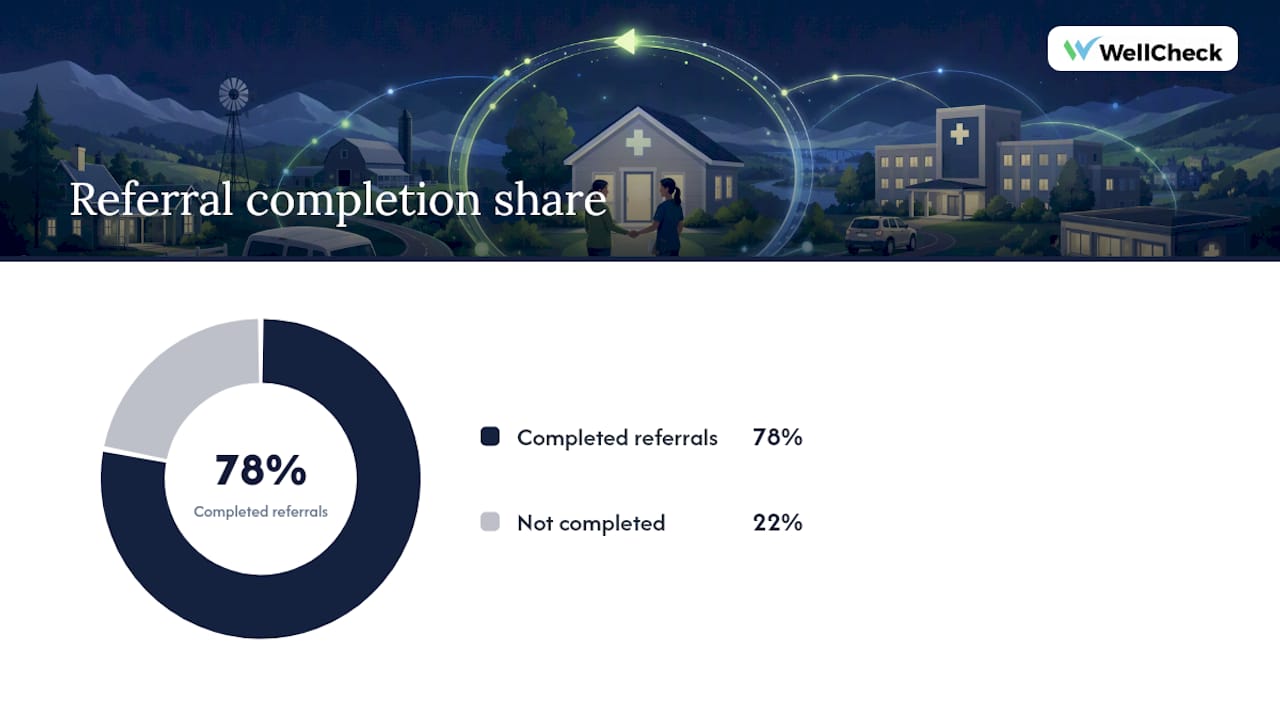
A one-way referral ends when the fax or portal message goes out. Closed-loop referral tracking follows the patient all the way to a documented result: accepted, contacted, enrolled, service received, or need resolved. That difference sounds small on paper. In practice, it is the difference between a program that can say “we made 400 referrals” and one that can say “312 of those referrals ended in a completed service.”
Rural programs have specific reasons to care about this. Staff often cover multiple roles, so a referral without a clear owner tends to sit untouched. Geography adds friction: a patient referred to a specialist two counties away may never make the trip. And funders increasingly want proof of follow-through, not just volume.
Closed-loop tracking supports that reporting directly by:
- Giving programs a documented outcome for every referral, not just a send record
- Creating the kind of structured data CMS and NCQA quality measures expect
- Surfacing which partners and referral types stall, so leaders can fix the actual bottleneck
Improving referral information exchange and workflow steps raises completion rates and lines up with the measurement approach used in CMS quality measures for referral loop closure.
Core Components of a Referral Tracking Workflow
An effective workflow has four working parts, and skipping any one of them breaks the loop somewhere downstream.
- Screening and structured intake. Capture the need (medical, food, housing, transportation) using consistent categories, not free text. If your program screens for social needs, keep those fields structured from the start so they can feed a referral automatically.
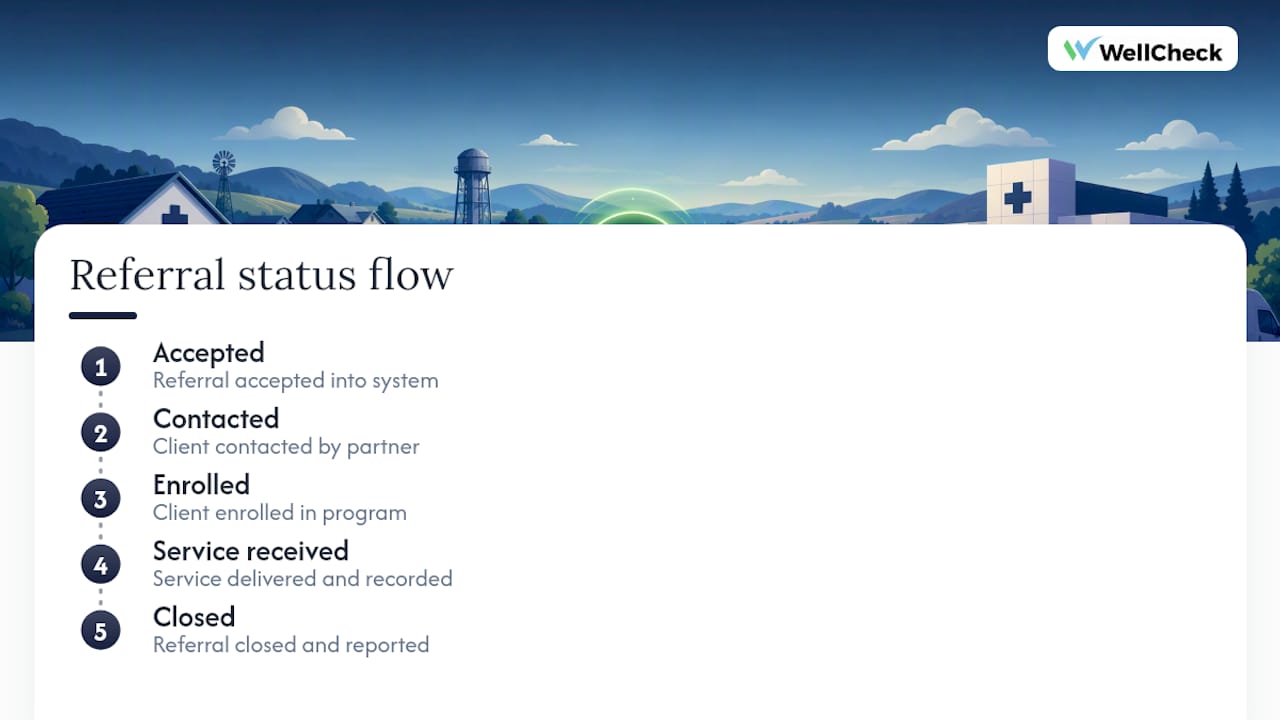
- Routing rules and status fields. Every referral needs a defined path to a partner and a small set of status options: sent, accepted, contacted, enrolled, service received, closed. Documenting outcomes with this exact structure makes referral “success” reproducible across every partner in the network, according to guidance from the SIREN social needs referral framework.
- Active follow-up and outreach cadence. Someone has to actually call or message the patient and the partner. A tickler system or calendar reminder beats hoping staff remember.
- Documentation and closure criteria. Decide in advance what counts as “closed” for each referral type. A closed food referral might mean confirmed enrollment; a closed specialty referral might mean a completed visit note.
Structured fields, rather than free-text notes, are what actually make automated follow-up lists and reports possible down the line.
Which Metrics Should You Track First?
Five KPIs cover most of what a rural program needs to know about whether referrals are working:
- Time to initial contact — how long between the referral being sent and the first outreach attempt
- Acceptance rate — the share of referrals a partner confirms they will act on
- Service receipt or enrollment rate — the share of accepted referrals that end in an actual service
- Referral closure rate — the share of referrals that reach a documented final status
- Time to resolution — the total time from referral to closure
Pro Tip: *Segment every KPI by partner and referral type before you look at program-wide averages.
Follow-up within 30 days is strongly associated with successful referral completion, which is why time-to-contact belongs at the top of any rural program’s dashboard, per the SIREN PULSE referral guide.
Treat time-to-contact and acceptance rate as short-term process indicators you check weekly. Treat closure rate and time-to-resolution as longer-term outcome indicators you report monthly or quarterly to funders. Both matter, but conflating them hides where a stalled referral actually stalled.
What Data Systems Work for Low-Resource Rural Programs?
You do not need an enterprise data warehouse to track referrals well. Most rural programs get further with a staged, practical approach than a full technical overhaul.
- Use structured fields inside your existing EHR referral module where one exists, rather than building a parallel spreadsheet no one maintains.
- If your EHR lacks a workable referral module, a lightweight shared registry, even a well-governed spreadsheet with defined status columns, can work as a bridge.
- Plan for staged standards adoption. National frameworks like USCDI v4 and 360X point toward bidirectional referral exchange, but most rural networks realistically start with unidirectional tracking and build toward two-way status updates over time, according to EHRA’s closed-loop referral barriers report.
- Keep the minimum data set small: patient identifier, referral reason, referring and receiving partner, date sent, and status. Add fields only once the basics are working.
Structured data fields, rather than narrative notes, are what let a program actually generate a follow-up list on a Monday morning instead of reading through months of chart notes.
Who Runs Referral Tracking Day to Day?
Referral tracking fails most often not because the technology is wrong, but because no single person owns the follow-up. A workable role matrix for a small rural program looks like this:
- Intake staff capture the structured referral and initial need category.
- Care coordinators or navigators own outreach and status updates.
- Community health workers (CHWs) handle in-person follow-up where phone contact fails, especially for transportation-limited patients.
- A weekly reconciliation owner reviews the full referral list and flags anything stalled past 30 days.
Shared navigator models, where two or three small clinics split a single coordinator role, and CHW outreach backed by a tickler system are both practical staffing patterns for low-resource rural settings.
Outreach within 30 days of the referral being sent correlates with higher completion rates, so build that window into your workflow rather than leaving contact timing to individual judgment.
Pro Tip: If you can only staff one dedicated role, make it the weekly reconciliation owner. That single habit, someone reviewing every open referral once a week, catches more stalled cases than any dashboard alone.
Training matters here too. Organized coordination and structured training measurably shortened referral and transfer intervals in a rural trauma care study, showing that operational training, not just software, moves the needle on speed.
Why Do Rural Referrals Stall, and What Fixes That?
Three barriers show up again and again in rural programs, and each has a specific, workable fix; coordinating with specialty partners is one key area addressed by specialist practice marketing.
- Uneven CBO capacity. Not every community partner can handle intake volume or timely status updates. Maintain an updated partner directory, and consider using a third-party convener to manage relationships with smaller organizations rather than each partner integrating separately.
- Transport and geography. A referral two counties away often just does not happen. Triage referrals by distance, expand telehealth options where the service allows it, and use transportation subsidies where funding permits.
- Funding gaps. CBO capacity is often the real bottleneck, not willingness. Small stipends for participating partners, along with grant funding and Medicaid Section 1115 waiver programs, are concrete levers that support scaling closed-loop referral work in underfunded rural networks.
How Do You Start Closing the Loop in 90 Days?
A realistic 90-day plan has three phases, each with a clear goal.
- Weeks 1 to 2: Define your outcome categories and exact KPI definitions. Decide what “closed” means for each referral type before you build anything else.
- Weeks 2 to 4: Pick the minimum data fields and assign the role matrix, including who owns weekly reconciliation.
- Month 1: Launch a pilot with one to three partners. Do not attempt a network-wide rollout on day one.
- Month 2: Monitor weekly, fix broken handoff points, and adjust outreach timing based on what the data shows.
- Month 3: Scale the workflow to additional partners once the pilot’s closure rate stabilizes.
| Month | Primary goal | What to measure |
|---|---|---|
| Month 1 | Launch pilot with 1 to 3 partners | Time to first contact |
| Month 2 | Fix workflow gaps | Acceptance and service receipt rates |
| Month 3 | Scale to more partners | Referral closure rate |
When reporting to funders, lead with the closure rate and time-to-resolution figures rather than raw referral volume. Funders increasingly ask for follow-through, and a documented closed-loop process answers that question directly.
How WellCheck Fits Into a Closed-Loop Referral Program
WellCheck builds locally configurable referral infrastructure specifically for rural and community health programs, and it complements the EHR and workflow pieces described above rather than replacing them. The EquiLoop platform handles SDoH screening and intake, referral routing to clinical and community partners, follow-up and status tracking, and funder-ready reporting, matching the same status fields (accepted, contacted, enrolled, service received, closed) covered in this guide.
One rural health hub deployment using a multi-partner ecosystem screened a large number of individuals and delivered tens of thousands of services, reaching a significant part of the community.* If your program needs to train navigators or CHWs to run the outreach cadence this article describes, the Workforce Development Academy offers white-labeled training and credentialing built for that exact workforce. To see how a configurable referral workflow like EquiLoop’s closed-loop system would map onto your own partner network, book a 30-minute demo and bring your current referral volume and partner list.
*Rural health hub deployment with a multi-partner ecosystem. Includes both clinical and social services referrals.
Sources
For deeper reading on measurement and standards, start with the SIREN PULSE guide on social needs referrals, EHRA’s report on closed-loop referral barriers, and the CMS eCQM measure for referral loop closure. For rural implementation context, NACo’s insight on rural program design is a useful companion piece.
- PULSE: Social Needs Referrals in Primary Care (SIREN/UC San Francisco)
- Closed-Loop Referrals for Health-Related Social Needs: Barriers and Recommendations (EHRA)
- Closing the Referral Loop: Receipt of Specialist Report | eCQI Resource Center
FAQ
What Is Closed-Loop Referral Tracking?
Closed-loop referral tracking documents a referral all the way through to a final outcome, such as service received or need resolved, instead of stopping once the referral is sent.
What Are the Most Important Referral KPIs to Track First?
Start with time to first contact, acceptance rate, service receipt rate, and referral closure rate. These four cover both speed and completion.
How Long Should Follow-Up Take After a Referral Is Sent?
Outreach within 30 days is associated with higher referral completion rates, so build that window directly into your outreach cadence.
Does Rural Referral Tracking Require a Full EHR Overhaul?
No. Most rural programs start with structured fields inside their existing EHR or a well-governed lightweight registry, then adopt broader exchange standards like USCDI in stages.
How Much Does EquiLoop Cost?
EquiLoop’s pricing is not published; current pricing details are available on the EquiLoop product page, or through a direct conversation with the WellCheck team.

