
Case management software for nonprofits is a platform that centralizes every stage of client service delivery, from intake and assessment through referrals, case notes, and outcomes, on a single persistent client record. Unlike fundraising CRMs, which track donor relationships, true nonprofit case management tools track direct service delivery and measure client outcomes. Choosing the right platform depends on your organization’s size, program complexity, and what your funders require you to prove. This guide covers the features that matter, the pitfalls to avoid, and how to match a solution to your specific operational needs.
1. Key features that nonprofit case management software must offer
The right case management software does more than store case notes. It structures the entire service lifecycle so your team spends less time on administration and more time with clients.
The features that separate capable platforms from basic databases include:
- Structured client intake and persistent records. Every client interaction, from the first screening through program exit, lives on one record. This eliminates duplicate data entry and gives case managers a complete service history at a glance.
- Workflow and task management. Task assignments and reminders keep cases from falling through the cracks. Case managers receive alerts when follow-ups are due, and supervisors can monitor caseload distribution.
- Outcome measurement tools. Pre- and post-assessments built into the platform let you measure client progress against defined goals. This is the feature most organizations underestimate until a funder asks for evidence of impact.
- Automated, funder-ready reporting. Modern software reads each case note upon arrival and generates real-time impact insights, eliminating time-consuming spreadsheet merges. That capability alone can save a program director several hours per grant report cycle.
- Configurable forms and workflows. Your intake form for a housing program looks nothing like one for a mental health program. Platforms that let you customize fields, logic, and workflows without coding reduce friction for frontline staff.
Pro Tip: Before you demo any platform, write down the three reports your funders request most often. Ask vendors to generate those exact reports live during the demo. If they cannot, the platform will not meet your reporting needs.
2. How to choose case management software based on nonprofit size

No single platform is the best case management solution for every organization. Organizations choose based on program complexity and outcome measurement needs, not feature lists alone.
Here is how to match platform type to organizational scale:
Small nonprofits (under 15 staff). Prioritize speed to deployment and ease of configuration. AI-native platforms let small nonprofits configure custom intake forms and outcome rubrics in plain language and go live in days, while legacy enterprise products require months and costly integrator support. If your team cannot afford a dedicated IT resource, an AI-native platform is the practical choice.
Mid-size organizations (15–75 staff). Look for platforms that support multiple programs under one account, with role-based access controls and cross-program client records. Outcome measurement depth becomes more critical at this scale because funders often require program-level and aggregate reporting simultaneously.
Large or multi-site organizations. Enterprise-level configurable tools with complex analytics and API integrations are appropriate here. These platforms support custom data models and advanced evaluation frameworks, but they require dedicated configuration time and often an internal data analyst.
Health-focused nonprofits. Organizations screening for social determinants of health (SDoH) need platforms built around referral management and closed-loop follow-up, not just case note storage. Wellcheck’s EquiLoop™ platform is purpose-built for this use case, with a 93.9% closed-loop completion rate across community health programs.
Pro Tip: Map your current workflow on paper before you evaluate any software. Platforms that match your existing process require less staff retraining and reach full adoption faster.
3. Common pitfalls in selecting nonprofit case management software
Selecting the wrong platform costs more than the license fee. It costs staff time, funder confidence, and client outcomes.
The most frequent mistakes nonprofit administrators make include:
- Choosing by feature count instead of outcome evidence needs. Many organizations purchase software good for tracking but inadequate for proving outcomes to funders. A platform with 50 features is worthless if it cannot generate the impact report your largest grant requires.
- Accepting rigid templates. Platforms allowing customization of forms and workflows increase staff buy-in. Rigid templates force staff to change how they work, which drives low adoption and incomplete records.
- Ignoring reporting implications. Funder renewals depend on your ability to report outcomes on time and in the required format. If your platform requires manual data exports to produce those reports, you are one grant cycle away from a compliance problem.
- Underestimating total cost. Configuration and analyst time often exceed software fees, especially with complex enterprise solutions. Budget for setup, training, and ongoing report-building support before you sign a contract.
Treating case management software selection as a strategic decision and prioritizing systems that fit existing workflows drive higher staff adoption and mission impact. The technology should serve the mission, not redirect staff energy toward managing the technology itself.
4. Affordable and low-cost case management options for nonprofits
Budget constraints are real for most nonprofits, and free or low-cost tiers exist across the market. The trade-offs, however, are significant.
| Tier | Typical capabilities | Key limitations |
|---|---|---|
| Free editions | Basic intake, case notes, limited users | No outcome measurement, manual reporting, no audit trail |
| Low-cost paid tiers | Intake, workflows, basic reports | Capped users, limited customization, minimal funder report templates |
| Mid-range paid platforms | Full outcome measurement, automated reports | Configuration time required, may need analyst support |
| Enterprise platforms | Advanced analytics, API integrations | High cost, long setup timelines, integrator fees |
Free tiers cap users and features, requiring manual reporting workarounds that consume staff time. For a program serving fewer than 50 clients per year with no funder outcome requirements, a free tier may be sufficient. For any program that reports to a government agency or foundation funder, the hidden cost of manual reporting almost always exceeds the price of a paid platform.
Pro Tip: Calculate the staff hours your team spends each quarter building funder reports manually. Multiply that by your average hourly rate. That number is your true cost of “free” software, and it is usually higher than a mid-range subscription.
5. How customization and scalability influence long-term success
The best nonprofit case management tools grow with your organization. Platforms that require re-platforming every time you add a program create unnecessary disruption and data loss risk.
Key capabilities that support long-term scalability include:
- Configurable intake forms and outcome rubrics. Programs change. A housing stability program may add a financial literacy component. Your platform should let you add fields and assessments without calling a developer.
- One persistent client ID across programs. Longitudinal outcome measurement and multi-program client tracking from a single data source support funder-ready evaluation reports without data reconciliation. This is the capability that separates advanced platforms from basic databases.
- Customizable funder reports. Different grants require different metrics. Platforms that let you build report templates for each funder eliminate the manual work of reformatting the same data repeatedly.
- Staff adoption support. Scalable platforms reduce future IT investment by keeping the user experience consistent as programs expand. Staff who learned the system for one program can apply that knowledge to new programs without retraining.
- Integration with other nonprofit systems. Connections to electronic health records, referral networks, and financial systems reduce duplicate data entry and improve data accuracy across the organization.
The table below summarizes how scalability features map to organizational growth stages:
| Growth stage | Priority capability | Business impact |
|---|---|---|
| Single program | Configurable intake and outcome tools | Accurate baseline data for first funder reports |
| Multi-program | Persistent client ID across programs | Eliminates duplicate records and data reconciliation |
| Multi-site | Role-based access and site-level reporting | Supports site comparisons and aggregate impact analysis |
| Enterprise | API integrations and advanced analytics | Connects case data to financial and health systems |
Wellcheck’s EquiLoop™ platform demonstrates this principle in practice. The platform has delivered over 45,000 services across community health programs by maintaining a closed-loop referral infrastructure that scales from single-site pilots to statewide deployments without re-platforming.
Key Takeaways
The most effective approach to selecting case management software for nonprofits is to match platform capabilities to your outcome reporting requirements, not your feature wish list.
| Point | Details |
|---|---|
| Match platform to org size | Small teams benefit from AI-native tools that deploy in days; large orgs need enterprise analytics. |
| Prioritize outcome measurement | Software that cannot generate funder-ready outcome reports creates compliance risk at renewal. |
| Budget for total cost | Configuration, training, and analyst time often exceed license fees, especially for enterprise platforms. |
| Demand workflow flexibility | Rigid templates reduce staff adoption; configurable platforms protect data quality. |
| Plan for scalability | Persistent client IDs and configurable reports prevent re-platforming as programs grow. |
What I’ve learned about picking nonprofit case management software
The conversation in most nonprofit technology evaluations focuses on features. I have watched organizations spend months comparing intake form builders and mobile apps while completely ignoring the one question that determines whether the platform succeeds: can it prove what your funders need to see?
Outcome measurement is not a reporting add-on. It is the core function that justifies the software investment. A platform that tracks case notes beautifully but cannot generate a pre/post outcome comparison for a federal grant is a liability, not an asset. I have seen programs lose funder renewals because their software produced case counts but not outcome evidence.
The second thing most evaluations get wrong is ignoring the people who will use the platform daily. Case managers are not software evaluators. They are service delivery professionals. Engaging them early, showing them the actual intake workflow, and asking whether it fits how they work will tell you more than any vendor demo. Platforms that fit existing workflows get used. Platforms that require staff to change how they think about their work get abandoned.
The hidden cost conversation also needs to happen earlier. Configuration and analyst overhead regularly exceed license fees for enterprise platforms. If your organization does not have an internal data analyst, factor in the cost of one before you commit to a platform that requires one to produce reports.
The technology should serve the mission. When it does, staff adoption follows, funder reports get easier, and client outcomes improve. When it does not, the platform becomes another administrative burden on already stretched teams.
— Lance
Wellcheck’s approach to nonprofit case management and referral tracking
Nonprofits focused on community health need more than a case note database. They need a platform that connects screening, referral, and follow-up into a single accountable workflow.
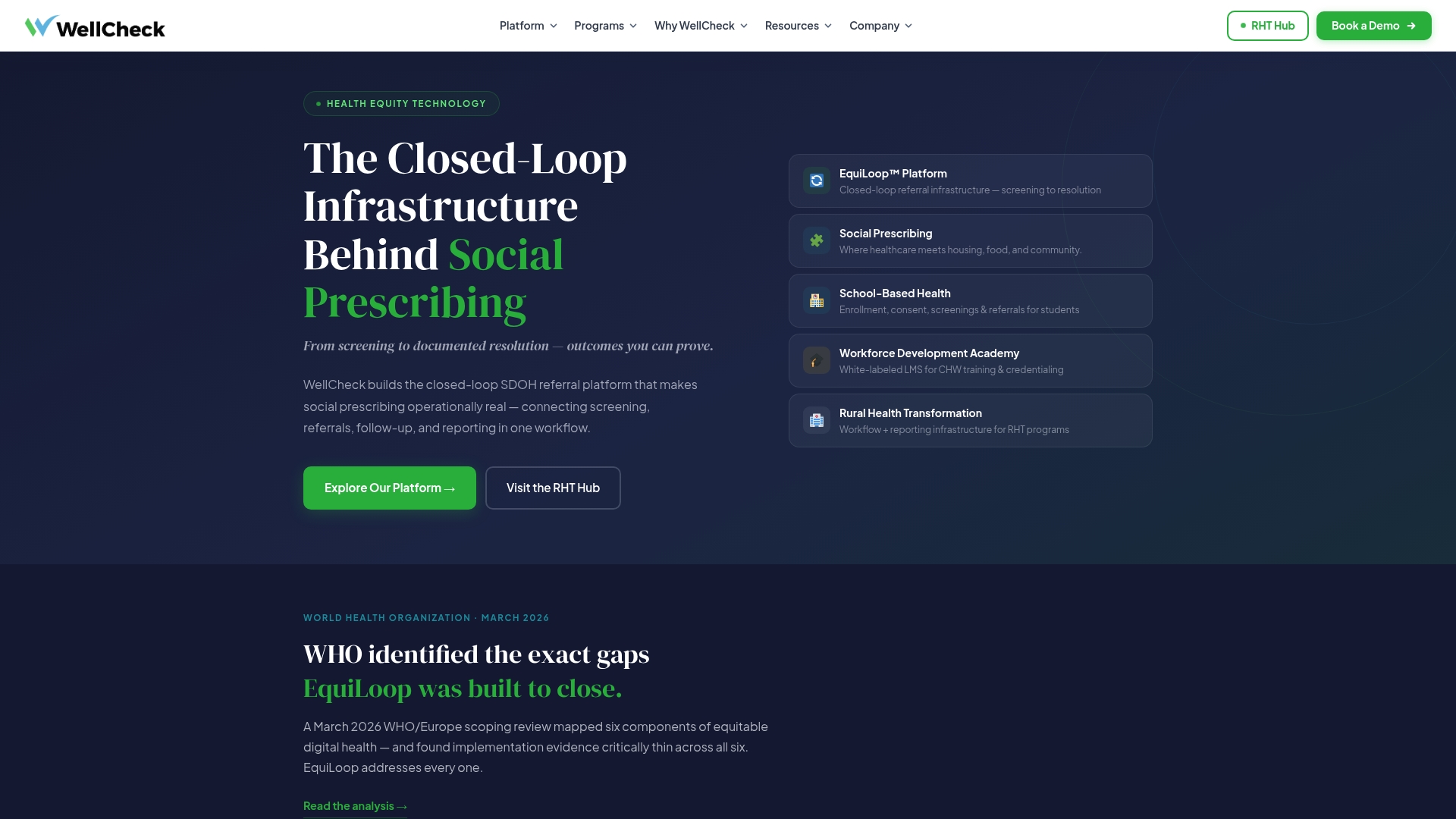
Wellcheck’s EquiLoop™ platform is built for exactly that purpose. It integrates SDoH screening, referral management, and closed-loop follow-up into one system, giving frontline teams and program administrators a complete picture of service delivery from first contact through confirmed outcome. The platform’s closed-loop referral infrastructure has achieved a 93.9% completion rate across community health programs, with over 45,000 services delivered. Funder-ready reporting is built in, not bolted on. If your organization needs a case management solution that proves impact without adding administrative burden, see how EquiLoop works for programs like yours.
FAQ
What is case management software for nonprofits?
Case management software for nonprofits is a platform that tracks the full service delivery lifecycle on a persistent client record, including intake, assessment, services, case notes, referrals, and outcomes. It differs from fundraising CRMs, which manage donor relationships rather than direct service delivery.
How long does it take to implement nonprofit case management software?
Implementation time varies significantly by platform type. Legacy platforms require 3–9 months to configure, while AI-native options deploy in days, making them a practical choice for small nonprofits without dedicated IT staff.
Is there free case management software for nonprofits?
Free tiers exist but carry significant limitations. They typically cap users and features and require manual reporting workarounds, making them unsuitable for organizations with funder outcome reporting requirements.
How do I choose the right case management software for my nonprofit?
Choose based on your outcome evidence requirements, not feature count. Identify the reports your funders require, confirm the platform generates them automatically, and verify the workflow matches how your case managers already work.
What is the difference between a case management system and a fundraising CRM?
A fundraising CRM tracks donor relationships and giving history. A case management system tracks direct service delivery and measures client outcomes. Using a CRM for case management creates data silos and leaves organizations unable to report program impact accurately.
Recommended
- From Crisis Response to Community Care: Scaling Digital Infrastructure After the Pandemic | WellCheck
- How CMS SDoH Rules Are Transforming Public Health Technology | WellCheck
- Enhancing Community Health Equity with Closed Loop Referral Systems | WellCheck
- PinPoint Safety Expands WellCheck Site and COVID Screening Tool to Help Organizations Manage Risk and Safely Return to Work | WellCheck

