
Community care resources are the local health and social support services that connect individuals to the programs they need to stay healthy, housed, and economically stable. These resources address social determinants of health (SDoH), the non-medical factors like food access, housing, and transportation that drive up to 80% of health outcomes. Programs like the Community Health Hub model and evidence-based interventions such as IMPaCT have demonstrated that well-coordinated community care resources reduce costs, improve chronic disease management, and build lasting trust in underserved populations.
1. What are the most effective community care programs?
Community Health Hubs (CHHs) represent one of the most proven models for delivering local support services. The CHH model consolidates screening, nutrition, and physical activity at familiar neighborhood sites, reducing the effort required to access multiple services. Programs led by local residents and grounded in cultural relevance build the trust needed for lasting behavior change in high-risk populations.
The IMPaCT program, developed by the Penn Center for Community Health Workers, takes a person-centered approach. It has supported nearly 25,000 people since 2013 by pairing individuals with trained community health workers who address social barriers like unstable housing and unemployment. That scale of impact shows what sustained, relationship-based care can accomplish.

Mobile health initiatives extend reach even further. Partnerships between community health programs and local nonprofits have produced results like over 20,000 COVID-19 vaccinations administered through mobile outreach. These initiatives prove that meeting people where they live, rather than expecting them to navigate complex systems, produces measurable public health gains.
Community health centers also run targeted screening campaigns with significant reach. Single initiatives have conducted over 10,000 cardiovascular screens and enrolled more than 500 individuals in health insurance programs. That combination of clinical screening and benefits enrollment in one setting reduces the fragmentation that typically discourages follow-through.
Key program types to know:
- Community Health Hubs: Consolidate multiple services at one local site, emphasizing cultural appropriateness and community leadership.
- Community health worker programs: Pair individuals with trained workers who share cultural and linguistic backgrounds.
- Mobile health units: Bring screenings, vaccinations, and referrals directly into neighborhoods.
- Federally Qualified Health Centers (FQHCs): Provide sliding-scale primary care regardless of insurance status.
- Faith-based health programs: Use trusted community institutions to deliver wellness education and referrals.
Pro Tip: When evaluating a community health program, ask whether it employs workers from the community it serves. Cultural congruence between workers and participants is a documented predictor of better outcomes.
2. How do social service directories help people find community aid?
Social service directories are searchable databases that catalog local support services by category, location, and eligibility. The best directories are co-designed with resident input and use simple keyword search so that both clinicians and residents can find relevant programs without specialized knowledge. That co-design step is what separates a useful directory from one that collects dust.
Practical usability features matter as much as content. Directories that include save, share, and print functions serve a wider range of users, including those with limited internet access who rely on printed referral sheets. A clinician who can share a resource directly from a directory during a patient visit is far more likely to complete that referral than one who has to search separately.
Organizations building or selecting a neighborhood assistance network should prioritize these directory features:
- Simple keyword search with filter options by service type, location, and eligibility
- Mobile-friendly design for access from any device
- Regular updates to remove outdated listings
- Save, share, and print functions for diverse user needs
- Integration with referral workflows so that directory searches connect directly to referral submission
The Wellcheck platform connects organizations to a closed-loop referral infrastructure that links directory search directly to referral tracking and follow-up. That integration closes the gap between finding a resource and confirming that a person actually received it.
Pro Tip: If your organization manages a resource directory, audit it quarterly. Outdated listings are one of the most common reasons referrals fail to connect.
3. What are the key challenges in connecting people to community care?
Complex navigation is the single largest barrier to community care access. Systems that require individuals to determine their own eligibility, contact multiple agencies, and restate their situation at each step actively discourage participation. The result is that the people who most need support are the least likely to receive it.
Distrust is the second major barrier, particularly in communities with historical experiences of discrimination in healthcare. Trusted community health workers who share the cultural and linguistic background of the people they serve are essential for building foundational trust. A referral from a trusted neighbor carries more weight than a pamphlet from a clinic.
Eligibility confusion compounds both problems. When intake processes ask complex screening questions before offering any help, many individuals disengage. Effective programs ask simple, conversational questions about a person’s life and current challenges rather than running through formal eligibility checklists. That approach increases program connection rates by reducing the perceived barrier to asking for help.
Strategies that overcome these barriers include:
- No-wrong-door intake: Any entry point accepts a referral and routes it to the right service, eliminating the burden of finding the “correct” door.
- Direct referral hotlines: A single phone number that connects callers to a navigator reduces friction for people without internet access.
- Personalized follow-up: Community health workers who check back after a referral confirm receipt and address any new obstacles.
- Co-location of services: Placing food assistance, behavioral health, and primary care in one familiar location reduces the number of separate trips required.
4. How to choose and use community care resources effectively
Selecting the right community wellness initiative starts with three criteria: cultural relevance, geographic accessibility, and evidence of outcomes. A program that does not reflect the language and cultural norms of the population it serves will struggle to retain participants regardless of its clinical quality.
For individuals seeking resources, the most direct path is through a community health worker or a local social service directory. Many public health departments maintain neighborhood assistance networks that can be accessed by phone or online. The key step is making first contact, because most programs are designed to guide people through the rest of the process once they reach out.
For organizations, the priority is closing the loop between referral and confirmed service delivery. A referral that goes untracked is functionally the same as no referral at all. Wellcheck’s EquiLoop™ platform reports a 93.9% closed-loop completion rate, meaning that nearly all referrals made through the system result in a confirmed service connection. That level of accountability is what funders and public health departments increasingly require.
Pro Tip: Organizations should designate one staff member as the referral coordinator for community partnerships. Distributed responsibility for follow-up is the most common reason referral loops stay open.
Evaluation criteria for organizations selecting a community care partner:
| Criterion | What to look for |
|---|---|
| Cultural relevance | Workers share language and background with the population served |
| Accessibility | Services available in person, by phone, and online |
| Outcome tracking | Program reports confirmed service delivery, not just referrals sent |
| Funder-ready reporting | Data is exportable and formatted for grant compliance |
| Community leadership | Local residents hold decision-making roles in program design |
Sustained participation matters as much as initial connection. Programs that provide ongoing social support, check-ins, and peer connections produce better adherence to health recommendations than one-time referrals. Organizations that integrate digital referral workflows into their existing clinical processes see higher follow-through rates because the referral becomes part of the standard care encounter rather than an afterthought.
Key takeaways
Effective community care resources combine cultural relevance, accessible navigation, and closed-loop accountability to produce measurable health outcomes for underserved populations.
| Point | Details |
|---|---|
| Program model matters | Community Health Hubs and CHW programs outperform fragmented referral systems. |
| Directory design drives access | Co-designed directories with simple search and share functions increase referral completion. |
| Navigation barriers are the top obstacle | No-wrong-door intake and direct hotlines reduce dropout before first contact. |
| Cultural congruence builds trust | Workers who share community backgrounds improve engagement and outcomes. |
| Closed-loop tracking is non-negotiable | Untracked referrals produce no accountability and no proof of impact for funders. |
What I’ve learned about trust and community care
After years of working at the intersection of public health technology and community health programs, the pattern I keep seeing is this: the quality of a referral network matters far less than the quality of the relationships inside it. Organizations spend significant resources building directories and intake systems, then wonder why connection rates stay low. The answer is almost always trust, not technology.
The programs that consistently outperform their peers share one characteristic. They hire from the communities they serve. A community health worker who grew up in the same neighborhood, speaks the same language, and understands the same cultural context does not have to spend the first three appointments building credibility. That credibility already exists.
What gives me confidence about the direction of this field is the shift toward closed-loop accountability. Funders are no longer satisfied with referral counts. They want confirmation that services were delivered. That pressure is forcing organizations to build the kind of infrastructure that actually tracks what happens after a referral is made. Wellcheck’s work on rural health transformation shows what that accountability looks like in practice, even in the most resource-limited settings.
The next frontier is community co-creation at the program design level, not just the service delivery level. Residents who help design the intake process, the directory, and the follow-up protocol produce programs that their neighbors actually use. That is not a soft principle. It is the most reliable predictor of sustained program engagement I have observed.
— Lance
Wellcheck’s platform for community health coordination
Organizations that want to move beyond fragmented referrals need infrastructure that tracks every step from screening to confirmed service delivery.
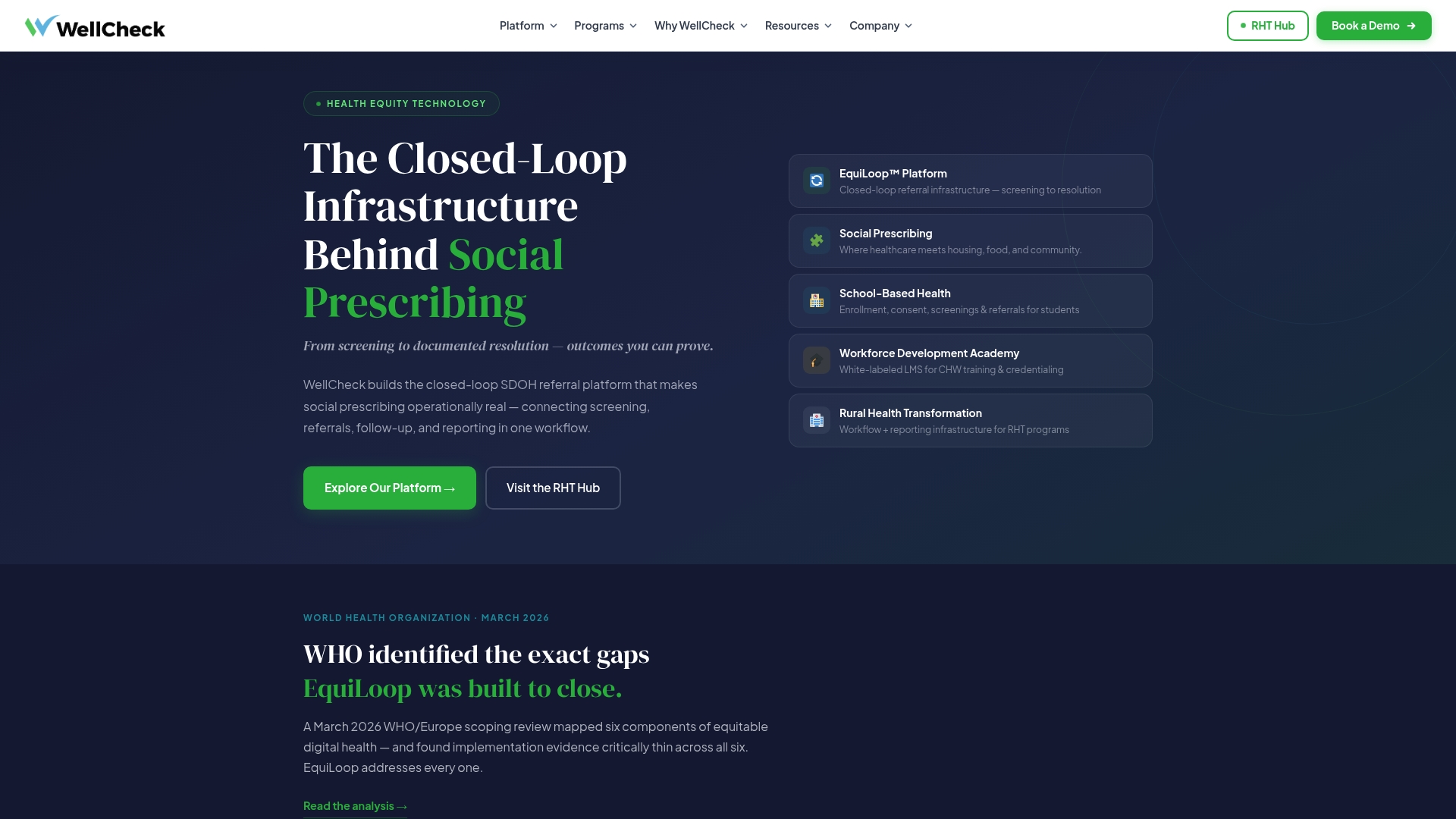
Wellcheck’s EquiLoop™ platform is built specifically for community health programs that need to prove their impact. It connects SDoH screening, referral management, and follow-up tracking in one system, with a documented 93.9% closed-loop completion rate and over 45,000 services delivered. For public health departments and community health organizations, that means funder-ready reporting and real accountability for every referral made. Learn how the EquiLoop referral workflow connects your team to the community care resources your population needs, or review the full approach to community health equity that guides the platform’s design.
FAQ
What are community care resources?
Community care resources are local health and social support services that address social determinants of health, including food access, housing, transportation, and behavioral health. They are delivered through programs like community health centers, Community Health Hubs, and community health worker partnerships.
How do I find local support services in my area?
The most direct method is contacting your local public health department or using an online social service directory filtered by zip code and service type. Many community health programs also operate referral hotlines that connect callers to a navigator without requiring prior eligibility screening.
What is a closed-loop referral system?
A closed-loop referral system tracks a referral from the moment it is made through confirmed service delivery, so that organizations know whether a person actually received help. Wellcheck’s EquiLoop™ platform achieves a 93.9% closed-loop completion rate across its community health programs.
Why are community health workers important for resources for caregivers?
Community health workers who share the cultural and linguistic background of the people they serve build trust faster and achieve better outcomes than systems that rely solely on digital referrals. The IMPaCT program, which has supported nearly 25,000 people, demonstrates the long-term impact of person-centered community health worker partnerships.
What makes a community care directory effective?
Effective directories are co-designed with resident input, use simple keyword search, and include save, share, and print functions for diverse users. Regular updates to remove outdated listings are equally critical to maintaining referral accuracy.
Recommended
- From Crisis Response to Community Care: Scaling Digital Infrastructure After the Pandemic | WellCheck
- Bridging Access and Action: The Role of Digital Referrals in Advancing Health Equity | WellCheck
- AHEC West Impact | Community Health Referrals in Action
- Enhancing Community Health Equity with Closed Loop Referral Systems | WellCheck

