
Partner network management for social determinants of health is the operating function that connects screening, referral routing, navigation, and closed-loop tracking so that a referral does not just get sent but actually resolves. The core goal is simple to state and hard to execute: every referral has a clear owner and a documented outcome. Some platforms support this work by managing screening, routing, follow-up, and reporting in one operational layer.
TL;DR:
- Referrals are most likely to succeed when the community resource inventory is regularly updated with partner capacity, hours, and closures.
- A staged implementation that includes defining needs, configuring minimal data fields, piloting with trusted partners, and ongoing monitoring prevents early failure.
- Partner engagement requires co-design, simple systems, and continuous technical support to maintain trust and response times.
- Process tracking must measure each step’s completion and timing, not just referral volume, to ensure actual outcomes like housing or food security are achieved.
- Clear governance, role-based access, and consent procedures are essential to reduce data risks when sharing referral information across organizations.
Table of Contents
- Core components: screening, referral routing, navigation, and closed-loop tracking
- How to sequence implementation: plan, pilot, train, monitor, scale
- Partner engagement and CBO capacity: onboarding, agreements, and ongoing support
- Measurement and dashboards: the process steps that show whether loops actually close
- Data governance and consent: the minimum groundwork before information moves
- Staffing and workflows: who owns the next action
- Pilot checklist and the pitfalls that repeat across programs
- Aligning partner network goals with organizational objectives
- Choosing technology platforms and tools for partner network management
- Best practices for partner communication and relationship building
- Managing risk and compliance in partner collaborations
- How EquiLoop and Workforce Development Academy support this work
- Sources
- FAQ
Core components: screening, referral routing, navigation, and closed-loop tracking
A functioning partner network moves through five identifiable stages, and each one needs a data field, not just a good intention. Screening identifies a health-related social need. A referral is made to a specific partner. The partner receives and acknowledges it. Contact happens with the person referred. The service is delivered, and the case is marked resolved or unresolved. The Accountable Health Communities Model frames this same sequence, connecting screening, referral, and navigation around common health-related social need domains such as housing, food, transportation, utilities, financial strain, and personal safety.
None of this works without an accurate Community Resource Inventory. A CRI needs current information on partner capacity, eligibility rules, intake requirements, hours, and temporary closures, because a referral routed to a partner that is closed or full just becomes a new failure point.
- Screening to resolution moves through intake, routing, acknowledgment, contact, delivery, and outcome.
- CRI attributes include capacity, eligibility, intake steps, hours, and closures, refreshed on a set schedule.
- Routing patterns vary: a clinician can select the partner directly, a hub can match based on need and capacity, or the person can choose from a short list, with a navigator or community health worker filling gaps the technology cannot close on its own.
How to sequence implementation: plan, pilot, train, monitor, scale
Programs that try to launch a full partner network all at once tend to stall on the first unexpected exception. A staged rollout surfaces problems while they are still small.
- Define the population and priority needs, then map the pathways already in use, even the informal ones staff rely on today.
- Agree partner roles and data governance before configuring anything, so routing rules match what partners can actually accept.
- Configure minimum data fields and routing logic, keeping the required fields as short as the workflow allows.
- Pilot with a small set of partners, ideally three to five, chosen for reliability rather than convenience.
- Train navigators and partner staff on the workflow, not just the software screens.
- Monitor process measures weekly, fix the bottlenecks that show up first, and only then expand to the full network.
This sequence follows the practical approach ONC’s SDOH information exchange toolkit lays out for programs building or refining referral pathways. Our own 9 step referral implementation plan walks through this same sequence in more operational detail for rural and community clinics.
Pro Tip: Pick pilot partners you already trust to answer the phone, not the partners with the flashiest intake system.
Partner engagement and CBO capacity: onboarding, agreements, and ongoing support
Community-based organizations often run on tight staffing and mixed technical capacity. A partner network that asks a small CBO to log into four different portals will lose that partner within a few months, regardless of how good the platform is.
Co-design the intake and reporting steps with each CBO before go-live, rather than handing over a finished process. Document each partner’s intake rules and capacity limits directly in the CRI, and formalize expectations with a memorandum of understanding or data-sharing agreement that spells out response times and required fields.
- Co-design first. Ask each CBO what its intake process already looks like before building routing rules around it.
- One system, not four. Avoid layering a new tool on top of a partner’s existing case management software when a simpler handoff will do.
- Support, not just reporting. Offer training and technical help alongside any reporting requirement, since ONC’s SDOH learning forum found that closed-loop tools succeed only when they match partner workflows and come with ongoing technical assistance.
Measurement and dashboards: the process steps that show whether loops actually close
Referral volume tells a funder that a program is busy. It does not tell them whether anyone got housed, fed, or connected to care, which is the question funders and payers increasingly ask.
Track each process step separately: screening completed, referral made, referral received, partner contact attempted, service delivered, and need resolved or unresolved, along with the reason when a referral stalls.
- Time-to-step matters as much as completion. A referral resolved in three days is a different outcome than one resolved in six weeks.
- Sankey-style flow charts show where referrals drop off between stages, which is harder to see in a simple count.
- Time-to-resolution distributions reveal whether delays cluster around a specific partner or a specific need type.
- A partner response table ranks partners by acknowledgment speed and completion rate, which helps target support where it is needed most.
AHRQ’s care coordination guidance emphasizes that explicit ownership after referral is what prevents a handoff from quietly failing, and process-level tracking is how a program actually sees that ownership working.
Data governance and consent: the minimum groundwork before information moves
Before any referral status crosses an organizational line, a few governance decisions have to be settled, not assumed.
- Name the data holder for each data element and set role-based access so staff see only what their role requires.
- Apply a minimum necessary standard to every field shared with a partner, especially non-covered entities that fall outside standard health privacy rules.
- Build consent workflows that distinguish clinical partners from community partners, since consent expectations differ between the two.
- Put a data-sharing agreement or MOU in place for every partner, with CBO representation included in the governance conversation, not added after the fact.
- Check state and local privacy rules, since requirements vary and a governance gap discovered mid-pilot is expensive to fix later.
Treat this as implementation work, not paperwork to finish afterward. A referral network with strong routing and weak governance still fails, just later and more visibly.
Staffing and workflows: who owns the next action
A referral without a named owner drifts. Programs that close loops reliably assign a responsible role to every operating state a referral can be in.
- Sent. The referring staff member confirms the referral left intake with complete information.
- Received. The partner acknowledges receipt within an agreed window.
- Accepted. The partner confirms eligibility and capacity to serve the person.
- Contact or appointment. A navigator or community health worker confirms the person was reached.
- Completed or unresolved. The outcome is documented, with a reason attached if the loop did not close.
Navigators and community health workers carry the bulk of this work, and they need defined caseload guidance, a monitoring cadence, and training that covers both the software and the judgment calls around it. Escalation rules should specify who steps in when a referral is rejected, when a need is urgent, or when a case needs to return to the clinical team. AHRQ’s guidance on care coordination points to defined responsibility at each state as the difference between a tracked handoff and a lost one.
Pilot checklist and the pitfalls that repeat across programs
Before scaling past a pilot, confirm five things: partner agreements are signed, the CRI is accurate and current, required data fields are agreed with each partner, staff training is complete, and a monitoring and feedback loop is running.
- Stale CRI entries are the most common cause of failed referrals, since a partner’s capacity or hours can change faster than the directory does.
- Too many disconnected systems burn out CBO staff faster than any single workflow problem.
- Unclear ownership lets referrals sit in limbo between organizations with no one accountable.
- Counting referrals sent instead of outcomes reached hides the exact problem funders are asking about.
Pro Tip: Run the pilot for at least one full billing or reporting cycle before judging it. Early weeks always look messier than the steady state.
Aligning partner network goals with organizational objectives
A partner network built without a link back to organizational goals tends to drift into activity for its own sake. Every routing decision, staffing assignment, and reporting field should trace back to what the organization is actually trying to achieve, whether that is a grant deliverable, a payer contract requirement, or a community health improvement target.
Start by naming the specific outcomes the organization is accountable for, whether that is a housing placement rate, a food security follow-up, or a chronic disease management target tied to a grant. Then check whether the partner network’s current routing and measurement actually produce evidence for those outcomes. A program measuring referral volume when its grant requires proof of resolved outcomes has a mismatch that no amount of additional referrals will fix.
This alignment work also shapes staffing and partner selection. If an organizational objective centers on maternal health outcomes, the partner network needs strong routing to prenatal and postpartum support services, not just a general social services directory. If the objective is reducing avoidable emergency department visits, the network needs tight integration with primary care and behavioral health partners specifically.
Revisit this alignment on a set schedule, not only when a grant cycle ends. Organizational priorities shift, funding requirements change, and a partner network that was well aligned two years ago can drift out of sync without anyone noticing until a report comes due. Treating partner network management as an ongoing operating function, the way CMS case studies from the Accountable Health Communities Model describe it, rather than a one-time project, is what keeps that alignment current.

Choosing technology platforms and tools for partner network management
The technology layer supporting a partner network needs to do a few specific jobs well: intake and screening, referral routing, status tracking, and reporting. It does not need to replace every system a program already runs.
Interoperability standards matter here as implementation aids, not as a substitute for agreed workflows. ONC’s guidance on referrals between clinicians and community-based organizations describes FHIR-based approaches and the 360X specification as ways to structure referral data exchange, supporting routing patterns where a clinician selects the partner directly, a hub matches based on capacity, or the person referred chooses among options.

Rural programs should plan for uneven technical capacity across partners from the start. Some CBOs will have modern case management systems; others will run on spreadsheets and phone calls. A workable technology plan includes fallback options such as manual intake forms, phone confirmation scripts, or central hub routing for partners who cannot receive electronic referrals directly. Our guide to closed-loop referral systems walks through how screening, acceptance, delivery, and follow-up communication fit together operationally, independent of which specific software a program uses.
Best practices for partner communication and relationship building
Technology moves data. Relationships move referrals. A partner who trusts that a referral will be handled well is more likely to accept the next one quickly, and a partner who has been burned by incomplete information or no follow-up will start slow-walking responses.
Set a communication cadence with each partner that goes beyond the transactional referral message. A short monthly or quarterly check-in, even informal, catches capacity changes and workflow friction before they show up as a spike in unresolved referrals. Share back the data partners care about, specifically their own response times and completion rates, rather than only asking them to report upward.
Be explicit about what each partner can expect from the network and what the network expects from them. Ambiguity about response windows, required fields, or escalation paths creates friction that looks like a technology problem but is actually a communication gap. Document these expectations once, in the partner agreement, and revisit them when either side’s capacity changes.
When a referral fails or a partner drops out of the network temporarily, treat that as routine maintenance rather than a crisis. Partner networks in rural and community settings deal with staff turnover, funding gaps, and seasonal capacity shifts constantly. A network built to absorb that turnover without losing referrals in the process is more durable than one that assumes stability.
Managing risk and compliance in partner collaborations
Every partner relationship carries some compliance exposure, and the risk profile differs depending on whether the partner is a covered entity under health privacy rules or a community organization that is not.
The clearest risk is data exposure beyond what a role or agreement permits. Role-based access and a minimum necessary standard, applied consistently, reduce this risk more than any single technology feature. The second common risk is an informal handshake agreement standing in for a documented data-sharing agreement or MOU, which leaves both sides exposed if a dispute arises over what was actually agreed.
Consent handling deserves particular attention when referrals move between clinical and non-clinical partners, since expectations and legal requirements differ between the two categories, and state or local rules can add further variation on top of federal baselines. Programs operating across county or state lines should confirm which rules apply to each partner relationship rather than assuming one standard covers the whole network.
Build a review cadence for partner agreements, not just an initial signing. A partner’s staff, systems, or capacity can change enough over a year or two that the original agreement no longer reflects reality. Treating governance and compliance as an ongoing part of partner network management, rather than a box checked once during onboarding, is what keeps the network usable when a funder or auditor asks how referral data is protected.
How EquiLoop and Workforce Development Academy support this work
EquiLoop manages the full referral workflow described above: SDoH screening and intake, referral routing to clinical and community partners, follow-up and status tracking, outcomes dashboards, and funder-ready reporting. It is set up around the partner network, referral pathways, and reporting requirements a program already has, and it is built to complement existing systems of record rather than replace them.
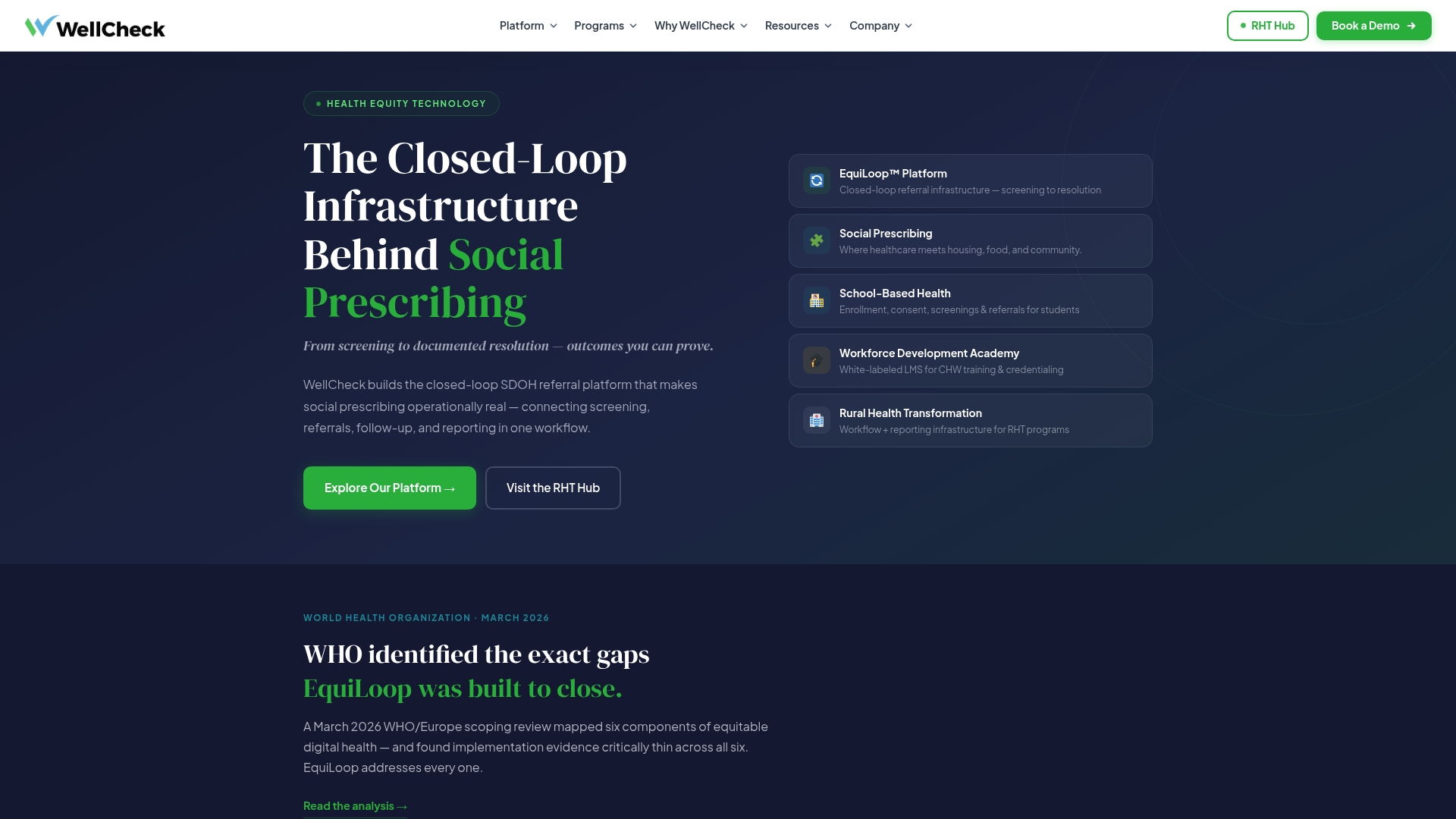
- EquiLoop handles screening, routing, status tracking, and reporting in one workflow.
- Workforce Development Academy provides white-labeled training and credentialing for community health workers and navigators.
- WellCheck stays engaged for the life of the deployment, not just through initial setup.
If your program is standing up or repairing a partner network and wants to see how closed-loop tracking and CHW training fit into what you already run, book a 30-minute demo or review the EquiLoop platform and Workforce Development Academy directly.
Sources
For technical and contractual planning, start with CMS’s Accountable Health Communities materials, ONC’s interoperability and 360X guidance, AHRQ’s care coordination playbook, and the ONC SDOH learning forum summary.
- Screening, Referral, and Community Alignment to Address HRSNs: Early Lessons from the Accountable Health Communities Model
- Referrals between clinicians and community-based organizations and other extra-clinical services (ONC ISP)
FAQ
What is partner network management in a health referral context?
It is the operating function that connects screening, referral routing, navigation, and closed-loop tracking so referrals reach a documented outcome rather than disappearing after they are sent. The Accountable Health Communities Model frames this same connected workflow around common social need domains like housing and food security.
How is closed-loop referral tracking different from simply counting referrals?
Closed-loop tracking follows a referral through specific states, sent, received, accepted, contact made, and resolved or unresolved, while a simple count only shows how many referrals went out. AHRQ’s care coordination guidance ties closed-loop coordination to explicit ownership at each of those states.
What should a partner network pilot include before scaling?
A ready pilot has signed partner agreements, an accurate Community Resource Inventory, agreed data fields, completed staff training, and an active monitoring and feedback loop. ONC’s implementation toolkit recommends this sequence before expanding beyond an initial set of partners.
Do FHIR and 360X replace the need for partner agreements and governance?
No. Interoperability standards like FHIR and the 360X specification structure how referral data moves between systems, but they do not resolve consent, workflow fit, or governance questions on their own. ONC’s referral guidance notes that 360X is an emerging specification and works alongside, not instead of, agreed workflows and consent processes.
Why do community-based organizations struggle to adopt closed-loop referral tools?
Adoption tends to fail when a tool does not fit how a CBO already works or when no training and technical support come with it. The ONC SDOH learning forum found that ongoing technical assistance is often the deciding factor between adoption and abandonment.

