
Program evaluation in community health is the systematic process of determining whether a program’s activities produced the outcomes it set out to achieve. The most reliable way to organize that work is the CDC’s six-step framework, paired with its three cross-cutting actions. Pick an evaluation design that matches your actual question, not the most rigorous one available, and start measurement the day the program launches, not the day the funder asks for a report.
TL;DR:
- Evaluation design should match the specific claim being made and focus on practicality and usefulness over ideal causal inference.
- Building a simple, standardized logic model and data collection system before program launch ensures credible, measurable results.
- Engaging stakeholders early and disaggregating data by race, language, and geography enhances the evaluation’s relevance and equity focus.
- Conducting an evaluability assessment helps determine if a program’s goals and data systems are ready for meaningful evaluation.
- Using dedicated tools like EquiLoop can improve referral follow-up and outcome tracking, preventing data gaps in community health programs.
Table of Contents
- What Are the Six Steps of the CDC Program Evaluation Framework?
- How Do You Choose an Evaluation Design and Type?
- What Belongs in a Logic Model and Which Indicators Matter?
- How Should Programs Engage Stakeholders and Advance Equity?
- When Should You Run an Evaluability Assessment?
- How Do You Avoid Data Gaps Before They Happen?
- How WellCheck Supports Program Evaluation in Community Health
- Sources
What Are the Six Steps of the CDC Program Evaluation Framework?
The 2024 CDC Program Evaluation Framework organizes evaluation into six steps that move in sequence but loop back as findings emerge. Each step produces a specific deliverable, which keeps evaluation from becoming an abstract exercise disconnected from program operations.
- Assess context. Understand the setting, resources, and political environment before designing anything. Output: a context summary that shapes every later choice.
- Describe the program. Build a logic model that lays out inputs, activities, outputs, and outcomes. Output: the logic model itself.
- Focus the evaluation questions and design. Decide what you actually need to know and how rigorously you need to know it. Output: a short list of prioritized evaluation questions and a chosen design.
- Gather credible evidence. Collect data that stakeholders will trust and that answers the questions you picked. Output: a data collection plan and instruments.
- Generate and support conclusions. Analyze the data and check conclusions against multiple data sources where possible. Output: a findings brief.
- Act on findings. Turn conclusions into program changes, funder reports, or policy recommendations. Output: an action plan with owners and deadlines.
Three cross-cutting actions run through all six steps: engage collaboratively, advance equity, and learn from and use insights. The framework also names five Federal evaluation standards, covering utility, feasibility, propriety, accuracy, and evaluation accountability, which give evaluators a shared bar for quality regardless of program size.
How Do You Choose an Evaluation Design and Type?
Design choice depends on what claim you need to make, not on what sounds most scientific. RHIhub’s evaluation planning guidance breaks designs into three categories, each suited to different circumstances.
- Experimental designs randomly assign participants to treatment and control groups. They produce the strongest causal claims but are rarely realistic for whole-community interventions where you cannot randomize who receives outreach.
- Quasi-experimental designs use a comparison group without randomization, such as a similar county that didn’t receive the program. They’re more feasible in community settings and still support reasonably strong claims.
- Non-experimental designs track a single group over time with no comparison group. They’re the most common choice for resource-constrained programs but the weakest at ruling out other explanations for change.
Layered on top of design type is evaluation purpose. Process evaluation asks whether the program was implemented as planned. Outcome evaluation asks whether it achieved its intended short and medium-term effects. Impact evaluation asks whether it changed longer-term population health. Performance monitoring is different from all three: it’s an ongoing comparison of baseline data against milestones, letting you adjust in real time rather than waiting for a summative verdict, as RHIhub notes. In practice, prioritize feasibility and utility over ideal causal attribution when the alternative is no evaluation at all. A well-run process evaluation you can actually complete beats an impact study you can’t afford to finish.
What Belongs in a Logic Model and Which Indicators Matter?
A logic model does not need to be elaborate to be useful. Build it around four columns: inputs (staff, funding, partnerships), activities (screenings, referrals, trainings), outputs (number screened, referrals sent), and outcomes (referrals completed, conditions improved). Add a short narrative explaining the assumed causal chain connecting them, since that narrative is what you’ll test.
- List your outputs first. These are countable products of activity, like screenings completed or referrals routed to a partner agency.
- Separate outputs from outcomes explicitly. An output is a referral sent; an outcome is a referral resolved, a client housed, or a blood pressure controlled. Confusing the two is the single most common error in community health reporting.
- Set baselines before you launch. Without a baseline, you can’t tell whether a change is real or coincidental.
- Decide measurement frequency by indicator type. Process indicators can be checked monthly; distal health outcomes may need annual measurement.
- Identify your data sources early. Common sources include intake forms, referral platforms, electronic health records, and partner-reported data. Standardizing intake fields and defining a minimum data set upfront, rather than retrofitting later, is what separates programs that can report follow-through from those that can only report volume. Simple dashboards built on this standardized data make credible evidence easier to produce on a routine basis, as described in WellCheck’s guide to community health records.
How Should Programs Engage Stakeholders and Advance Equity?
Engaging collaboratively means bringing in program participants, community leaders, funders, and frontline implementers when you’re still drafting evaluation questions, not after the design is locked. Participants often flag outcomes that matter to them, like transportation barriers, that a funder-driven framework would miss entirely.
Advancing equity is not a separate add-on step. It’s a lens applied to the same six steps: it asks not just what worked but for whom, and who was left out. That framing, drawn from the CDC framework’s explicit equity focus, changes concrete choices.
- Disaggregate data by race, language, geography, and insurance status wherever sample size allows.
- Recruit evaluation advisory input from the populations the program actually serves, not just program staff.
- Use culturally valid measures instead of translating an English-language instrument and assuming equivalence.
- Document informed consent and data governance decisions before collection starts, and be explicit in reports about what the evaluation can’t tell you.
Pro Tip: Write your evaluation’s limitations section before you write the findings. Naming what the data cannot support keeps a report credible instead of overclaiming to please a funder.
Closed-loop referral workflows that route both clinical and social services referrals can make this equity lens operational rather than aspirational, since disaggregation depends on complete records in the first place, as outlined in WellCheck’s piece on equity-focused referral systems.

When Should You Run an Evaluability Assessment?
An evaluability assessment is a short, upfront check on whether a program is ready to be evaluated at all, before you commit resources to a full study. It typically asks whether program goals are clearly defined, whether data systems can produce the needed indicators, and whether stakeholders agree on what success looks like.
- Confirm the logic model is specific enough to generate testable questions.
- Check whether existing data systems already capture your planned indicators, or whether new intake fields are needed.
- Verify stakeholder agreement on priority outcomes before finalizing design.
Timelines vary sharply by evaluation type. Process evaluations can often be completed within a single grant cycle. Outcome evaluations typically need months of follow-up data once the program is fully operational. Impact evaluations, especially any using comparison communities, often run multiple years, consistent with the multi-year, propensity-weighted design used in one national community health evaluation.
Budget for data collection staff time, analysis (internal or contracted), stakeholder engagement meetings, and dissemination materials. Programs frequently underfund the last two categories, then wonder why findings never reach the people who could act on them.
How Do You Avoid Data Gaps Before They Happen?
Data gaps in community health evaluation almost always trace back to the same root cause: measurement was designed after the program launched instead of before it. By the time someone asks “how many referrals were actually completed,” the records needed to answer that question were never structured to capture it.
- Build your minimum data set into intake, not into a later retrofit. Decide at program design what fields every client record must include.
- Add status fields to every referral, not just a sent/not-sent flag. Track sent, accepted, scheduled, completed, and resolved, so you can report follow-through instead of only volume.
- **Train staff on data fidelity as a workforce competency, not as an afterthought bolted onto orientation. A white-labeled training platform like the Workforce Development Academy can standardize how community health workers document referral status across a multi-site program.
Experts who study whole-community interventions recommend exactly this kind of standardized, longitudinal measurement system because randomized trials are rarely feasible at that scale. One rural health hub deployment using this kind of closed-loop tracking recorded several key performance metrics and referral completion rates.[^1] Tracking individual referrals through resolution, rather than just counting activity, provides more accurate completion data than a pre-post design without comparison groups typically can produce.
[^1]: Rural health hub deployment with a multi-partner ecosystem. Includes both clinical and social services referrals.
How WellCheck Supports Program Evaluation in Community Health
Every step above depends on one thing: data that’s structured to answer the question before someone asks it. That’s the operational gap most program evaluations run into, and it’s the specific problem EquiLoop was built to close.
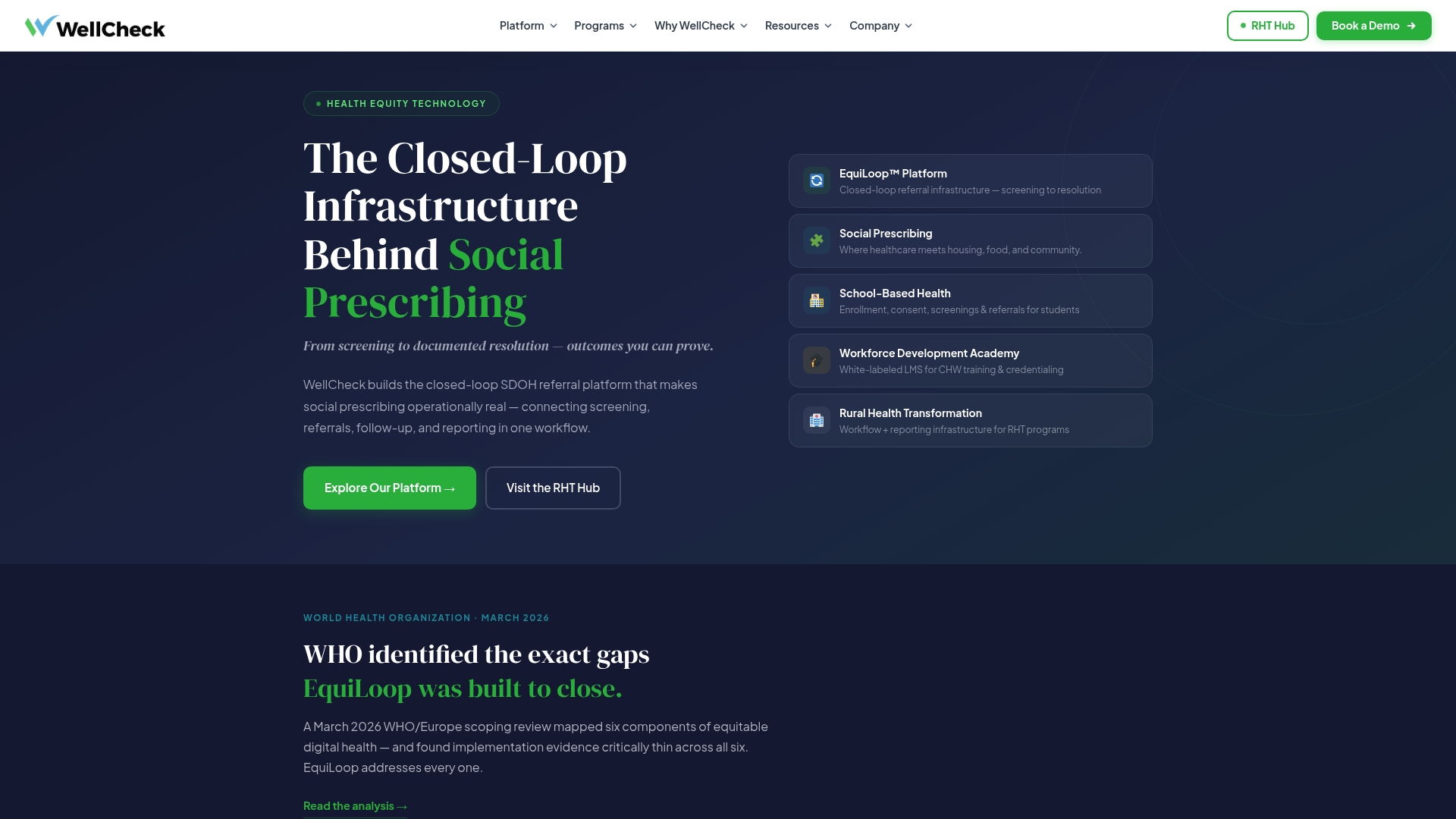
EquiLoop manages the referral workflow end to end, from SDoH screening and intake through referral routing, follow-up status tracking, and outcomes dashboards, so program directors can report completion instead of only referrals sent. It’s built to sit alongside the systems of record you already use, not replace them, which matters when a funder wants documentation that a screening actually led to a resolved referral. You can see how the closed-loop referral workflow works in practice, or review a program leader’s implementation guide for planning the operational side.
For programs building or standardizing a community health workforce, the Workforce Development Academy offers white-labeled training and credentialing so referral documentation and follow-up practices stay consistent across staff and sites. If your program is heading into an evaluation cycle and you want to see how closed-loop tracking would fit your referral pathways, book a 30-minute demo and walk through your specific data gaps directly.
Sources
- CDC Program Evaluation Framework
- Evaluation Planning for Community Health Programs | RHIhub
- Evaluating community-based health improvement programs

