
Social determinants of health screening tools are standardized instruments that identify unmet social needs, such as food insecurity, housing instability, and transportation barriers, that directly shape patient health outcomes. Social determinants account for 30–55% of health outcomes, making systematic screening a clinical priority, not an optional add-on. Public health teams across the United States now rely on validated SDOH screening tools to move from identifying need to delivering measurable community impact. Wellcheck’s EquiLoop™ platform, which has delivered over 45,000 services, demonstrates what is possible when screening connects directly to closed-loop referral infrastructure.
1. What are the key criteria for selecting effective social determinants of health screening tools?
Choosing the right SDOH screening tool requires more than picking the most widely recognized name. The tool must perform reliably in your specific clinical or community setting.
Clinical validation and sensitivity are non-negotiable starting points. New digital screeners with just 3 questions can detect social needs with 80% sensitivity in under one minute. High sensitivity means fewer missed cases, which matters most for marginalized populations with compounding needs.

Brevity reduces patient burden. Average screening tool length ranges from 3 to 25 questions, and shorter validated tools consistently outperform longer ones in clinical settings for completion rates and data quality. A tool that patients abandon halfway through produces worse data than a shorter tool completed fully.
Alignment with CMS core domains is the compliance baseline for most U.S. health organizations. Over 20 distinct SDOH screening tools exist in the United States, but only tools covering food insecurity, housing instability, transportation, utility needs, and interpersonal safety satisfy CMS requirements. Covering all five domains positions your organization for reimbursement and regulatory alignment.
Actionability separates useful tools from data collection exercises. Screening without actionable referral pathways risks damaging patient trust and creating ethical dilemmas. Every question on your SDOH questionnaire should connect to a resource your team can actually offer.
Digital and asynchronous administration expands reach. Asynchronous digital screening via SMS, app, or email reduces stigma and improves comfort, particularly among marginalized groups who may feel less comfortable disclosing needs face-to-face.
- Clinical validation with documented sensitivity rates
- Brevity (3–15 questions for most clinical settings)
- Coverage of all five CMS core SDOH domains
- Direct linkage to referral pathways and community resources
- Support for digital or asynchronous administration modes
Pro Tip: Before adopting any SDOH screening tool, map your existing community resource network first. A tool is only as useful as the referrals it can generate.
2. Top SDOH screening tools used in clinical and community settings
No single tool fits every organization. The right social needs screening tool depends on your patient population, setting, and available resources.
Maven’s 3-question digital screener
Maven’s clinically validated screener uses just three questions to detect social needs with 80% sensitivity in under one minute. It is designed for digital administration and integrates well with asynchronous workflows. This tool suits high-volume clinical settings where staff time is limited and patient throughput is high.
PRAPARE (Protocol for Responding to and Assessing Patients’ Assets, Risks, and Experiences)
PRAPARE covers 21 items across multiple social domains, including personal characteristics, money and resources, social and emotional health, and optional additional questions. It is widely used in Federally Qualified Health Centers (FQHCs) and is available as a validated SDOH assessment instrument with EHR-compatible versions. PRAPARE suits organizations that need comprehensive data for population health reporting.
HRSN (Health-Related Social Needs) Screening Tool
The HRSN tool, developed for CMS Accountable Health Communities, covers five core domains aligned directly with CMS screening mandates. It uses 10 core questions and is designed for clinical settings serving Medicare and Medicaid populations. Its direct alignment with CMS requirements makes it a strong choice for organizations pursuing G0136 reimbursement.
AAFP EveryONE Project Tool
The American Academy of Family Physicians developed this tool specifically for primary care settings. It covers food insecurity, housing, transportation, utilities, and safety in a brief format. The EveryONE Project tool integrates with the AAFP’s broader health equity framework and is freely available for download as a social determinants of health screening tool PDF.
WellCheck EquiLoop™ Screening Framework
Wellcheck’s EquiLoop™ platform supports digital SDOH screening connected directly to a closed-loop referral system. It achieves a 93.9% closed-loop completion rate, meaning nearly all referrals generated from screening reach resolution. This distinguishes it from tools that collect data without tracking what happens next.
| Feature | Brief validated tools (3–10 questions) | Comprehensive tools (15–25 questions) |
|---|---|---|
| Completion rate | High | Moderate |
| Domain coverage | Core CMS domains | Broad, including optional domains |
| Administration time | Under 5 minutes | 10–20 minutes |
| Best setting | High-volume clinical | FQHC, research, population health |
| EHR integration | Varies | Varies |
| Referral linkage | Depends on platform | Depends on platform |
Pro Tip: Download the social determinants of health questionnaire PDF versions of PRAPARE and HRSN to pilot test with your team before committing to a digital platform. Paper pilots reveal workflow gaps that software demos miss.
3. How to implement SDOH screening tools effectively in health organizations
Effective implementation requires more than selecting a validated tool. The operational structure around the tool determines whether screening produces real outcomes or just data.
1. Define roles before launch. Assigning clear roles to specific staff members, such as nurses, medical assistants, or community health workers, for administering and acting on screening results is the foundation of sustainable screening. Without role clarity, screening data sits unused.
2. Integrate with your EHR from day one. Lack of EHR integration causes screening data to remain siloed, which undermines population health analysis and care coordination. EHR integration is the standard for sustainable SDOH data management.
3. Reduce stigma through digital administration. Offering the SDOH survey via tablet, patient portal, or SMS before the clinical encounter reduces the discomfort of disclosing sensitive information to a provider directly. Over half of surveyed participants were comfortable sharing social needs even when immediate assistance was unavailable, provided the engagement felt respectful.
4. Build referral pathways before screening begins. Screening without a referral network is an ethical problem, not just an operational one. Map local food banks, housing programs, and transportation services before your first screening encounter.
5. Establish follow-up protocols. Closing the loop means confirming that a referred patient received the service. Wellcheck’s EquiLoop™ platform automates this process, tracking referral status through to completion. Teams using closed-loop referral systems demonstrate measurable equity outcomes that funders and regulators recognize.
6. Bill appropriately using CMS code G0136. CMS payment code G0136 covers administration of standardized SDOH risk assessments lasting 5–15 minutes, billable up to twice per year per patient. This reimbursement pathway makes screening financially sustainable for most health organizations.
7. Customize to your community. No single tool fits all populations. Adapting validated frameworks to reflect local resources and patient demographics improves both response rates and referral success. A rural health center serving agricultural workers needs different resource linkages than an urban safety-net clinic.
Pro Tip: Schedule a quarterly review of your screening data against referral completion rates. If your referral completion rate drops below 80%, the bottleneck is almost always in follow-up, not in the screening tool itself.
4. What challenges and solutions exist for SDOH screening implementation?
Every organization encounters barriers when scaling SDOH screening. Recognizing them early reduces the risk of program failure.
Patient reluctance and confidentiality concerns are the most common barriers. Patients worry that disclosing housing instability or food insecurity could affect their care or insurance. Addressing this directly, by explaining how data is used and who sees it, before screening begins, builds the trust needed for honest responses.
Data entry burden slows adoption among frontline staff. When screening adds 10 minutes to an already full clinical encounter, staff find workarounds that compromise data quality. Digital and asynchronous SDOH survey formats solve this by shifting data entry to the patient before the encounter.
Screening without support is the most serious risk. Identifying a need and offering nothing in response damages the patient-provider relationship more than not screening at all. This is why actionability is essential to effective screening implementation.
Tool length and comprehensiveness create a genuine tension. More questions generate richer data, but balancing comprehensiveness with brevity is vital to maintain response rates and data quality. The practical answer is to start with a brief validated tool and add supplemental questions only when your referral network can respond to the additional domains.
Screening that identifies a need but cannot address it creates a burden on the patient without delivering benefit. The ethical standard for SDOH screening is that every question asked must connect to a resource the organization can offer or facilitate.
Addressing these challenges requires ongoing evaluation. Review your SDOH form completion rates, referral rates, and closed-loop outcomes monthly. Adjust the tool, the workflow, or the resource network based on what the data shows. The ethics of holistic practice in health settings reinforces this point: screening carries an obligation to act, not just to document.
Key takeaways
Effective SDOH screening tools balance clinical validation, brevity, and direct linkage to referral pathways to produce measurable community health outcomes.
| Point | Details |
|---|---|
| Prioritize validated, brief tools | Tools with 3–15 questions and documented sensitivity rates outperform longer instruments in clinical settings. |
| Cover all five CMS core domains | Food insecurity, housing, transportation, utilities, and safety are the compliance baseline for U.S. health organizations. |
| Build referral pathways first | Screening without an established resource network creates ethical risk and damages patient trust. |
| Integrate with EHR systems | EHR integration prevents data silos and enables population health analysis across screening cycles. |
| Close the loop on every referral | Tracking referrals through to completion, as Wellcheck’s EquiLoop™ does at a 93.9% rate, is the standard for accountable screening programs. |
Why I think most organizations are screening for the wrong reasons
Public health teams often adopt SDOH screening tools because a funder or regulator requires it. That is the wrong starting point. The organizations I have seen produce real outcomes start with a different question: “What can we actually do for someone who screens positive?”
The answer to that question should drive tool selection, not the other way around. A 25-question SDOH questionnaire generates impressive-looking data. But if your team cannot act on 20 of those questions, you have collected data at the patient’s expense without delivering value. Customizing validated tools to match your actual resource network is not a compromise. It is the correct approach.
Digital screening has changed what is possible. Asynchronous administration via SMS or patient portal removes the awkwardness of disclosing sensitive needs to a provider face-to-face. That shift alone improves data quality. But digital tools only matter if the referral infrastructure behind them is functional. I have seen organizations invest in sophisticated screening platforms while their referral follow-up process was still a sticky note on a desk.
The metric that matters is not how many patients you screen. It is how many referrals reach resolution. Wellcheck’s EquiLoop™ platform tracks this at scale. That is the standard every screening program should hold itself to. Equity is not built by collecting data. It is built by closing the loop.
— Lance
Wellcheck’s approach to SDOH screening and referral management
Public health organizations that screen for social needs without a referral management system are leaving outcomes on the table. Wellcheck connects digital SDOH screening directly to a closed-loop referral infrastructure that tracks every referral through to completion.
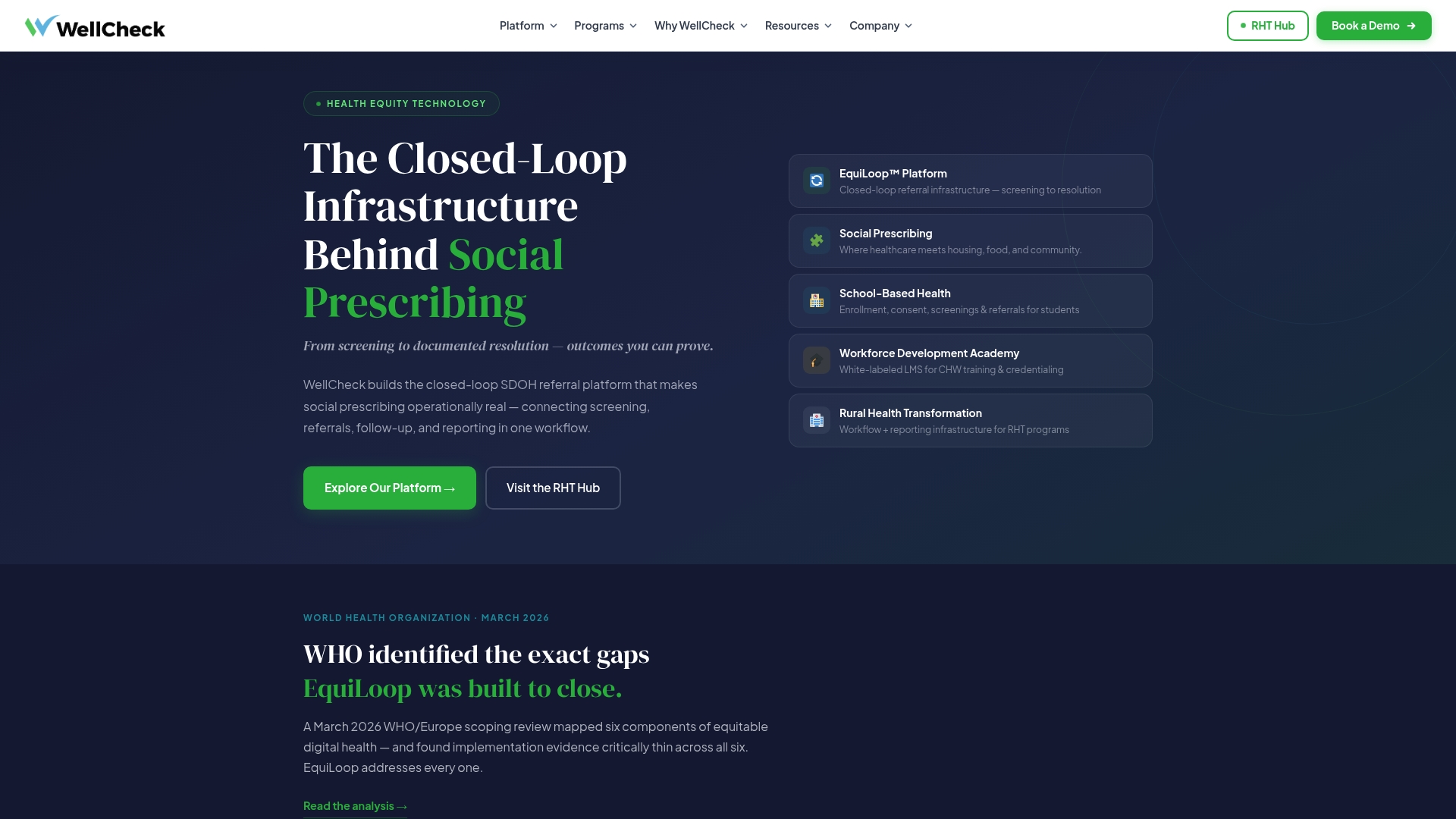
Wellcheck’s EquiLoop™ platform has delivered over 45,000 services and maintains a 93.9% closed-loop completion rate across community health programs. The platform supports community health equity by generating funder-ready reporting and real-time outcome data. For organizations building or scaling an SDOH screening program, Wellcheck provides the infrastructure to prove impact, not just measure need. Learn how EquiLoop™ works and what it can deliver for your program.
FAQ
What are social determinants of health screening tools?
Social determinants of health screening tools are validated questionnaires that identify unmet social needs, such as food insecurity, housing instability, and transportation barriers, that affect patient health outcomes. They range from brief 3-question digital screeners to comprehensive 25-question instruments like PRAPARE.
Which SDOH domains does CMS require screening tools to cover?
CMS requires SDOH screening tools to address five core domains: food insecurity, housing instability, transportation needs, utility assistance, and interpersonal safety. Tools covering all five domains qualify for reimbursement under CMS payment code G0136.
How often can organizations bill for SDOH screening?
CMS payment code G0136 covers standardized SDOH risk assessments lasting 5–15 minutes and is billable up to twice per year per patient, providing a reimbursement pathway that supports sustainable screening programs.
What is the biggest risk of implementing SDOH screening without preparation?
Screening without established referral pathways damages patient trust and creates ethical problems. Identifying a social need and offering no response is more harmful than not screening at all, which is why referral infrastructure must be in place before screening begins.
How does digital SDOH screening improve data quality?
Digital and asynchronous screening reduces stigma by allowing patients to disclose sensitive needs privately via SMS, app, or patient portal. This approach improves comfort and honesty, particularly among marginalized populations, which directly improves the accuracy of screening data.

