
Social drivers of health are the nonmedical conditions shaped by social, economic, and political policies that determine health outcomes across populations. The term itself carries important weight. Unlike “determinants,” which implies fixed outcomes, “social drivers” signals that these conditions are modifiable and that policy and community action can change them. For public health professionals and community leaders, that distinction is not semantic. It is the foundation of every equity-focused program worth building. Healthy People 2030 organizes these factors into five core domains, giving practitioners a shared framework for screening, intervention, and accountability.
What are the social drivers of health?
Social drivers of health/01%3A_What_is_Public_Health/1.07%3A_Social_Determinants_of_Health) are the conditions in which people are born, grow, live, work, and age. These conditions include income, housing quality, access to education, neighborhood safety, and social connectedness. They are shaped by the distribution of money, power, and resources at local, national, and global levels. The standard industry term is “social determinants of health” (SDoH), but the shift toward “social drivers” reflects a growing consensus that these factors are changeable, not fixed.
Healthy People 2030/01%3A_What_is_Public_Health/1.07%3A_Social_Determinants_of_Health) classifies these factors into five core domains. Each domain captures a distinct set of conditions that affect health at the population level.

| Domain | Representative examples |
|---|---|
| Economic Stability | Income, employment, job security, poverty status |
| Education Access and Quality | Literacy, early childhood education, high school graduation |
| Health Care Access and Quality | Insurance coverage, proximity to providers, care quality |
| Neighborhood and Built Environment | Housing, air quality, access to healthy food, transportation |
| Social and Community Context | Social isolation, civic participation, discrimination, incarceration |
These domains do not operate in isolation. A person living in a low-income zip code may simultaneously face poor housing, limited transportation to a clinic, and social isolation. Each factor compounds the others, producing health outcomes that no single clinical intervention can fully address.
Pro Tip: Political and environmental policies shape all five domains. When designing a program, map which upstream policies affect your target population’s domain-level conditions. That mapping will reveal where advocacy can produce the most durable change.
How do social drivers impact health equity and population outcomes?
Social drivers create or reduce health inequalities by determining who has access to the resources needed to stay healthy. Health equity is not the same as health equality. Equality provides the same resources/01%3A_What_is_Public_Health/1.07%3A_Social_Determinants_of_Health) to everyone, which is often ineffective. Equity allocates resources based on need, recognizing that people start from different positions shaped by history and structure.
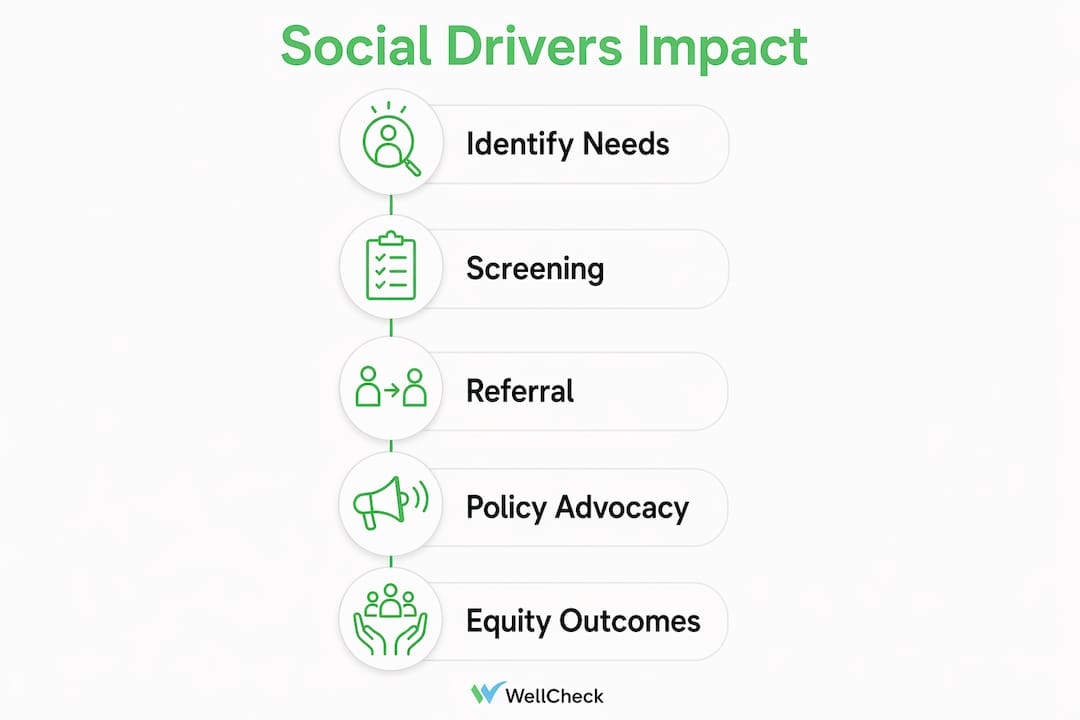
The data on older adults illustrates this clearly. Approximately 1 in 4 community-dwelling older adults in the U.S. experience social isolation, significantly increasing their risk of chronic diseases. Social isolation is not a personal failing. It is a predictable outcome of policies and built environments that leave aging populations without transportation, community programs, or nearby family networks.
Financial barriers compound the problem. Adults 65 and older incurred nearly $6,000 in average out-of-pocket health care costs in 2020. That figure represents a structural barrier, not an individual spending choice, and it directly limits access to care for a population already managing chronic conditions.
Political, economic, and environmental policies have a larger systemic impact on health outcomes than healthcare access alone. Experts consistently rank policy-level factors above clinical care when assessing what drives population health. This finding challenges the common assumption that expanding insurance coverage is sufficient to close health gaps.
The distinction between systemic and individual-level influences matters for program design. Systemic factors include:
- Zoning laws that concentrate poverty in specific neighborhoods
- Wage policies that keep working families below the poverty line
- Discriminatory lending practices that limit homeownership and wealth-building
- Underfunded public schools in low-income districts
- Criminal justice policies that disrupt family and community stability
Individual-level factors include food choices, physical activity, and adherence to medical treatment. These matter, but without addressing political economy and policy-level factors, efforts targeting individual social needs alone struggle to achieve sustained improvements in health outcomes.
Pro Tip: When presenting program data to funders or policymakers, distinguish between individual-level outcomes and population-level change. Conflating the two obscures what your program can realistically achieve and what requires policy reform.
What challenges do public health professionals face in screening social drivers?
Screening for social drivers is operationally demanding. The clinical encounter is already compressed, and adding SDoH screening tools to an electronic health record workflow creates real data burden. Screening for SDoH leads to clinician burnout when referral pathways are unclear or when identified needs cannot be connected to actual resources. Identification without follow-through is not just ineffective. It erodes trust with the communities you serve.
The core implementation obstacles are:
- Workflow integration. Screening tools must fit within existing clinical or community workflows. Tools that require separate logins, manual data entry, or duplicate documentation get abandoned quickly.
- Referral pathway clarity. Frontline staff need a clear, current map of community resources. Without it, a positive screen for food insecurity produces a referral to a food bank that has a six-week waitlist or has closed.
- Closed-loop follow-up. Knowing that a referral was made is not the same as knowing it was completed. Programs without follow-up coordination cannot demonstrate impact to funders or adjust services based on outcomes.
- Funder expectations. Many funders are accustomed to equality-based metrics, such as number of screenings completed, rather than equity-based outcomes, such as whether the right resources reached the right people. Navigating those expectations requires clear reporting frameworks.
- Data privacy and consent. Collecting sensitive social needs data requires clear consent processes and secure data management, which adds compliance burden to already stretched teams.
Closed-loop referral systems address several of these obstacles by connecting screening directly to referral management and follow-up tracking in a single workflow. When a community health worker screens a client for housing instability, the referral, the resource connection, and the outcome confirmation all live in the same system. That architecture reduces data burden and produces the outcome documentation that funders require.
What strategies can community leaders use to address social drivers effectively?
Effective strategies combine individual-level screening with systemic policy advocacy. Neither approach alone produces durable change. Individual screening identifies who needs help now. Policy advocacy changes the conditions that create need in the first place.
Equity-focused program design requires individualized interventions that recognize historical and structural marginalization. A generic food assistance referral does not account for whether a client has transportation to the distribution site, whether the site offers culturally appropriate foods, or whether the client’s immigration status creates barriers to enrollment. Tailoring interventions to these realities is not optional. It is what separates programs that close gaps from programs that document them.
The table below compares intervention types by scope and expected impact level.
| Intervention type | Scope | Expected impact |
|---|---|---|
| Individual SDoH screening | Single person | Immediate need identification |
| Closed-loop referral coordination | Individual to community resource | Confirmed service delivery |
| Community health worker programs | Neighborhood or population segment | Sustained engagement and trust |
| Policy advocacy and coalition work | System or jurisdiction | Long-term structural change |
| Multi-sector partnerships | Cross-sector (health, housing, education) | Compounded, population-level gains |
Healthy People 2030 provides the organizing framework, but implementation requires local adaptation. A rural county in Appalachia faces different built environment constraints than an urban neighborhood in Chicago. SDoH screening mandates from CMS and other federal bodies are accelerating adoption, but compliance alone does not produce health equity. Programs must move from screening to meaningful resource connection.
Multi-sector partnerships are the most underused lever available to community leaders. Housing agencies, school districts, food banks, and workforce development programs all touch the same populations that health departments serve. Formalizing those relationships through data-sharing agreements and shared referral infrastructure multiplies the reach of any single program.
Pro Tip: Advocate internally for equity-based reporting metrics before your next funder conversation. Shifting from “screenings completed” to “referrals closed” to “needs resolved” tells a more accurate story and positions your program for sustained funding.
Key takeaways
Addressing social drivers of health requires combining individual-level screening, closed-loop referral infrastructure, and systemic policy advocacy to produce measurable, equitable health outcomes.
| Point | Details |
|---|---|
| Terminology signals agency | “Social drivers” emphasizes that these conditions are changeable through policy and community action. |
| Five domains organize the field | Healthy People 2030’s framework covers Economic Stability, Education, Health Care, Neighborhood, and Social Context. |
| Equity requires differentiation | Allocating resources based on need, not equally, is what closes health gaps in structurally marginalized populations. |
| Screening without follow-up fails | Closed-loop referral systems are necessary to confirm that identified needs are actually resolved. |
| Policy change is non-negotiable | Individual interventions alone cannot sustain population health improvements without upstream policy reform. |
Why the language we use about social drivers actually matters
The shift from “determinants” to “drivers” is one I think about often. Determinants implies that your zip code is your destiny. Drivers implies that someone is steering, and that the steering can change. That is not a small distinction when you are sitting across from a community health worker who needs to believe their work can move the needle.
What I have seen repeatedly is that programs get stuck at the screening stage. They collect data, generate reports, and present numbers to funders. But the loop never closes. The client who screened positive for housing instability three months ago is still in the same situation. The program has documentation. The client has nothing resolved. That gap is where trust erodes and where health disparities persist.
The perception gap between what the public values (healthcare access) and what experts know drives health (political economy and social policy) is real and persistent. Closing that gap requires community leaders to speak both languages. You need to meet people where they are, acknowledge that a doctor’s visit matters, and then explain why the conditions outside the clinic matter more over time. That dual fluency is a skill, and it is worth developing deliberately.
Technology like closed-loop referral platforms does not replace that human work. It makes the human work visible, trackable, and fundable. That is its real value.
— Lance
How Wellcheck supports social driver screening and referral programs
Public health teams and community organizations need more than a screening tool. They need a system that connects identification to resource delivery and documents the outcome.
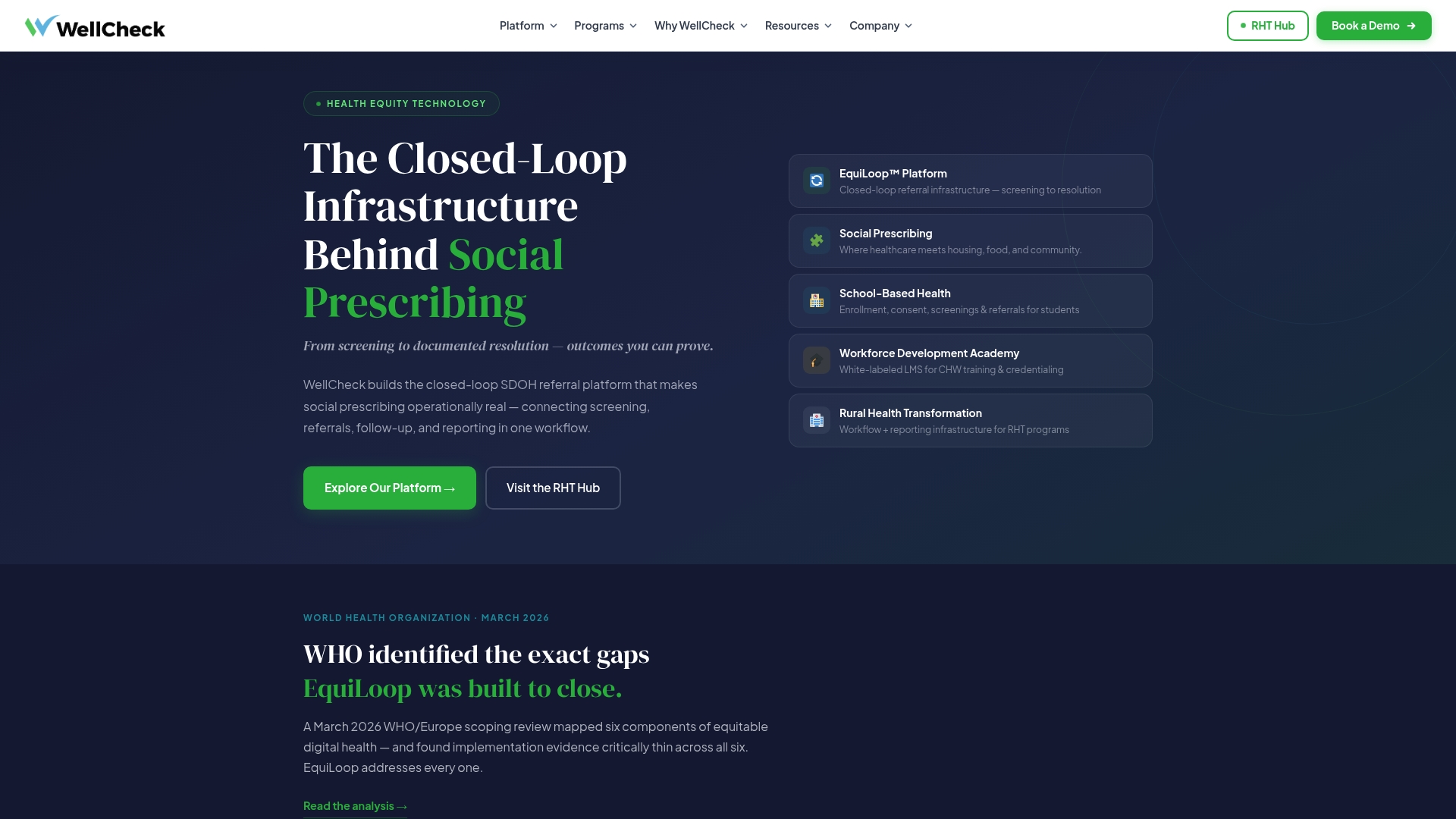
Wellcheck’s EquiLoop™ platform is built for exactly that workflow. It manages SDoH screening, referral routing, and follow-up coordination in a single closed-loop system, with a reported 93.9% closed-loop completion rate and over 45,000 services delivered. For teams working under funder reporting requirements or CMS mandates, EquiLoop™ generates the outcome documentation that proves program impact. Learn how the EquiLoop™ referral workflow connects screening to confirmed service delivery, or see how community health equity programs have used the platform to close gaps at scale.
FAQ
What are social drivers of health?
Social drivers of health are the nonmedical conditions shaped by social, economic, and political factors that determine health outcomes. They include income, housing, education, neighborhood safety, and social connectedness, organized by Healthy People 2030 into five core domains.
How do social drivers differ from social determinants of health?
The terms refer to the same underlying conditions. “Social drivers” is increasingly preferred because it emphasizes that these factors are modifiable through policy and community action, rather than fixed outcomes beyond anyone’s control.
Why does health equity require more than equal resource distribution?
Equality provides the same resources/01%3A_What_is_Public_Health/1.07%3A_Social_Determinants_of_Health) to everyone, which fails populations with greater structural disadvantages. Equity allocates resources based on need, accounting for historical and structural marginalization that creates unequal starting points.
What is a closed-loop referral system?
A closed-loop referral system connects a social needs screening to a community resource referral and then confirms that the referral was completed. It eliminates the gap between identifying a need and verifying that the need was addressed.
How does social isolation affect health outcomes in older adults?
Approximately 1 in 4 community-dwelling older adults in the U.S. experience social isolation, which significantly increases their risk of chronic diseases including heart disease and cognitive decline.

