
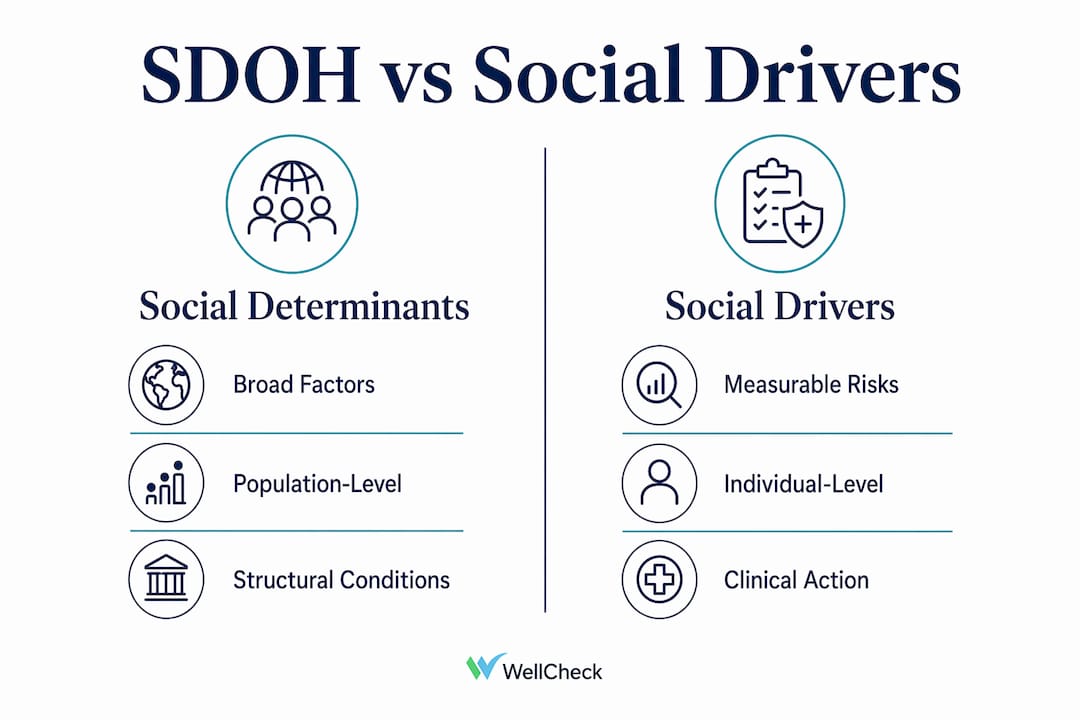
Social determinants of health are defined as the broad environmental and socioeconomic conditions that shape health outcomes across populations, while social drivers of health are the specific, modifiable factors within those conditions that can be targeted through direct intervention. Understanding the distinction between social determinants of health vs social drivers of health is not a matter of semantics. It determines how public health professionals design programs, allocate resources, and meet regulatory requirements. SDOH account for 30–55% of overall health outcomes, a figure that makes precise terminology a program design imperative, not an academic exercise.
What are social determinants of health vs social drivers of health?
Social determinants of health (SDOH) describe the conditions in which people are born, grow, live, work, and age. The CDC and WHO both organize these conditions into five domains: economic stability, education access and quality, healthcare access and quality, neighborhood and built environment, and social and community context. These are upstream, structural forces. A neighborhood’s walkability, a county’s median income, or a school district’s graduation rate all qualify as social determinants.
The term “social drivers of health” shifts the frame from description to action. Social drivers are the measurable, individual-level factors within those broader conditions that directly influence a person’s health trajectory and can be addressed through targeted programs. Food insecurity, housing instability, and transportation barriers are social drivers. They are observable, screenable, and modifiable. That distinction matters enormously when designing an intervention.

Social and structural determinants frameworks also emphasize power dynamics, governance, and institutional practices that shape health inequities. This layer sits above both determinants and drivers. Recognizing it prevents programs from treating screening as a substitute for structural change.
The practical consequence: SDOH analysis informs policy and community-level investment, while social drivers guide clinical screening, referral, and individual care coordination. Programs that conflate the two often end up with broad awareness but no clear intervention pathway.
What are health-related social needs and how do they fit in?
Health-related social needs (HRSN) represent the clinical operationalization of social drivers. SDOH are broad societal conditions; HRSN are actionable individual risks captured in clinical settings using standardized screening tools and ICD-10 Z-codes. The distinction is critical for billing and program eligibility.
Consider the difference this way. Food insecurity as a social driver describes a measurable condition affecting a person’s health. When a clinician screens for it, documents it with a Z59.4 code, and links it to a care plan, it becomes a billable HRSN. HRSN services must be linked to patient care plans and defined health barriers to qualify for Medicaid reimbursement. That linkage is what separates a documented social need from an unaddressed risk factor.
The HRSN vs SDOH distinction also shapes workforce roles. Community health workers (CHWs) and navigators typically work at the HRSN level, connecting individuals to resources. Public health departments and policymakers operate at the SDOH level, addressing conditions that affect entire populations. Both roles are necessary, and neither substitutes for the other.
Pro Tip: When building a screening program, map each screened item to its corresponding ICD-10 Z-code before launch. This step prevents documentation gaps that trigger claim denials downstream.
How has this terminology evolved in recent public health practice?
The shift from SDOH to social drivers to HRSN reflects a deliberate regulatory and clinical evolution. Screening and intervention for social drivers have transitioned from innovation experiments to contractual obligations in value-based care ecosystems. That transition accelerated sharply between 2023 and 2025.
CMS moved decisively in this period. In 2024, CMS reimbursed 73.2% of 285,270 HRSN-related services delivered in the United States, with SDOH risk assessments comprising 82.7% of those services. That volume confirms that HRSN screening is now a mainstream clinical activity, not a pilot program.
The reimbursement picture is not without friction. 26.8% of HRSN-related service claims in Medicare were denied due to documentation hurdles and workflow misalignments. That denial rate signals a systemic gap between screening intent and operational execution. Programs that screen without a documented closed-loop workflow leave reimbursement on the table.
“Shifting terminology from ‘social determinants’ to ‘social drivers’ makes social health factors more measurable and actionable within clinical care. The language change is not cosmetic. It reframes fixed conditions as modifiable targets, which changes what clinicians and community organizations believe they can accomplish.”
The regulatory push also reflects a broader debate about fatalism in public health language. Calling something a “determinant” implies it determines outcomes. Calling it a “driver” implies it can be steered. That framing shift has practical consequences for how frontline workers approach their work and how communities perceive their own agency.
Understanding CMS SDOH requirements is now a baseline competency for any program seeking federal reimbursement. The rules governing what qualifies as a billable HRSN service continue to evolve, and staying current is a compliance necessity.
What strategies work best for applying these concepts in programs?
Effective programs treat SDOH and social drivers as distinct inputs requiring different responses. The following framework reflects current best practice for public health professionals and community organizers.
Assess at the community level first. Use SDOH data from sources like the CDC’s PLACES database or the Area Deprivation Index to identify which determinants are most prevalent in your service area. This analysis should drive resource allocation and partnership decisions before any individual screening begins.
Screen for social drivers at the individual level. Use validated tools such as the PRAPARE, AHC Health-Related Social Needs Screening Tool, or the Hunger Vital Sign to capture individual-level social risks. Link every positive screen to an ICD-10 Z-code and a care plan entry. This step is what converts a social driver into a billable HRSN.
Build a closed-loop referral workflow. A successful SDOH program requires closed-loop infrastructure that translates screening into codified interventions with documented outcomes, not just data collection. Referral without follow-up confirmation produces no accountability and no reimbursable outcome.
Invest in community capacity alongside clinical screening. Building community capacity and investing in social services is essential to prevent screenings from becoming “a bridge to nowhere.” A referral to a food pantry that has no capacity, or a housing navigator with a six-month waitlist, produces no health improvement.
Track outcomes, not just outputs. Counting screenings completed is an output. Documenting that a person received food assistance, stabilized housing, or connected to transportation is an outcome. Funders and CMS increasingly require the latter. Programs without outcome data cannot demonstrate impact or sustain funding.
Pro Tip: Pair your digital SDOH assessment tool with a community resource directory that is updated at least quarterly. Stale referral data is one of the most common reasons closed-loop rates fall below acceptable thresholds.
Understanding primary care access is also relevant here. Social driver interventions that connect individuals to primary care must account for access barriers at the point of care, not just at the point of screening.
Key Takeaways
Precise terminology separates programs that screen from programs that produce documented, reimbursable health outcomes at scale.
| Point | Details |
|---|---|
| SDOH vs social drivers | SDOH are broad structural conditions; social drivers are modifiable, individual-level factors that programs can directly address. |
| HRSN as clinical bridge | HRSN translate social drivers into billable clinical events when linked to ICD-10 Z-codes and patient care plans. |
| Reimbursement depends on documentation | CMS denied 26.8% of HRSN Medicare claims in 2024 due to documentation gaps and workflow misalignments. |
| Closed-loop workflows are required | Screening without documented referral, follow-up, and outcome data does not meet CMS or funder accountability standards. |
| Community capacity must match screening volume | Referrals to under-resourced community partners produce no health improvement and undermine program credibility. |
Why the terminology debate is actually a program design debate
The argument over whether to say “determinants” or “drivers” looks like a language dispute. It is actually a dispute about what public health programs are responsible for delivering. I have seen programs invest heavily in screening infrastructure while treating community resource capacity as someone else’s problem. The result is predictable: high screening rates, low closed-loop completion, and frustrated frontline workers who cannot tell patients where to go.
The shift to “social drivers” language matters because it forces programs to ask a harder question. If this factor drives poor health outcomes, what is our plan to change it for this specific person? That question requires a referral pathway, a community partner with real capacity, and a follow-up mechanism. It requires, in short, a system rather than a survey.
The healthcare access dimension compounds this. Screening someone for transportation barriers while your referral network has no transportation resources is not a program. It is documentation. The terminology shift only produces value when it is backed by operational infrastructure that connects identified needs to real services and confirms that those services were received.
Programs that treat SDOH screening as a compliance checkbox will continue to see high denial rates and low community trust. Programs that build closed-loop referral systems around social drivers will produce the outcome data that sustains funding and justifies the investment.
— Lance
How WellCheck supports social driver screening and referral
WellCheck builds the operational infrastructure that turns social driver screening into documented, reimbursable outcomes. Its EquiLoop™ platform manages the full workflow from SDOH screening through referral management, follow-up, and outcomes reporting, with a documented 93.9% closed-loop completion rate across 22,682 individuals screened and 45,458 services delivered.
EquiLoop produces funder-ready reporting aligned with CMS requirements, giving FQHCs, AHECs, community-based organizations, and local health departments the accountability infrastructure they need. For programs working to close the gap between screening and real patient support, community health equity solutions from WellCheck provide the workflow and reporting infrastructure to do it at scale. Learn more about the EquiLoop platform and how it supports value-based care obligations.
FAQ
What is the difference between SDOH and social drivers of health?
SDOH are broad, structural conditions such as poverty, neighborhood safety, and education access that shape population health. Social drivers are the specific, modifiable factors within those conditions, such as food insecurity or housing instability, that programs can directly address through screening and referral.
What are health-related social needs (HRSN)?
HRSN are individual social risks identified through clinical screening and documented with ICD-10 Z-codes. They qualify for Medicaid reimbursement when linked to a patient care plan and a defined health barrier.
How does HRSN differ from SDOH in a clinical setting?
SDOH describe community-level conditions that clinicians cannot bill for. HRSN are the individual-level expressions of those conditions that, when properly documented, generate reimbursable claims under CMS guidelines.
Why are HRSN claim denials so high?
In 2024, 26.8% of HRSN-related Medicare claims were denied due to documentation gaps and workflow misalignments. Programs that screen without a closed-loop referral and outcome documentation system produce claims that fail CMS review.
What is another word for social determinants of health?
“Social drivers of health” and “health-related social needs” are the most common alternatives, each with a distinct scope. “Social drivers” emphasizes modifiable factors; “HRSN” refers specifically to clinically documented individual needs.

