
SDoH Z codes are ICD-10-CM diagnosis codes in categories Z55 through Z65 that document social, economic, and environmental factors affecting a patient’s health status and access to care. These codes give clinical teams a standardized way to record what happens outside the exam room: housing instability, food insecurity, unemployment, and limited education. The ICD-10-CM Official Guidelines and CMS both recognize these codes as tools for capturing social determinants of health (SDoH) systematically. Used correctly, sdoh z codes improve risk stratification, support value-based reimbursement, and advance health equity at the population level.
What are SDoH Z codes and what domains do they cover?
SDoH Z codes are ICD-10-CM codes within categories Z55 through Z65 that document social, economic, and environmental factors influencing health and care access. They cover nine distinct domains, giving clinical teams a structured vocabulary for social needs that previously went unrecorded.
The nine domains span a wide range of life circumstances:
- Z55: Problems related to education and literacy
- Z56: Problems related to employment and unemployment
- Z57: Occupational exposure to risk factors
- Z59: Problems related to housing and economic circumstances
- Z60: Problems related to social environment
- Z62: Problems related to upbringing
- Z63: Problems related to primary support group and family circumstances
- Z64: Problems related to certain psychosocial circumstances
- Z65: Problems related to other psychosocial circumstances
The table below summarizes the most clinically significant codes in this range.
| Code | Description | Domain |
|---|---|---|
| Z59.0 | Homelessness | Housing |
| Z59.4 | Lack of adequate food | Economic circumstances |
| Z56.0 | Unemployment, unspecified | Employment |
| Z55.0 | Illiteracy and low-level literacy | Education |
| Z60.2 | Problems related to living alone | Social environment |
| Z63.0 | Relationship distress with spouse or partner | Family circumstances |
| Z65.3 | Problems related to legal circumstances | Psychosocial |
These codes complement primary medical diagnoses rather than replace them. A patient presenting with poorly controlled diabetes may also carry Z59.4 for food insecurity. That secondary code tells the care team why glycemic control is failing and points toward a community resource referral rather than a medication adjustment alone.
Z codes provide context by answering “why the patient is here” beyond disease coding. That context is what makes them indispensable under value-based care models.
Who can document SDoH Z codes?
Per FY 2026 ICD-10-CM Guidelines, SDoH Z codes may be documented by nurses, social workers, dieticians, and other qualified clinicians, not only physicians. This expansion of documentation authority is significant. It means a community health worker who captures a patient’s housing status during a screening visit can generate a valid record that supports Z59.0 assignment.

Documentation can also come from patient self-reports, provided those reports are captured in a permanent part of the medical record by a qualified care team member. The key requirement is that the record must reflect an actual clinical encounter or formal screening instrument, not coder inference alone.
Best practices for documentation include:
- Use validated screening tools such as PRAPARE, AHC HRSN, or the Accountable Health Communities screening instrument to generate structured, auditable data.
- Record patient self-reported social needs in a permanent section of the medical record, not in a temporary note field.
- Assign specific Z codes rather than unspecified codes whenever the clinical record supports it. Specificity improves reimbursement accuracy and quality measurement.
- Never assign a Z code as the primary diagnosis when an active disease or condition is present. Z codes are secondary descriptors in those encounters.
- Confirm that the assigned code matches the language in the clinical note. Mismatches between notes and codes are a leading audit trigger.
Pro Tip: Broader clinician documentation authority increases capture of social determinants. Relying only on physicians creates under-reporting and misses critical risk factors. Train your full care team on Z code documentation at onboarding, not just during annual compliance reviews.
Digital SDoH assessment tools integrated with EHRs reduce documentation gaps by prompting clinicians at the point of care and auto-populating structured fields that coders can act on directly.
How do SDoH Z codes affect reimbursement and quality metrics?
Z codes do not trigger direct payment on their own. Claims with only Z codes and no medical diagnoses are typically denied. That rule underscores the importance of pairing SDoH coding with clinical diagnoses for every encounter.
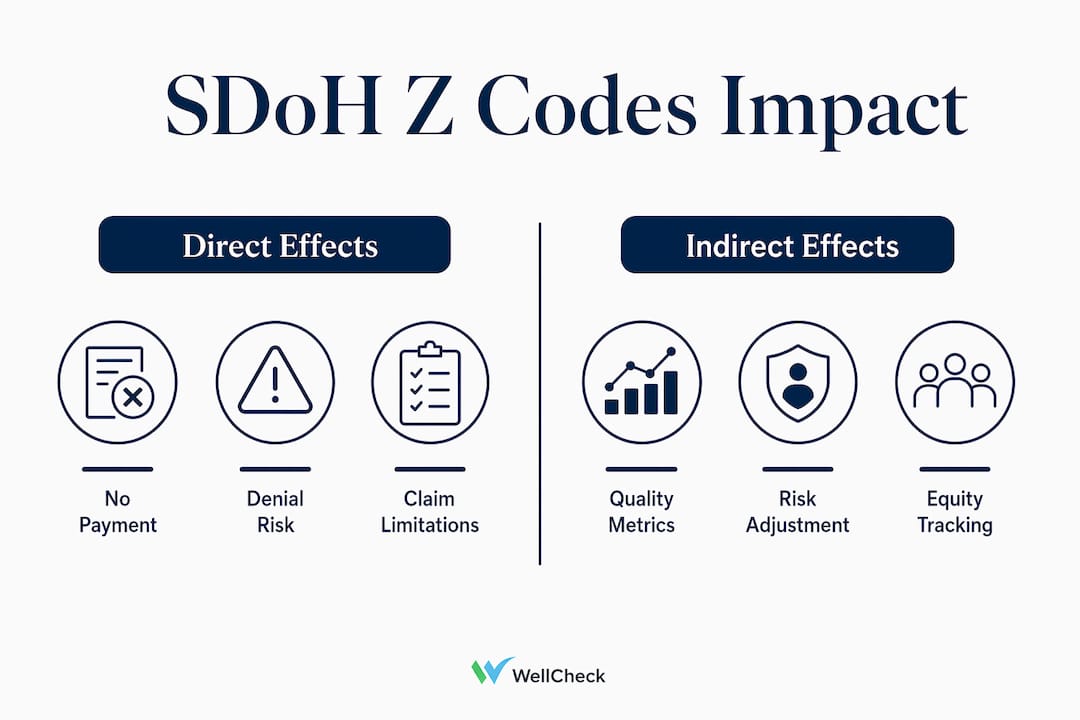
The indirect reimbursement impact, however, is substantial. The table below contrasts direct and indirect effects.
| Impact Type | Mechanism | Example |
|---|---|---|
| Direct | None on its own | Z code alone does not generate payment |
| Risk adjustment | Higher risk scores from documented social complexity | Increased payments in Medicare Advantage and Medicaid managed care |
| Quality reporting | MIPS and HEDIS metrics reflect SDoH documentation | Improved performance scores and shared savings eligibility |
| Medical necessity | Social context supports necessity of services | Justifies additional visits, care management, or community referrals |
| Audit defense | Coded social factors align with clinical notes | Reduces claim denials and supports appeals |
CMS tracks utilization of SDoH codes on Medicare claims as part of its health equity initiatives. Under-documentation creates incomplete risk profiles, which can reduce risk-adjusted payments and disqualify programs from value-based incentives.
Consider a concrete scenario. A Federally Qualified Health Center (FQHC) serves a patient population with high rates of housing instability. If clinicians consistently document Z59.0 alongside relevant diagnoses, the organization builds a data record that justifies higher care management intensity. That record supports both MIPS performance scores and Medicaid managed care risk scores. Without it, the same population appears lower-risk on paper, and the FQHC loses reimbursement it has legitimately earned.
Pro Tip: Review your CMS SDoH reporting requirements annually. CMS updates health equity tracking criteria each fiscal year, and a code that was optional in FY 2025 may carry quality weight in FY 2026.
Higher risk scores from documented social complexity can increase payments in Medicare Advantage and Medicaid managed care. That financial reality makes SDoH coding a billing priority, not just a clinical courtesy.
What are common pitfalls in assigning SDoH Z codes?
The most common coding error is assigning a Z code as the primary diagnosis when an active condition is present. Using Z codes as primary diagnosis for active conditions causes claim denials. Z codes must be secondary, providing social context to a clinical diagnosis that leads the claim.
A second frequent problem is under-documentation driven by assumptions about who is responsible. Many clinical teams assume physicians must document social needs. That assumption leaves nurses, social workers, and community health workers out of the workflow entirely. The result is that patients with significant social complexity appear uncomplicated in the record.
Best practices to avoid these pitfalls:
- Assign Z codes as secondary diagnoses only when an active condition is present and leads the claim.
- Build documentation responsibility into every role on the care team, not just physicians.
- Replace ad hoc social need queries with systematic SDoH screening workflows that generate consistent data across all patient encounters.
- Minimize use of unspecified Z codes. Specific codes produce better reimbursement outcomes and more useful population health data.
- Audit Z code assignments quarterly against clinical notes to catch mismatches before a payer does.
Standardizing SDoH screening rather than relying on ad hoc documentation is critical. Without systematic data capture, health systems lack visibility into the social drivers affecting outcomes. Sporadic documentation produces a fragmented picture that neither supports quality reporting nor holds up under audit.
Pro Tip: Z codes must be consistent with clinical notes reflecting patient self-report or formal screening instruments. Minimize unspecified codes in favor of specific codes to optimize reimbursement and quality measurement. Run a quarterly code-to-note reconciliation review with your coding and clinical teams together.
Routine SDoH coding supported by digital workflows and closed-loop referral systems effectively links patients to social resources, which can reduce hospital readmissions and improve population health outcomes.
Key Takeaways
SDoH Z codes in categories Z55 through Z65 are the primary ICD-10-CM mechanism for documenting social determinants, and their correct use directly affects risk adjustment, quality scores, and care coordination outcomes.
| Point | Details |
|---|---|
| Z codes are secondary codes | Never assign a Z code as the primary diagnosis when an active condition is present. |
| Full care team can document | FY 2026 guidelines allow nurses, social workers, and dieticians to document SDoH Z codes. |
| Indirect reimbursement impact | Z codes improve risk scores and quality metrics in Medicare Advantage and Medicaid managed care. |
| Systematic screening is required | Ad hoc documentation produces incomplete data; standardized workflows generate consistent, auditable records. |
| Specificity matters | Specific Z codes outperform unspecified codes for reimbursement accuracy and population health reporting. |
The gap between knowing and doing in SDoH coding
The clinical logic behind SDoH Z codes is straightforward. The execution is where most organizations fall short, and I have seen this pattern repeat across FQHCs, rural health networks, and community-based organizations.
The most persistent problem is not ignorance of the codes. It is the absence of a workflow that makes documentation the default rather than the exception. When social need screening depends on a physician remembering to ask, it happens inconsistently. When it depends on a social worker who has no structured place to record the answer, the data disappears. The FY 2026 ICD-10-CM guidelines expanded documentation authority precisely because the field recognized this bottleneck. Giving nurses, dieticians, and community health workers formal authority to document is a policy correction for a workflow failure.
The second issue I see consistently is the disconnect between coding teams and clinical teams. Coders cannot assign what clinicians do not document. Clinicians document what their workflows prompt them to capture. Closing that gap requires joint training, shared audit reviews, and technology that connects the screening moment to the billing record. Organizations that treat SDoH coding as a billing department problem will keep under-coding. Organizations that treat it as a care team responsibility, backed by digital infrastructure, produce records that hold up under audit and generate the risk-adjusted payments they have earned.
The policy direction is clear. CMS is expanding health equity tracking, and payers are building SDoH data into risk models. Organizations that build consistent SDoH documentation practices now will be better positioned for the value-based contracts that follow. The window to build that infrastructure before it becomes a compliance requirement is narrowing.
— Lance
WellCheck’s approach to SDoH documentation and care coordination
Accurate SDoH Z code documentation requires more than coding knowledge. It requires a workflow that connects screening, referral, follow-up, and reporting in a single system.
WellCheck’s EquiLoop™ platform manages the full workflow from SDoH screening through referral management, follow-up, and outcomes reporting. Across 22,682 individuals screened and 45,458 services delivered, EquiLoop has achieved a 93.9% closed-loop completion rate. That rate reflects a system built to close the gap between a documented social need and a resolved one. For FQHCs, AHECs, local health departments, and rural health networks, WellCheck’s closed-loop referral infrastructure produces the funder-ready reporting that CMS and other payers require, while giving clinical teams the structured data they need to assign accurate Z codes at every encounter.
FAQ
What are Z codes in medical billing?
Z codes are ICD-10-CM diagnosis codes that document factors influencing health status that are not classified as diseases or injuries. In medical billing, they provide social and environmental context that supports medical necessity, risk adjustment, and quality reporting.
Are Z codes billable on their own?
Z codes are not independently billable. Claims submitted with only Z codes and no medical diagnoses are typically denied. Z codes must be paired with a primary clinical diagnosis to support a valid claim.
What is the Z code list for social determinants of health?
The SDoH Z code list spans categories Z55 through Z65, covering nine domains including education, employment, housing, economic circumstances, social environment, upbringing, family circumstances, and psychosocial factors.
Who can document SDoH Z codes under FY 2026 guidelines?
Per FY 2026 ICD-10-CM Guidelines, nurses, social workers, dieticians, and other qualified care team members can document SDoH Z codes. Documentation may also reflect patient self-reports captured in a permanent part of the medical record.
How do SDoH Z codes affect value-based care reimbursement?
SDoH Z codes influence reimbursement indirectly through risk adjustment models, quality reporting programs like MIPS and HEDIS, and medical necessity documentation. Higher documented social complexity can increase risk-adjusted payments in Medicare Advantage and Medicaid managed care.

