
AHEAD (Achieving Healthcare Efficiency through Accountable Design) is a voluntary state total cost of care model run by the CMS Innovation Center (CMMI). It aligns Medicare, Medicaid and commercial payers around cost growth targets, hospital global budgets and stronger primary care. For rural health networks, FQHCs, AHECs and health departments in participating states, it raises a practical question: can your program show what happened to a patient after a referral was made? Payment under AHEAD is tied to performance, so follow-through becomes something you have to document.
TL;DR
- AHEAD is a state total cost of care model developed by CMMI under Section 1115A of the Social Security Act. It runs through December 31, 2035.
- Five states participate: Maryland (Cohort 1), Connecticut and Hawaii (Cohort 2), Rhode Island and New York (Cohort 3). Cohorts 2 and 3 begin performance on January 1, 2028.
- Hospitals receive global budgets. Primary care practices, FQHCs and Rural Health Clinics can join Primary Care AHEAD and receive an enhanced prospective payment.
- Primary Care AHEAD payments are meant to fund care coordination, behavioral health integration and health-related social needs interventions, including coordination with community-based organizations.
- Programs in AHEAD states need referral tracking and outcome reporting that shows follow-through, not only service volume.
Table of Contents
- What AHEAD is and what CMMI’s role is
- Which states participate, and the timeline
- How AHEAD holds states accountable
- Hospital global budgets
- Primary Care AHEAD: payments, participants and requirements
- The September 2025 changes
- What AHEAD means for rural and community programs
- How closed-loop tracking supports AHEAD-style reporting
- Where EquiLoop fits
- FAQ
- Sources
What AHEAD is and what CMMI’s role is
CMMI is the part of CMS that tests new payment and delivery models. AHEAD is one of them. According to the CMS AHEAD model page, it is a voluntary state total cost of care (TCOC) model that drives state and sub-state-regional health care transformation and multi-payer alignment. The goal is to improve the health of a state’s population while lowering costs.
Total cost of care means everything spent on a population’s health care, across hospitals, physicians, post-acute care and drugs. Most programs in the past have been paid by one payer at a time, each with its own rules. AHEAD asks Medicare, Medicaid and commercial payers to work toward shared targets instead.
When CMS announced the model in September 2023, it said the aim was better quality and efficacy of care delivery and fewer health disparities, with specific payment models for participating hospitals and primary care practices.
Which states participate, and the timeline
Per CMS, AHEAD has five state participants, in three cohorts:
| Cohort | States | Performance begins |
|---|---|---|
| Cohort 1 | Maryland | Already under way |
| Cohort 2 | Connecticut, Hawaii | January 1, 2028 |
| Cohort 3 | Rhode Island, New York | January 1, 2028 |
All cohorts run through December 31, 2035. Earlier materials from advocacy groups listed Vermont and described a New York portion only, so check the CMS model page for the current list before you plan. Maryland signed an agreement to continue its participation on November 13, 2025, according to CMS’s September 2025 Innovation Insight.
If your program is not in one of these states, AHEAD does not apply to you directly today. It still shows where CMS payment design is heading: payments tied to total cost, quality, and proof that coordination happened.
How AHEAD holds states accountable
The accountability structure is the part most relevant to program directors, because it flows down to the organizations that deliver care.
According to the CMS grants.gov application instructions, participating states are accountable for:
- Annual TCOC growth targets for Medicare fee-for-service and for all payers. All-payer targets cover state residents with Medicare, Medicaid or commercial insurance.
- Primary care investment targets. CMS anticipates the final Medicare fee-for-service target will fall between 6% and 7% of Medicare TCOC.
- Statewide quality and equity measures.
If a state misses its all-payer TCOC target, CMS can require corrective action or adjust payments to primary care practices. The Maryland State Agreement, signed October 28, 2024, sets a 0.128% annual Medicare savings component for performance years 1 through 9. It also requires at least five core statewide quality measures and one optional measure, with targets set every two years that exceed results under the earlier Maryland model.
The lesson for local programs: state targets are only reachable if the organizations behind them can show that people got the services they were referred to. A state cannot report on follow-through that no program tracked.
Hospital global budgets
Under AHEAD, participating hospitals receive a Hospital Global Budget (HGB). The CMS technical specifications describe it as a prospectively set, fixed amount of annual revenue for a specific population, such as Medicare fee-for-service patients. It replaces payment for inpatient and outpatient facility services, but not professional services.
The amount is based on prior-year Medicare payments, updated for inflation and for changes in population and services. It is adjusted for performance on quality and health outcomes. CMS also makes waivers available so participating hospitals can formalize arrangements with non-hospital providers.
That last point matters for rural networks. When a hospital’s revenue is fixed, it gains from keeping patients well and out of avoidable admissions. Community partners that help with transportation, food, housing or behavioral health become part of the hospital’s operating picture.
Primary Care AHEAD: payments, participants and requirements
Primary Care AHEAD (PC AHEAD) is open to primary care practices, FQHCs, Health Centers and Look-Alikes, and Rural Health Clinics in AHEAD areas serving Medicare fee-for-service beneficiaries. The CMS financial specifications describe an Enhanced Primary Care Payment (EPCP), paid prospectively each quarter on top of fee-for-service, with an anticipated statewide average of $17 per beneficiary per month. The amount is adjusted for:
- Patient risk scores
- Dual eligibility and low-income status
- Quality performance
- Statewide hospital global budget and TCOC performance
There are four payment pathways, including two capitated options. Participation requires concurrent enrollment in a state Medicaid patient-centered medical home or advanced primary care program.
What community health centers must do
Per the CMS financial specifications for 2026, Community Health Center participants (FQHCs, Health Centers, Look-Alikes and Rural Health Clinics) participate by CMS Certification Number rather than a practitioner roster. They can join at the site or organization level, must sign a Participation Agreement and pass program integrity screening, and must meet three Care Transformation Requirements with annual attestation:
- Behavioral health integration
- Care management and specialty coordination
- Health promotion
The same specifications state that attribution is only a way to estimate a participant’s Medicare population for payment. Beneficiaries can still see any practitioner they choose.
Behavioral health integration is where billing rules and payer mix get specific. Understanding how units and reimbursement work, as in this look at out-of-network reimbursement in California, shows how much payer rules shape what a behavioral health service actually pays.
Where social needs fit in
The CMS AHEAD FAQ says PC AHEAD payments fund care transformation in care coordination, behavioral health integration and health-related social needs interventions. They also let practices hire staff for team-based whole-person care and strengthen coordination with specialty providers and community-based organizations.
Coordination with community-based organizations only produces value if each handoff is visible: was the referral accepted, was the service delivered, was the need resolved? That is a workflow problem, and it sits at the center of how CMS SDoH rules are reshaping public health technology.
The September 2025 changes
CMS changed the model’s design in September 2025, implemented across all cohorts beginning January 2026. According to the CMS FAQ, the main changes are:
- Health Equity Plans are replaced by Population Health Accountability Plans focused on prevention.
- Capitated PC AHEAD pathways and a new geographic program, Geo AHEAD, start in 2028, with two four-year contract periods (2028 to 2031 and 2032 to 2035).
- States must implement at least one consumer-choice policy and one market-competition policy.
- Transparency requirements are added for TCOC and primary care investment targets.
- The TCOC guardrail is strengthened.
- The state-designed HGB option is removed for states with hospital rate-setting authority.
- The end date is extended to December 31, 2035.
Geo AHEAD is the biggest structural shift. As CMS describes it, it brings TCOC accountability to all Original Medicare beneficiaries in AHEAD regions through geographic attribution. Risk-bearing Geographic Entities share in payments or losses through two-sided risk arrangements. Ownership does not have to be provider-led, so health plans or digital health companies can form and lead them.
CMS frames the changes around two priorities: choice and competition, and prevention. The shift from Health Equity Plans to prevention-focused plans changes the language programs will report in, but it does not remove the need to document social needs work.
What AHEAD means for rural and community programs
Rural organizations face a specific challenge. Hawaii’s Department of Health said in an April 2026 presentation that rural providers often lack the scale, infrastructure and financial flexibility to succeed in value-based arrangements like AHEAD without added support. Hawaii’s Rural Health Transformation Program awards $189 million per year across six initiatives, and one of them finances local value-based work such as quality reporting, advanced analytics, coaching and staff hiring.
Maryland’s Medicaid advanced primary care program shows what this looks like in practice. Its PY 2026 program manual requires practices to conduct outreach to assigned members and provide episodic or transitional care management, while managed care organizations continue longitudinal care management. Several parties touch the same patient, and each needs to know what the others did.
For a program director, that translates into five operating questions:
- Screening: Are SDoH screens done consistently and recorded in a form you can count?
- Routing: Does each referral go to a named clinical or community partner?
- Status: Can you see whether it was accepted, delivered or declined?
- Follow-up: Who is responsible when a referral stalls?
- Reporting: Can you give a funder or payer a completion rate, not only a count of referrals sent?
Most programs can answer the first and second. Few can answer the third through fifth without manual spreadsheets. If you run a hub that connects clinics with community partners, our community care hub model playbook covers the structure, and community case management strategies cover the day-to-day work. For software criteria, see our guide to care coordination software platforms.
How closed-loop tracking supports AHEAD-style reporting
A closed-loop referral is one where the sending organization learns the outcome: the receiving partner accepted it, the service happened, and the result was recorded. In most community health settings, a referral is sent and no one tracks whether it was accepted, delivered or resolved. Programs end up reporting service volume but not follow-through.
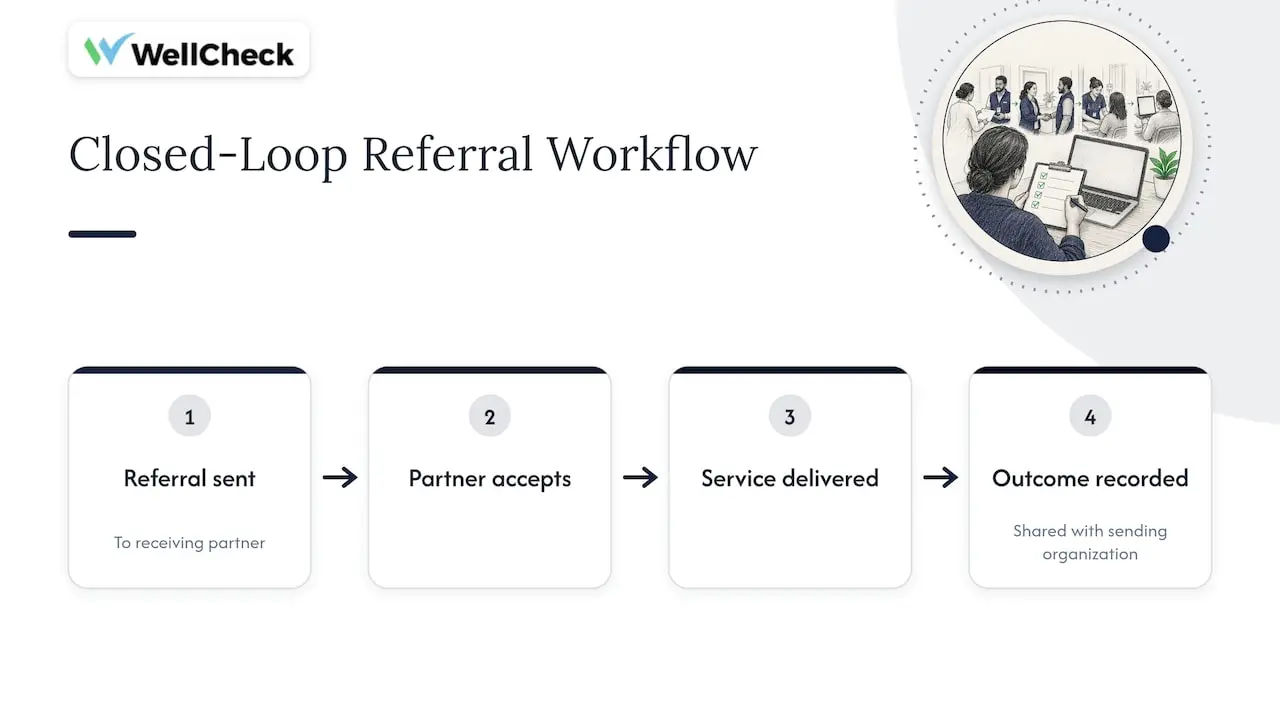
In one rural health hub deployment of EquiLoop with a multi-partner ecosystem, 22,682 individuals were screened, 45,458 services were delivered and the closed-loop completion rate was 93.9%.* Those figures describe one deployment and are not a forecast for another program, but they show what a tracked referral workflow can report when partners participate.
*Rural health hub deployment with a multi-partner ecosystem. Includes both clinical and social services referrals.
AHEAD does not name a required software product, and nothing here implies that any platform makes a program eligible. The point is narrower. The model’s design leans on coordination, social needs interventions and quality measures, and programs that can document what happened after a referral are better placed to answer the questions payers and funders ask.
Where EquiLoop fits
EquiLoop is WellCheck’s closed-loop referral and care coordination platform for rural and community health programs. It manages SDoH screening and intake, referral routing to clinical and community partners, follow-up and status tracking, outcomes dashboards and funder-ready reporting.
Each deployment is configured around the partner network, referral pathways and reporting requirements your organization already has. It is built to complement existing systems of record, not replace them. It is not a resource directory: its purpose is workflow and accountability. Programs in AHEC, FQHC and county health department settings can see how it is set up on the EquiLoop page, and FQHC and hospital teams can start with the FQHC and hospital one-sheet.
If you are planning for AHEAD reporting or comparable payer requirements, book a 30-minute demo and we will walk through your referral pathways and reporting needs.
Training the people who do this work is the other half. Our Workforce Development Academy is a white-labeled learning platform for community health worker, navigator and community health workforce training and credentialing, described on the Workforce Development Academy page.
FAQ
What states are in the AHEAD model?
CMS lists five state participants. Maryland is Cohort 1, Connecticut and Hawaii are Cohort 2, and Rhode Island and New York are Cohort 3. Cohorts 2 and 3 begin performance on January 1, 2028, and all cohorts run through December 31, 2035.
Is AHEAD mandatory?
No. AHEAD is a voluntary model. States apply to take part, and within a participating state, hospitals and primary care practices choose whether to join the hospital global budget or Primary Care AHEAD tracks. Primary Care AHEAD participation requires concurrent enrollment in the state Medicaid medical home or advanced primary care program.
Can FQHCs and Rural Health Clinics participate?
Yes. CMS lists FQHCs, Health Centers, Look-Alikes and Rural Health Clinics as eligible Primary Care AHEAD participants in AHEAD areas. They must sign a Participation Agreement, pass program integrity screening, meet three Care Transformation Requirements and attest annually.
What did CMS change in September 2025?
CMS replaced Health Equity Plans with prevention-focused Population Health Accountability Plans, added capitated primary care pathways and Geo AHEAD starting in 2028, and required states to adopt consumer-choice and market-competition policies. It also extended the model to December 31, 2035.
Sources
- CMS: AHEAD Model
- CMS: AHEAD Model Frequently Asked Questions
- CMS: Innovation Insight on changes to AHEAD, September 2025
- CMS: Announcement of the AHEAD model, September 2023
- CMS: AHEAD technical specifications v3.2
- CMS: AHEAD financial specifications, 2026
- Grants.gov: AHEAD application instructions
- Maryland HSCRC: AHEAD State Agreement, October 2024
- Maryland Department of Health: Medicaid Advanced Primary Care Program Manual PY 2026
- Hawaii Department of Health: EMS Advisory Committee presentation, April 2026
- Kin Wellness: out-of-network reimbursement in California
