
Referral leakage is what happens when a referral is made and the patient never completes it. In a hospital system, the term usually means patients leaving for out-of-network care. In rural and community health programs, it more often means a referral to a clinic, food program, housing agency or other community partner that no one confirms was accepted, delivered or resolved. You can stop it by tracking every referral through defined steps, measuring where each one stops, and reporting the result. That requires a closed-loop workflow, not just a list of referrals sent.
This guide is for program directors, care coordination managers and funder-reporting staff. It explains where referrals leak, what published data shows, how to measure it, and how to reduce it.
TL;DR
- Referral leakage in community health is a follow-through problem: referrals are sent, but acceptance, service delivery and outcome go unrecorded.
- Published data shows large drop-off after a referral is placed. In one Ohio study, only 98 of 360 accepted referrals (27%) were resolved.
- The most common cause is not a refusal. It is that no one could reach the client.
- Measure each step (screened, needs found, consent, referral placed, accepted, outcome) and the time between steps, not only referral volume.
- Funders increasingly ask for resolution data, so a workflow that records outcomes is also your reporting system.
Table of Contents
- What referral leakage means outside the hospital
- Where referrals leak: what the data shows
- Why referrals leak in rural and community settings
- What leakage costs a program
- How to measure referral leakage
- What a closed loop needs to record
- Reducing unresolved referrals
- Reporting follow-through to funders
- How EquiLoop closes the loop
- FAQ
- Sources
What referral leakage means outside the hospital
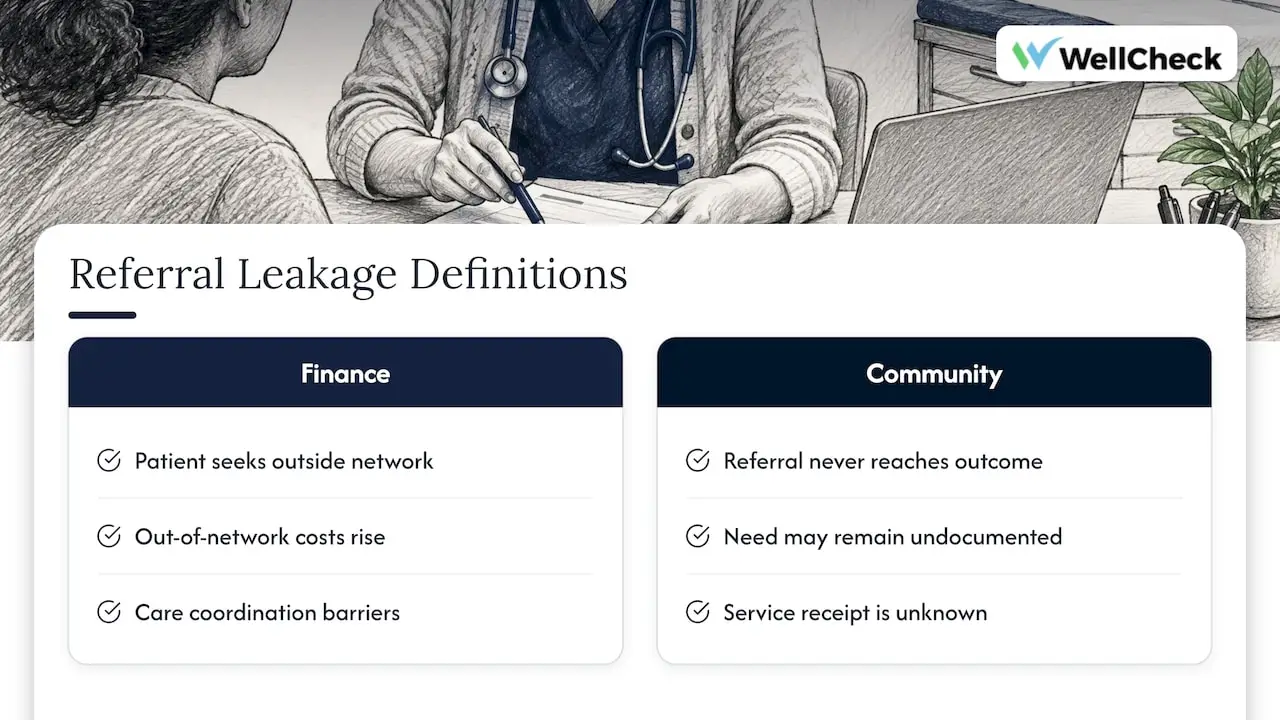
The term comes from health system finance. A peer-reviewed study of provider network design describes community service leakage as a patient in a provider network seeking services outside the community. That raises out-of-network costs and creates care coordination barriers, which matters most for accountable care organizations, where in-network providers carry financial responsibility for quality and outcomes.
Rural health networks, health departments, AHECs and FQHCs use the word more broadly. The patient may never leave the network. The referral simply goes nowhere. A screening finds a food or housing need, a referral goes out, and the record ends there. The program can report how many referrals it sent. It cannot say how many people received a service.
A Harvard Kennedy School Government Performance Lab analysis describes the same pattern in public agencies. They often know who enrolls and who exits, but the steps in between feel like a black box. Delays in assessment, enrollment or service provision can drive clients away entirely.
So for your program, a practical definition is: any referral that does not reach a documented outcome. That covers clinical referrals to specialists and social referrals to community organizations.
Where referrals leak: what the data shows
Three published datasets show the same shape. Most loss happens after the referral is placed.
A six-step view of one Ohio clinic
Researchers at a Cleveland COVID-19 vaccine clinic tracked 5,741 patients through six sequential steps: screened, has a need, consents, referral placed, referral accepted, and outcome. Step completion ranged from 17% to 98%. Of 360 referrals accepted by community organizations, only 98 (27%) were resolved.
The reasons for the unresolved referrals were:
- Could not contact the patient: 151
- No reason stated: 71
- Patient declined the service: 30
The 71 cases with no recorded reason matter as much as the other two. A program that does not capture why a referral failed cannot fix the process.
Statewide referral data from Oregon
A Connect Oregon implementation review covered 20,464 cases created in 2021 and 2022, with data through March 2023. Fifty-four percent were resolved, 28% were unresolved and 18% were still open. The leading reasons for unresolved cases were inability to contact the client (45%), client declined (11%) and resource not available (8%).
Funding changes closure rates
A North Carolina Medical Journal study of NCCARE360 compared two five-month windows in Durham County. While COVID-19 support services funding was available, 3,220 referrals were placed and 88% were resolved. After the funds were exhausted, 860 cases were placed and about 30% were resolved. The authors point to reimbursement as a driver of whether community organizations can close cases in real time.
The lesson for a program director is that leakage is not only a patient behavior problem. Partner capacity, funding and contact information all affect it, and a program can see each of them only if the referral is tracked.
Why referrals leak in rural and community settings
Four causes recur across the evidence.
1. No one can reach the client. This is the leading reason for unresolved referrals in both the Ohio and Oregon data. A single phone number is a weak point, especially where phone service, housing or work schedules change. The Ohio authors recommend asking patients right after a positive screen whether they want help, and collecting alternate contact information such as a second phone, an email or a family member.
2. The partner has no capacity. An EHRA report on closed-loop referrals notes that rural areas may have fewer social service resources than urban areas, that service availability shifts with state funding and Medicaid policy, and that community organization capacity for new clients varies widely. A Health Affairs study describes the result of referring people to low-capacity agencies: patients seek help that largely does not exist, agencies take on more work, and clinicians lose time and credibility.
3. Information does not flow back. The NCQA guide to community referral platforms observes that when patients are referred to community organizations, little follow-up about the visit or result often returns to the referring practitioner. That raises the chance the patient falls through the cracks.
4. Programs cannot see their own data. The ACEP Emergency Medicine Informatics section states that most programs cannot tell from structured data whether a positive screen produced a referral, whether the receiving service acknowledged it, whether anything happened, or what the outcome was.
What leakage costs a program
The cost shows up in three places a program director recognizes.
- Continuity of care. A need was identified and nothing visibly changed. The clinician who made the referral does not learn the result, so the next visit starts without that information.
- Credibility with partners and clients. The Health Affairs finding above applies here: referrals that go nowhere cost staff time and trust.
- Accountability. A program that reports service volume but not follow-through cannot answer the questions funders and payers now ask. The Harvard analysis makes the same point about agencies: time-based review of each step shows where progress lags, and without it the gaps stay hidden.
The research gives these effects at the program level. Patient-level outcome effects depend on the need and the service, so measure them locally instead of assuming them.
How to measure referral leakage
Start with a definition your staff and partners share, then count at every step. The CMS Transforming Clinical Practice Initiative guide on closing the loop directs programs to collect the percent of loops closed, track no-shows, cancellations without a reschedule, and referrals never scheduled. It also advises reporting at the clinic level and potentially the clinician level.
A practical measurement set
| Measure | What it tells you |
|---|---|
| Screened and positive for a need | The size of the identified need |
| Consented to a referral | Whether the offer matched what the person wanted |
| Referral placed | Whether staff acted on the screen |
| Referral accepted by the partner | Whether the partner has capacity and received it |
| Service delivered or outcome recorded | Whether the loop closed |
| Unresolved, with a reason | Contact failure, declined, or resource unavailable |
| Days between steps | Where delay drives people away |
The Harvard team recommends breaking the referral process into individual steps, timing each one, and checking for differences by race, ethnicity, gender and geography. For rural programs, geography is often the most revealing cut: a county or a partner may account for most of the stalls.
Benchmarks from published work
In the CMS document, Denver Health’s average close-the-loop rate across 43 specialty clinics was 18.2% in January 2017 and 73.3% in January 2019, after the clinics adopted new processes. The Indian Health Service Purchased/Referred Care fact sheet describes a referral dashboard that tracks days from referral initiated to approval and to date of service, and a referral loop closure measure: the percentage of referrals completed with medical records received and medical action completed.
These are not targets for your program. They show that the loop can be measured as a rate and improved over time.
An audit you can run this week
The American Academy of Family Physicians described a simple audit: pull the referrals sent in a past month and check how many are still incomplete. In the example it cites, 8 of 35 consults sent in September were still incomplete in a later audit. Run the same check on your own referral list, split by partner. It will show how much of your volume has no recorded outcome.
What a closed loop needs to record
A referral is closed when the sender knows the result. The CMS guidance describes this as two-way information sharing: log and track every referral request through completion, have the receiving party report the disposition (appointment date, or that the referral is inappropriate or cannot be scheduled), report cancellations and no-shows, and send a timely response after the visit.
For social needs, the AMA Council on Science and Public Health report describes a closed-loop platform as one that lets clinicians and community organizations exchange patient data for review, action, acknowledgment and documentation, and lets the organizations report back whether the need was addressed. It lists four recommended practices:
- Collaborative governance, for shared decisions, trust and transparency.
- Technology links between existing platforms so outcomes are visible.
- Regional resource directories built into the technology.
- Evaluation of the system’s effect on equity, efficiency and cost.
Note the second item. Programs rarely need to replace their record systems. They need the referral status to travel with the referral.
Reducing unresolved referrals
The evidence points to a short list of changes.
- Ask at the moment of the screen. Offer help immediately after a positive screen, and record alternate contact details before the person leaves.
- Record a reason for every failure. “Unable to reach,” “declined” and “resource unavailable” lead to different fixes. A blank reason leads to none.
- Match referrals to partner capacity. The EHRA report recommends that closed-loop referrals be tailored to each community, with localized directories. A referral to a partner with no openings is a leak you created.
- Set expectations by need type. The Ohio authors note that food assistance is generally resolved within 30 days of screening, while housing may take longer because of waiting lists. A single time limit for all needs will flag the wrong referrals.
- Keep updates useful. EHRA also cautions that providers can find status updates on every referral overwhelming. Design feedback so staff see exceptions and stalled referrals, not every event.
Our referral tracking metrics guide and rural referral tracking guide walk through setting these up over 90 days. If you manage a partner network, referral network management covers partner capacity and routing.
Reporting follow-through to funders
Funders are moving from asking how many referrals you made to asking what happened next. Indiana’s Rural Health Transformation Program working group, for example, proposed a $3.3 million statewide coordinated care network that integrates referrals into the electronic medical record and ensures follow-up, with stated outcomes that include accountability for services rendered and people served by community organizations.
The Durham County data above shows why the numbers need context. A resolution rate of 88% in one period and about 30% in another did not reflect a change in effort alone. Funding was a factor. When you report closure rates, report them with the step data and unresolved reasons, so a funder can see what drove the figure. The same workflow data supports UDS and other reporting; see our guide to UDS SDOH reporting.
How EquiLoop closes the loop
EquiLoop is our closed-loop SDoH referral and care coordination platform. It manages SDoH screening and intake, referral routing to clinical and community partners, follow-up and status tracking, outcomes dashboards and funder-ready reporting. Each deployment is configured around the partner network, referral pathways and reporting requirements your organization already has, and it is built to work alongside your existing systems of record instead of replacing them.
It is not a resource directory. Its job is workflow and accountability: recording what happened after the referral was made.
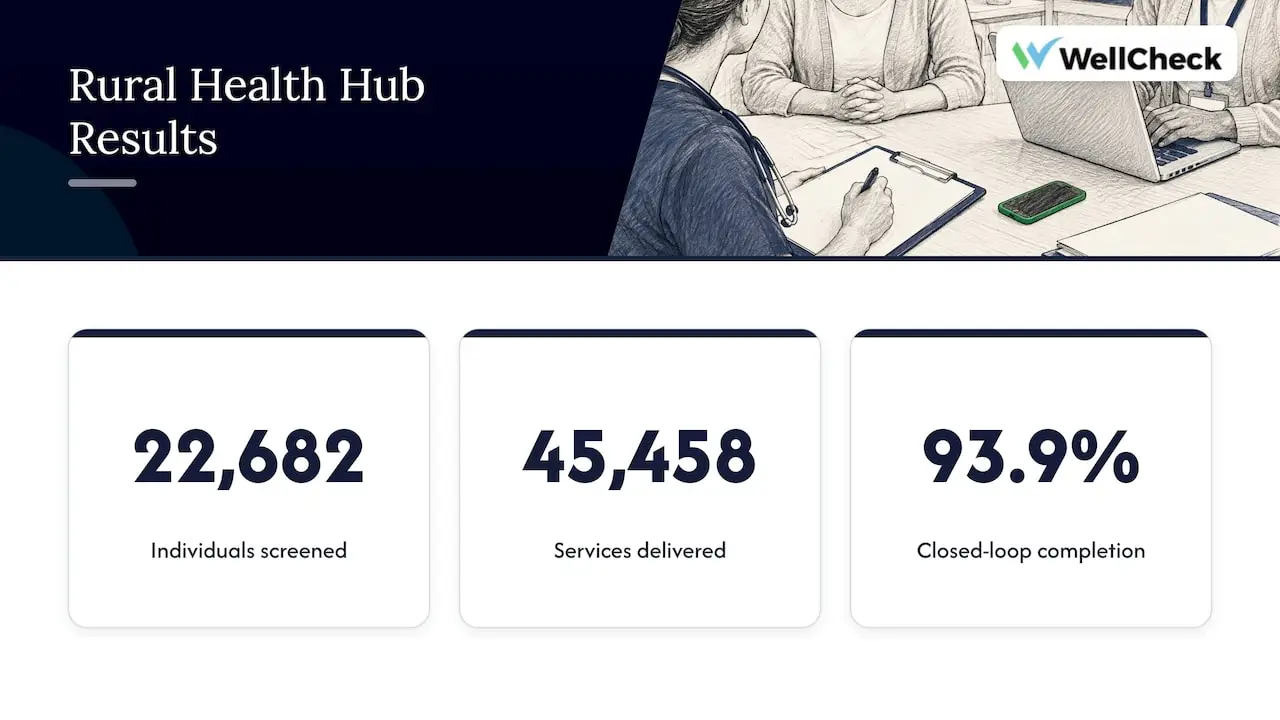
In one rural health hub deployment with a multi-partner ecosystem, EquiLoop recorded 22,682 individuals screened, 45,458 services delivered and a 93.9% closed-loop completion rate.*
*Rural health hub deployment with a multi-partner ecosystem. Includes both clinical and social services referrals.
If you want to see how this would map to your referral pathways and funder requirements, book a 30-minute demo.
FAQ
Is referral leakage the same as network leakage?
The terms overlap. In hospital finance, referral leakage and network leakage both describe patients leaving the network for out-of-network care. In community health programs, the term is often used for any referral, clinical or social, that never reaches a documented outcome, whether or not the patient left the network.
What is a good referral closure rate?
No single rate applies to every program. Published figures vary widely: Denver Health’s clinic average rose from 18.2% to 73.3% over two years, and Connect Oregon resolved 54% of cases in its first data period. Your own baseline, by need type and by partner, is the benchmark that matters.
Why do so many referrals end as unable to contact?
In both the Ohio and Oregon data, inability to contact the client was the largest single reason a referral went unresolved. Collecting a second phone number, an email or a family contact at the time of the screen, and offering help immediately after a positive result, are the steps the Ohio authors recommend.
What should we report to funders about referrals?
Report the step counts (screened, needs found, consented, placed, accepted, resolved), the number unresolved with reasons, and the time between steps. Volume alone does not show follow-through.
Sources
- On designing of a low leakage patient-centric provider network
- A Framework for Evaluating Social Determinants of Health Screening and Referral
- A First Look at Connect Oregon Implementation
- Implementation of NCCARE360, a Digital Statewide Closed-Loop Referral Platform
- EHRA: Closed-Loop Referrals for Health-Related Social Needs
- Harvard Government Performance Lab: Using Data to Identify Gaps in Service Referrals
- Health Affairs: Assessing the Capacity of Local Social Services Agencies
- NCQA: Implementing a Community Referral Platform
- ACEP: What We Measure Determines What We Can Fix
- CMS: Closing-the-Loop
- IHS Purchased/Referred Care Program Fact Sheet
- AMA CSAPH Report 2-A-25: Addressing Social Determinants of Health Through Closed-Loop Referral
- AAFP: Are Your Patient Referrals Getting Lost in the Shuffle?
- Indiana Rural Health Transformation Program working group document
