
A resource directory helps someone find who provides a service. A referral platform sends that referral, tracks whether it was accepted, and confirms whether the person actually got served. The deciding factor is whether your program needs closed-loop tracking and outcome data, not just discovery. If funders or payers ask you to prove follow-through, you need a referral platform, and the sections below cover the features, rollout hurdles, and vendor questions that come next.
TL;DR:
- Referral platforms are essential when programs must track whether a referral results in actual service delivery and produce outcome data for funders or payers.
- They support closed-loop status updates, real-time workflow management, and generate reports needed for grant compliance, unlike directories that only list provider information.
- Successful implementation depends heavily on community partner engagement, ongoing data maintenance, and workflows aligned with existing staff operations.
- EquiLoop offers a tailored solution that manages referral routing, follow-up, outcome tracking, and funder-ready reporting, ideal for programs needing verified service delivery data.
- Vendor demonstrations should include live status updates, clear data ownership policies, and realistic system integration capabilities, with a dedicated liaison recommended for sustained success.
Table of Contents
- Directory vs Referral Tracking: A Side-by-Side Look
- What Each Platform Actually Delivers Day to Day
- Why CBO Buy-In Determines Whether Any of This Works
- How to Choose Between a Directory and a Referral Platform
- What Deployment Data Actually Shows
- Where to Go If You Need Closed-Loop Referral Tracking
- Sources
- FAQ
Directory vs Referral Tracking: A Side-by-Side Look
A directory answers one question: who does this? A referral platform answers a harder one: did the person we referred actually get help? That gap defines almost everything else in this comparison.
Directories are searchable listings, typically organized by service category, eligibility, and location, making healthcare SEO services crucial to help patients and staff find these resources easily. Staff or patients browse, find a match, and make contact on their own. Nothing in a plain directory confirms whether that contact turned into an appointment, a delivered service, or a resolved need. Referral platforms add a workflow layer on top of that same information: a referral gets sent to a specific partner, that partner accepts or declines it, and the system logs status changes until the loop closes.
Who maintains the data differs sharply between the two models. A directory’s value lives entirely in how current its listings are, and that burden usually falls on a small internal team or a contracted data service that calls partner organizations on a set cycle. A referral platform shifts part of that maintenance to the receiving partners themselves, since they have to log in and update referral status to keep the workflow moving. That does not eliminate the maintenance problem, but it distributes it differently.
The outcomes each model supports also diverge:
- A directory typically reports search volume or listing views, which tells you interest, not impact.
- A referral platform reports referral counts, acceptance rates, and completion rates, which is the kind of data most funders and payers now expect.
- Directories rarely produce data suitable for grant reporting on their own.
- Referral platforms generate the audit trail needed for outcome reporting and, in many cases, for CMS Accountable Health Communities style reporting.
Cost and timeline follow the same logic. A directory is cheaper to stand up because it is mostly a database and a search interface. A referral platform costs more up front because it has to integrate with partner workflows, sometimes touch an EHR, and support ongoing status updates rather than a one-time listing. Implementation timelines for directories often run weeks; referral platforms commonly take months because partner onboarding and workflow training are part of the build, not an afterthought.
What Each Platform Actually Delivers Day to Day
The SIREN/UCSF guide to community resource referral platforms breaks most tools into a consistent set of functions: screening, a resource directory, referral management, care coordination, privacy protection, systems integration, and reporting. Not every vendor builds all seven well, and the gap between “has the feature” and “the feature actually works for your partners” is where most disappointment happens.
- Directory data quality. The fields that matter most are hours of operation, eligibility criteria, required documents, and languages spoken, not just an address and a phone number. Listings decay faster than most program leads expect, because CBO funding, staffing, and program eligibility change constantly and nobody notifies the directory when it happens.
- Referral initiation flows. Some referrals start with a clinician sending a single referral during a visit. Others are patient-facing, where the individual browses and self-refers. Larger programs sometimes batch referrals into lists for outreach teams to work through. A platform that only supports one of these flows will frustrate staff who need another.
- Closed-loop status tracking. A referral typically moves through stages such as sent, accepted, in progress, and completed or declined. Status updates need to reach the referring clinician and the reporting dashboard automatically, not through a phone call three weeks later.
- EHR integration, realistically defined. Most “EHR integration” means a referral order can trigger a record in the platform, or a completed referral note can post back to the chart. Full bidirectional, real time integration is still the exception, and the handoff between systems is usually where delays creep in.
- Reporting outputs. Programs need two different things here: a live dashboard staff check daily, and a funder-ready export they can hand to a grant officer without reformatting. Key metrics include referral counts, completion rates, and time-to-service, and a platform that cannot produce all three on demand will cost you hours at every reporting deadline.
Closed-loop tracking is not a theoretical benefit. One multi-partner rural health hub deployment recorded 22,682 individuals screened, 45,458 services delivered, and a 93.9% closed-loop completion rate.* That completion rate is the number a directory simply cannot produce, because nothing in a directory model tracks what happens after the search.
*Rural health hub deployment with a multi-partner ecosystem. Includes both clinical and social services referrals.
Why CBO Buy-In Determines Whether Any of This Works
The best platform in the world fails if your community partners will not log in and update it. That is the single most common implementation problem program leads report, and it is worth planning for before you sign a contract, not after.
Engagement is the first wall. Many CBOs run on thin staffing and see no direct benefit to updating referral status for a hospital system’s dashboard. Research on referral technology adoption found that use depends heavily on perceived usefulness and workflow fit, not on feature lists. Programs that succeed usually assign a coordination center or dedicated navigator team to triage referrals and keep partners engaged, rather than expecting the software to do that work on its own.
Data maintenance is a recurring cost, not a one-time task. Studies on directory upkeep confirm that service listings go stale quickly because CBO funding and staffing shift constantly. Build a verification cadence, quarterly at minimum, and expect some partner fatigue when the same update requests land in their inbox every few months.
Workflow fit beats feature count. Training has to match how staff already work, not how the vendor imagines an ideal clinic operates. Standard operating procedures that spell out exactly who sends what referral, when, and to whom cut down on the confusion that kills adoption in month two.
- Privacy and consent need separate tracks for medical data covered under HIPAA and nonmedical social service data, which often carries different release requirements.
- Use data minimization: collect only what the referral actually requires, not everything a form template offers.
- Interoperability standards like those from the Gravity Project and USCDI are moving the field toward shared data formats, but they are not universal yet, so plan for partial integration rather than a clean data pipe.
Pro Tip: Budget for a part-time CBO liaison role in year one. Programs that skip this step tend to see referral response rates drop within the first quarter, once the novelty of a new tool wears off.
How to Choose Between a Directory and a Referral Platform
Start with one question: does your program need to prove that a referral led to a delivered service? If yes, you need closed-loop tracking, which means a referral platform. If your program only needs to help staff or patients find the right resource, and nobody downstream requires outcome proof, a directory service may be enough, at least for now.
- Confirm your reporting obligations first. Grant terms, payer contracts, and value-based care agreements increasingly ask for completion rates and time-to-service, not just referral counts. If any of your funding sources require that, a directory alone will leave you unable to answer.
- Insist on closed-loop status updates as a baseline requirement. Ask vendors to demonstrate, live, how a referral status changes from sent to completed and how that update reaches both the referring clinician and your dashboard.
- Ask about data governance up front. Who owns the directory data, who is responsible for verifying it, and what happens if a CBO partner stops responding to update requests?
- Request specific SLAs, not vague promises. Reasonable benchmarks include referral acknowledgment within 48 to 72 hours and directory data refresh cycles no longer than 90 days. Vendors who cannot commit to a number here are telling you something.
- Push on integration claims. Ask exactly what “EHR integration” means for their platform: does it support HL7 or SMART on FHIR, or is it a manual export/import process labeled as integration?
- Talk to your CBO partners before you sign anything. Ask what training and ongoing support they will need, and whether their staffing can realistically sustain another login and another workflow.
Red flags worth walking away from: a vendor who cannot show a live demo of status updates, a directory sold as “referral tracking” with no closed-loop confirmation step, and a cost model with no clarity on who pays for CBO-side training.
What Deployment Data Actually Shows
Closed-loop platforms only work when the technology matches how community partners already operate, not the other way around. That lesson shows up consistently in Health Affairs research on early adopters, which points to community partner engagement, internal change management, and privacy compliance as the three recurring hurdles, regardless of which platform an organization chose.
A completed referral flag in a system is not proof that a person’s need was met. Programs that pair status tracking with follow-up conversations, not just automated flags, get a truer picture of whether care actually happened.
Local configuration matters more than most procurement checklists suggest. A referral network built around a rural hospital’s partner list looks nothing like one built around a county health department’s CBO roster, and a platform that forces every deployment into the same template tends to create friction rather than remove it. Training cadence matters too: a single onboarding session rarely sticks, and the deployments that sustain CBO engagement usually build in refreshers every few months.
The 22,682 individuals screened, 45,458 services delivered, and 93.9% closed-loop completion rate cited earlier reflect that kind of sustained, multi-partner effort, not a one-time software install. Governance practices, in line with AMA guidance on closed-loop referral systems, and human navigation are what turn a status field into a reliable number. EquiLoop’s role in that workflow is specific: it manages screening, referral routing, follow-up tracking, and reporting output, and it is built to sit alongside a program’s existing systems of record rather than replace them.

Where to Go If You Need Closed-Loop Referral Tracking
If your program has concluded it needs status tracking and funder-ready outcome data, not just a searchable list of services, that points toward a referral platform built for that job. EquiLoop handles referral routing to clinical and community partners, follow-up and status tracking, outcomes dashboards, and reporting formatted for grant and funder review, aligned with the decision criteria above.
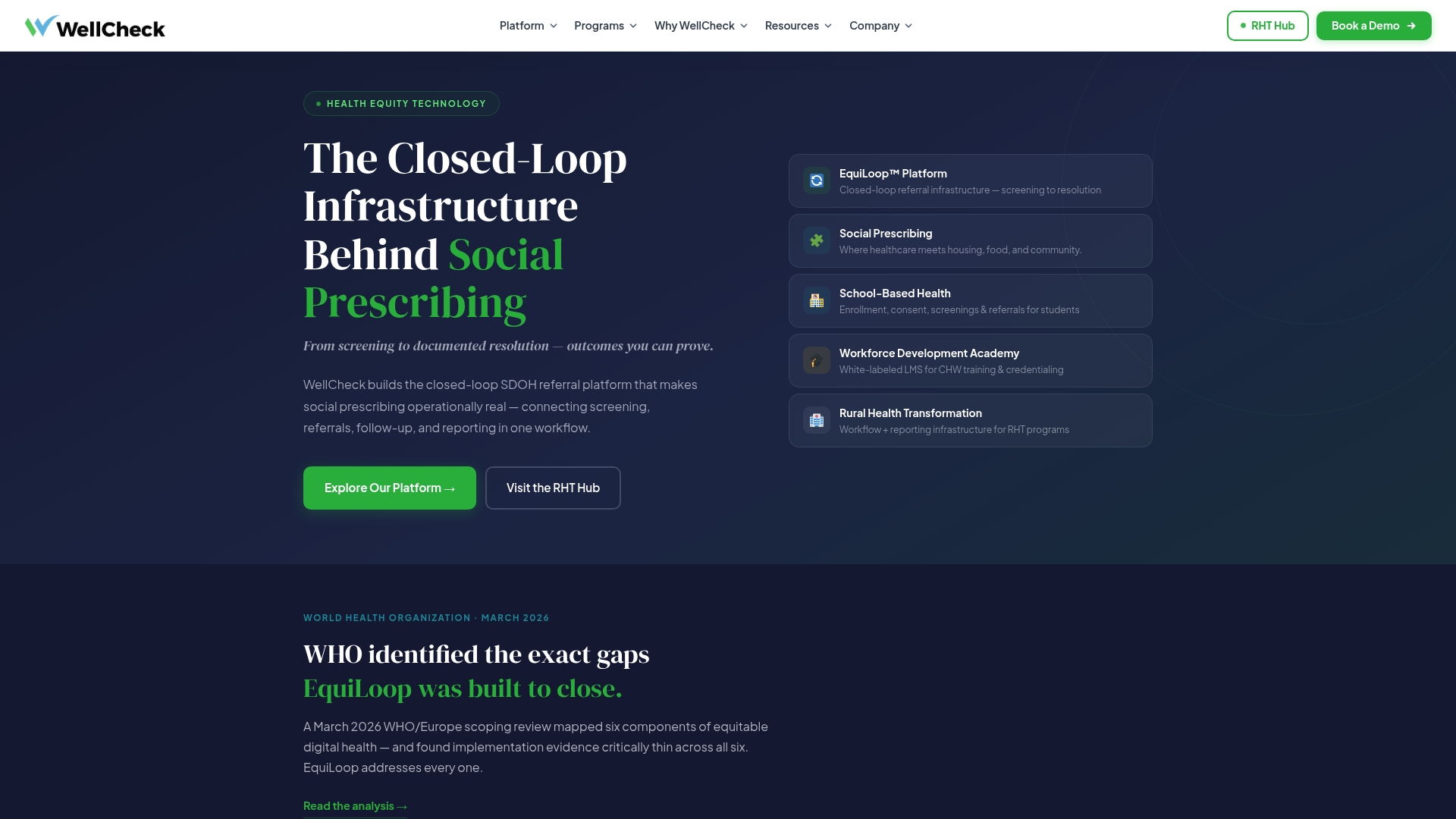
EquiLoop fits program directors and care coordination leads who need to document outcomes, not just log activity. It is configurable to align with the partner network and reporting requirements a program already has, rather than forcing a generic template onto an existing referral network. For programs also building out community health worker or navigator training, the Workforce Development Academy offers white-labeled training and credentialing that pairs with the referral workflow.
If closed-loop tracking is the gap in your current setup, book a 30-minute demo to walk through how EquiLoop would map onto your partner network and reporting requirements.
Sources
- CMS — Accountable Health Communities Model / related innovation models
- Community Resource Referral Platforms: A Guide for Health Care Organizations (SIREN/UCSF)
- Implementing community resource referral technology: facilitators and barriers described by early adopters (Health Affairs)
- If you build it, they may not come: Understanding factors influencing use of a community resource referral technology
FAQ
What Is the Main Difference Between a Directory and a Referral Platform?
A directory helps someone find a service provider through a searchable list. A referral platform sends the referral, tracks its status, and confirms whether the person received the service, which is what makes closed-loop reporting possible.
What Are the Four Types of Referrals?
Referral systems generally handle clinician-initiated referrals during a visit, patient self-referrals through a portal, batch referral lists for outreach teams, and CBO-to-CBO referrals between community partners. Which types a platform supports well varies significantly by vendor.
What Are CMS Guidelines for Closed-Loop Referrals?
CMS has promoted closed-loop referral tracking through models like the Accountable Health Communities Model, which ties screening and navigation to measurable service delivery and follow-up. Programs reporting to CMS-adjacent funding sources should expect completion-rate data to be part of the requirement.
What Should I Look for in a Referral Platform?
Prioritize closed-loop status updates, clear data governance over who maintains directory listings, realistic EHR integration, and reporting that produces funder-ready exports without manual reformatting. Ask vendors for a live demonstration of a referral moving from sent to completed before signing anything.
Can a Program Use Both a Directory and a Referral Platform?
Yes, and many programs do: a directory covers broad service discovery while a referral platform handles the smaller set of referrals that need tracked follow-through and outcome reporting. EquiLoop is designed to complement existing systems of record rather than replace a directory a program already relies on.

