
A referral workflow implementation succeeds when it reliably closes the loop: every referral has a tracked disposition and a consult report that makes it back to the referring clinician. Getting there takes five moves: map the current process, assign accountable roles, enable bi-directional electronic exchange, test in phases, and measure performance with a clinic-level dashboard.
TL;DR:
- Measure each pilot phase by clinic for at least 30 days, tracking consult report receipt, scheduling delay, and completed outreach after missed appointments.
- Assign named owners to referral closure and daily worklists; clerks should flag referrals unscheduled after 7 days, while navigators escalate urgent cases to reviewers.
- Use a unique identifier on every referral; support CCDA, FHIR, or IHE 360X exchange where partners can, so returned reports reconnect to requests.
- Review closure rate, appointment wait, missed visit rates, and referrals pending over 30 days weekly at both clinic and clinician levels.
Table of Contents
- Why Referrals Fail Today
- Core Components of a Closed-Loop Referral Workflow
- Step-by-Step Implementation Plan for Referral Workflows
- Technology and Standards That Enable Closed-Loop Referrals
- Measurement, Dashboards, and Compliance
- Governance, Agreements, and Staff Roles That Sustain Performance
- Operational Proof Points from Rural Referral Deployments
- How EquiLoop Supports Referral Workflow Implementation
- FAQ
- Sources
Why Referrals Fail Today
Most referral breakdowns trace back to a handful of repeatable failure modes, not random error. Faxed referrals disappear into inboxes nobody owns. Specialist reports never return to the referring clinician. Scheduling gaps stretch into weeks, and patients who miss one appointment often fall out of the workflow entirely. Parallel systems, a spreadsheet here, a sticky note there, spring up as workarounds and quietly break the audit trail.
The operational cost shows up as patient leakage, delayed diagnosis, and reporting gaps that leave programs unable to answer questions from funders or MIPS auditors. Peer-reviewed implementation research supports the idea that process redesign and clear role assignment, not just new software, drive better closure rates.
- Fax-and-forget referrals with no confirmation of receipt
- Missing or delayed specialist consult reports
- Scheduling gaps and no-show follow-up that never happens
- Parallel manual systems that break reporting accuracy
Core Components of a Closed-Loop Referral Workflow
Every closed-loop workflow rests on the same structural pieces, regardless of organization size.
- Process mapping and intake standardization. Walk the referral path end to end with clinicians and staff, then standardize intake forms so required fields are not optional.
- Assigned roles and worklists. Designate specialist reviewers, schedulers, and care team follow-up staff, each with a defined queue of referrals to manage.
- Routing rules and eligibility criteria. Define clear destinations and acceptance criteria so referrals land with the right partner the first time.
- Bi-directional communication and unique referral identifiers. Attach an identifier to each referral so the consult report maps back to its origin and the loop actually closes.
Pro Tip: Build intake forms with the clinicians who will use them. Forms designed without clinician input tend to accumulate the gaps that cause downstream delays.
Step-by-Step Implementation Plan for Referral Workflows
A referral workflow implementation moves faster and sticks longer when it follows a fixed sequence rather than running everything at once.
- Align stakeholders and set measures. Agree on goals early and anchor at least one metric to Measure 374, the CMS/QPP quality measure for closing the referral loop.
- Map current-state workflows. Identify gap metrics such as referrals unscheduled past 30 days and missed no-show follow-up.
- Design the workflow. Build intake forms, define data fields, set routing logic, and draft care coordination agreements with partner sites.
- Build and integrate. Configure EMR order sets, eReferral or portal settings, referral identifiers, and any needed interfaces.
- Test in three phases. Bench test the configuration, run a pilot cohort, then move to a soft go-live, with acceptance criteria at each stage.
- Operationalize. Train staff, assign worklists, set escalation flows, and establish a daily or weekly monitoring cadence.
- Scale. Add partner clinics, iterate on metrics, and keep care coordination agreements current.
The AHRQ eReferral implementation handbook recommends measuring each pilot phase by clinic for at least 30 days before expanding, tracking consult report receipt, scheduler lag, and no-show outreach completion.
| Phase | Primary focus | Minimum measurement window |
|---|---|---|
| Bench testing | Order sets, mapped codes, opt-out pathways | Before go-live |
| Pilot cohort | Consult report receipt, scheduler lag | 30 days per clinic |
| Soft go-live | No-show outreach completion, escalation flow | 30 days per clinic |
Technology and Standards That Enable Closed-Loop Referrals
The technology layer matters less than the decisions behind it. Three common setups exist: standalone eReferral portals, EMR-native referral modules, and integration middleware that connects multiple systems. Each can support closed-loop referrals when configured with the right standards and identifiers.
- Plan for a unique referral identifier on every referral so a returning consult report maps back to its origin.
- Account for CCDA and FHIR exchange formats, and IHE 360X where partner systems support it, since 360X is purpose-built for closed-loop referral exchange.
- Prioritize sending and receiving referral identifiers before anything else, since this is what lets a consult report reconnect to the original request.
- Weigh quick wins, worklists and email alerts, against longer-term FHIR-based integrations that take more IT time but scale further.
Measurement, Dashboards, and Compliance
Four metrics carry most of the weight in a referral workflow: percent of referrals closed with a consult report received, time-to-appointment, no-show and reschedule rates, and referrals left unscheduled past 30 days.
Closing the referral loop is the specific quality metric behind Measure 374, which defines the numerator as referrals for which the referring clinician receives a report from the clinician the patient was referred to. That specification also sets the measurement period and reporting expectations programs need to follow for compliance.
| Metric | What it tracks |
|---|---|
| Referral closure rate | Consult report received back at origin |
| Time-to-appointment | Days from referral to scheduled visit |
| No-show/reschedule rate | Missed or moved appointments |
| Referrals unscheduled >30 days | Referrals still pending past the target window |
Review these numbers at both the clinic and clinician level on a weekly cadence, and set performance targets that staff can see themselves moving.
Governance, Agreements, and Staff Roles That Sustain Performance
A workflow holds up over time only when governance backs it. Care coordination agreements with partner sites should spell out information exchange expectations, reporting timelines, and an escalation path for referrals that stall.
Accountability needs a name attached to it. Someone owns the referral closure measure, and someone else, usually a clerk, medical assistant, or navigator, owns the daily worklist of following up on open referrals.
- Define escalation timing in writing: clerks flag referrals unscheduled past 7 days, navigators escalate clinical urgency to a designated reviewer.
- Build a short training curriculum for navigators, clerks, and MAs so new staff can run the workflow without relying on institutional memory.
Pro Tip: Put the escalation matrix on one page. Staff follow a one-page rule far more consistently than a policy buried in a longer document.
Operational Proof Points from Rural Referral Deployments
Clinician codesign of referral forms, designated staff worklists, and funder-ready dashboards are the practices we keep seeing work across rural and community health deployments. In one rural health hub deployment with a multi-partner ecosystem, covering both clinical and social services referrals, the workflow reached 22,682 individuals screened, 45,458 services delivered, and a 93.9% closed-loop completion rate.[^1] Leaders who want ready templates can start with a step-by-step implementation plan or a program leader’s closed-loop guide.
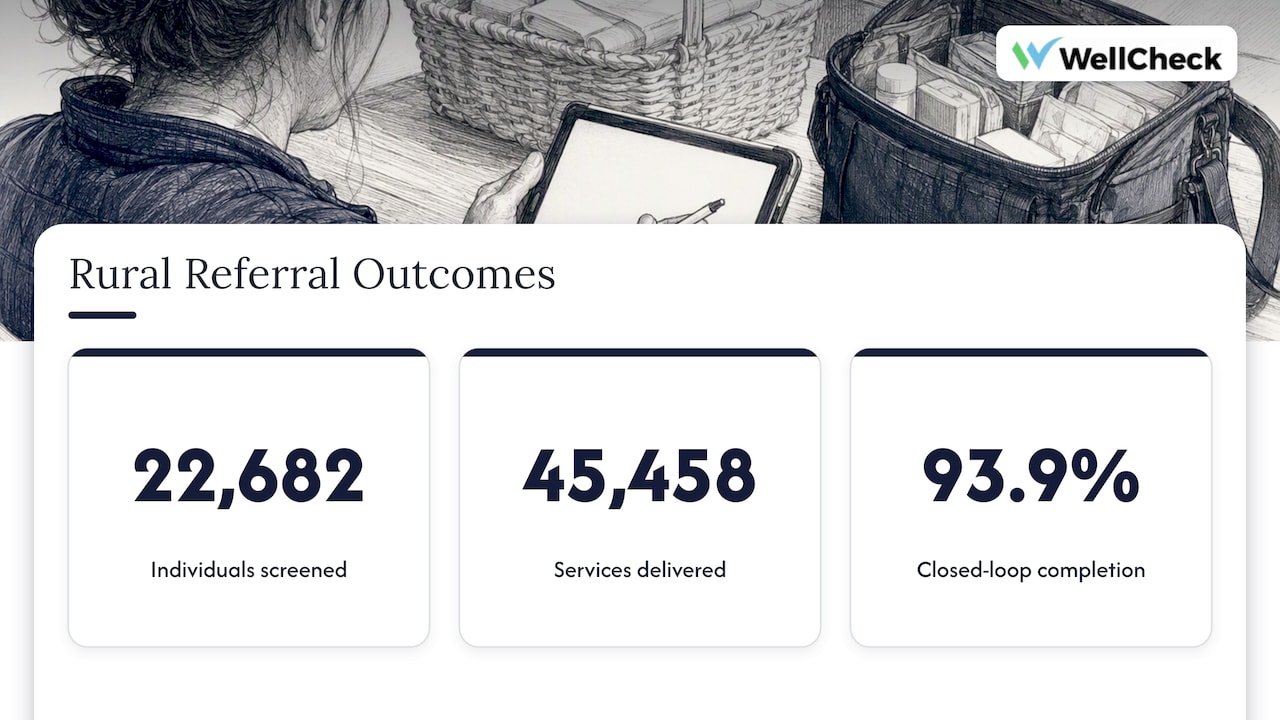
[^1]: Rural health hub deployment with a multi-partner ecosystem. Includes both clinical and social services referrals.
How EquiLoop Supports Referral Workflow Implementation
EquiLoop manages the full referral workflow: SDoH screening and intake, routing to clinical and community partners, follow-up and status tracking, and outcomes dashboards built for funder reporting. Each deployment is configured around the partner network and referral pathways an organization already has, so EquiLoop complements EHRs and case management systems rather than replacing them.
- See how referral routing and tracking work in EquiLoop
- Review intake fields and routing logic requirements before your next planning meeting
- Confirm referral/authorization data requirements with billing partners like ClaroClaim to avoid downstream denials
- Check readiness for electronic exchange with destinations such as rural teleradiology services
If a closed-loop referral workflow is on your roadmap this year, schedule a 30-minute demo to walk through how EquiLoop fits your existing referral pathways and reporting requirements.
This article is general information, not a substitute for advice from a qualified doctor. Consult a qualified healthcare professional about your own circumstances before acting on anything here.
FAQ
What are the typical success rates for referral programs?
Baseline referral closure rates are commonly low, and national program guidance has documented sites raising closure substantially after redesigning their process and assigning clear roles. Results vary widely by setting, so track your own closure rate against Measure 374 rather than assuming a universal benchmark.
How do I create a referral system?
Start by mapping the current referral path, then standardize intake, assign accountable roles for scheduling and follow-up, and enable bi-directional communication so consult reports return to the referring clinician. Test the design in a pilot before rolling it out across additional clinics.
What is referral management in healthcare?
Referral management is the set of processes and tools that track a referral from the point it is made through scheduling, the specialist visit, and receipt of the consult report back at the originating clinic. It covers routing, follow-up, and the reporting needed to show whether referrals actually resulted in completed care.
What is an internal referral in healthcare?
An internal referral sends a patient from one provider or department to another within the same health system or organization, rather than to an outside specialist. The same closed-loop principles apply: the referral needs tracking, a clear destination, and confirmation that the visit and report were completed.
Sources
- 2026 Measure 374: Closing the Referral Loop: Receipt of Specialist Report (CMS/QPP)
- eReferral implementation handbook (AHRQ)
- Systems engineering and human-factors approaches to referral workflow improvement (PMC article)
