
We recommend a five-stage, role-first onboarding sequence: preboarding, orientation, training, integration, and sustainment. Each stage secures role clarity, agreed workflows, a data-sharing agreement, and monthly feedback before partners take on live referrals. A short pilot and monthly scorecards anchor the process. Templates and legal pointers for MOUs and data-sharing agreements appear below.
TL;DR:
- Small pilot referrals should be limited to five to ten cases to identify issues early before scaling the process.
- A dedicated internal owner must oversee the entire onboarding sequence to ensure consistency and accountability.
- Agreements like MOUs, DUAs, or BAAs should specify only essential fields initially for smaller partners, with larger organizations handling full contracts.
- Partner staff require competencies in roles, privacy, referral procedures, and escalation steps, verified through supervised pilots and competency checks.
- Using simple coordination methods such as shared calendars and weekly huddles can outperform complex technology in early onboarding phases.
Table of Contents
- A step-by-step framework for onboarding community partners
- A reusable checklist and templates for onboarding
- Governance and data sharing: MOUs, DUAs, and BAAs
- Training and capacity building for new partners
- Monitoring partner performance and sharing results
- Common onboarding pitfalls and how to avoid them
- Operational lessons from real-world partner deployments
- How WellCheck supports partner onboarding
- FAQ
- Sources
- Authoritative templates and guidance
A step-by-step framework for onboarding community partners
Onboarding works best as a sequence, not a single event. Each stage has a narrow goal, and skipping one usually shows up later as confusion over who owns what.
- Preboarding (week 1 to 2): Clarify program goals, assess the partner’s current capacity, and confirm constraints like staffing hours or existing caseloads before signing anything.
- Orientation (week 2 to 3): Introduce shared values, name a single point of contact on each side, and set communication norms, such as response-time expectations for referral updates.
- Training (week 3 to 5): Deliver role-based modules with short competency checks, using a learning management system or brief microlearning sessions rather than long seminars.
- Integration (week 5 to 8): Run pilot referrals through the actual workflow, with a supervisor reviewing each case before the partner operates independently.
- Sustainment (ongoing): Review data monthly, offer refresher training as needed, and recognize partners whose performance improves.
A few practices make the sequence hold together:
- Assign one internal owner for the whole onboarding process, not a committee.
- Keep the pilot small, so early problems surface before scale.
- Document every agreement in writing, even informal ones with small community-based organizations.
Programs that pair technology adoption with workflow redesign and hands-on training see stronger uptake than programs that roll out new tools before the workflow is settled, according to health information exchange pilot reports. Our referral implementation plan walks through comparable staging for rural and community clinics.
A reusable checklist and templates for onboarding
A compact checklist keeps onboarding consistent across partners of different sizes. At minimum, confirm these before a partner receives a live referral:
- Signed agreement on file (MOU or equivalent) naming the point of contact.
- Orientation session completed and documented.
- System or portal access granted and tested.
- Pilot referral pathway walked through with a supervisor present.
Four templates are worth preparing once and reusing for every new partner:
| Template | Purpose |
|---|---|
| Welcome email | Confirms contact names, timeline, and next steps |
| MOU checklist | Lists required fields before signature |
| Role description | Defines who does what in the referral workflow |
| Training plan | Sequences modules and sets completion dates |
Smaller community-based organizations often lack dedicated administrative staff, so trim the MOU checklist to the fields that are operationally necessary: who signs, what data moves, and how often reporting happens. Larger partners, such as hospital systems or health departments, can usually absorb a fuller agreement with defined escalation paths and formal reporting schedules.
Governance and data sharing: MOUs, DUAs, and BAAs
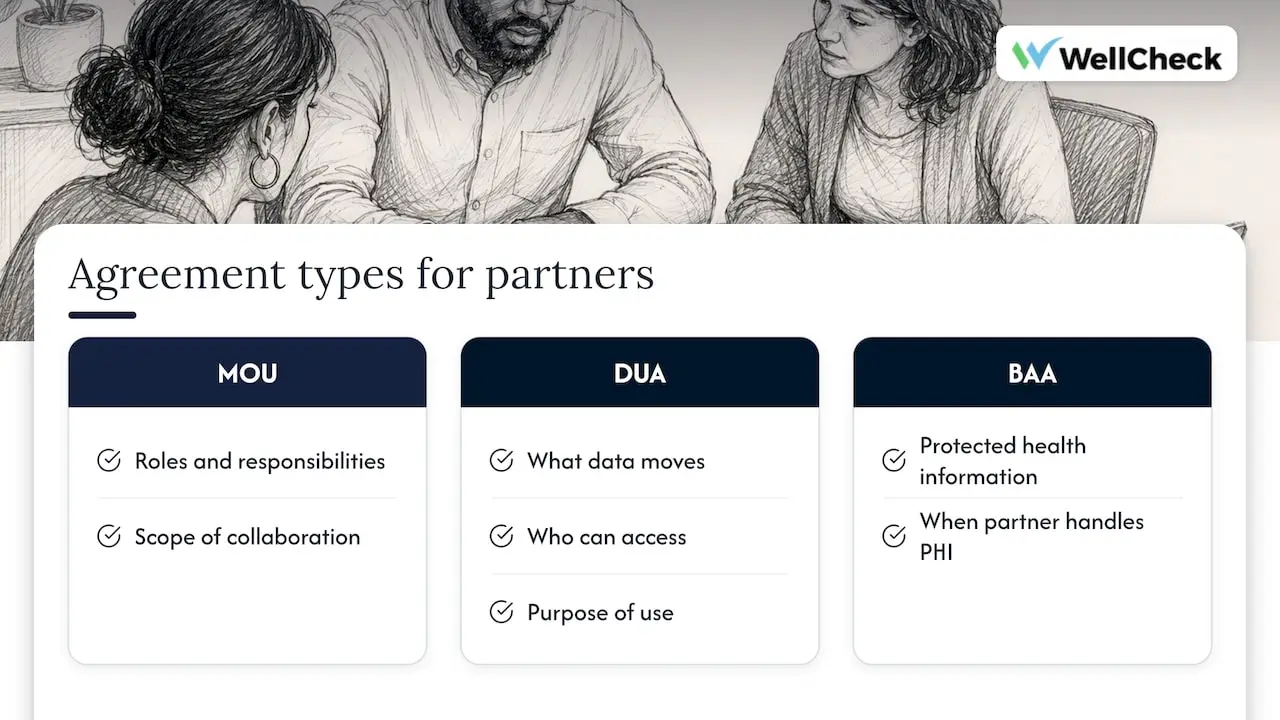
Three agreement types cover most partner relationships, and each documents something different. A memorandum of understanding records roles, responsibilities, and the general scope of collaboration. A data use agreement specifies what data moves, who can access it, and for what purpose. A business associate agreement applies when a partner handles protected health information on behalf of a HIPAA-covered entity.
Not every community partner is a HIPAA-covered entity, and that is not a barrier to participation. Practical options include sharing data that limits direct identifiers, using privacy-preserving methods so partners can link records without exchanging raw identifiers, or routing data through a technology partner that hosts the connection while preserving each partner’s control over its own data.
Multi-party governance documents, such as a shared use agreement combined with delegated-authority language, cut negotiation time and reduce the paperwork burden on smaller partners joining a data-sharing network, according to governance framework guidance from a longitudinal data integration project.
Pro Tip: Limit a new partner’s first 90 days of obligations to what they can realistically deliver, then schedule a joint capacity review at day 90 before expanding their responsibilities.
Expect legal review to take two to four weeks per agreement, longer when multiple partners sign the same document. Naming one internal signer and one external signer per organization, rather than routing through full boards, keeps review times shorter.
Training and capacity building for new partners
Partner staff, including community health workers, need four core competencies before they touch a live referral: role expectations, referral intake procedures, privacy basics, and escalation steps for cases that need follow-up.
Delivery format should match the partner’s size and schedule:
- Cohort workshops work well when onboarding several partners at once and building shared norms.
- Microlearning modules suit staff with limited time away from direct service work.
- A learning management system supports partners that need tracked completion records for funders or licensing bodies.
Guidance on including community health workers in health settings recommends collaborative planning that covers stakeholder engagement, defined operational structures, and built-in evaluation, rather than training delivered in isolation from the workflow itself, per the CDC’s CHW inclusion guide.
Before a partner goes live, verify readiness with a short competency quiz and a supervised pilot task. Sign-off should rest on actual performance during the pilot, not attendance at training.
Monitoring partner performance and sharing results
Four metrics cover most of what programs need to track: referral volume, closure or completion rate, time-to-service, and response time to initial contact.
Monthly partner-level referral data helps sustain engagement by showing partners concrete evidence of their own impact, according to AHRQ implementation guidance on automatic referral processes. A one-page scorecard delivered monthly, backed by a quarterly aggregated dashboard across all partners, keeps reporting manageable without burying anyone in detail.
- Present results as trends over time, not single-point judgments.
- Highlight improvement alongside raw numbers so partners see progress, not just gaps.
- Pair any below-target metric with a specific, discussable next step.
Our referral tracking metrics guide covers a fuller set of KPIs for programs closing the loop within 90 days.
Common onboarding pitfalls and how to avoid them
The most common failure is moving to technical integration before roles are clear. A partner who does not know who approves what will hesitate on every referral, and hesitation compounds into attrition. Unclear expectations and a lack of organizational backing inside the partner’s own agency cause the same problem from a different angle.
- Run a small pilot of five to ten referrals before full integration.
- Name a specific gatekeeper at the partner organization who can resolve questions without escalation.
- Schedule recurring touchpoints, weekly at first, rather than waiting for problems to surface.
Pro Tip: Spend more time than feels necessary explaining how the collaboration actually works day to day; upfront alignment on roles reduces partner churn more reliably than any technology fix.
Operational lessons from real-world partner deployments
A minimum-viable pilot needs only a handful of staffing roles: one internal owner, one named contact at each partner, and a supervisor who reviews early cases. Keeping the pilot small reduces the burden on partner staff who are learning a new workflow alongside their existing caseload.
Low-tech coordination often outperforms complex integrations in the first months:
- A shared calendar for check-ins beats a new scheduling platform nobody has time to learn.
- A brief weekly huddle, even 15 minutes, surfaces problems faster than a monthly report.
- A single shared login or simple access list avoids identity-management delays that stall pilots for weeks.
Pro Tip: Stage technology rollout after workflow and roles are settled, not before. Partners adopt tools faster once they already understand what the tool is supposed to replace.
A designated local convener, someone who already has relationships across clinical and community organizations, reduces onboarding friction and helps sustain partnerships once the pilot phase ends, as described in AHRQ’s Pathways Community HUB model guidance. Our community case management strategies page covers how that role fits into day-to-day coordination.
How WellCheck supports partner onboarding
Our platform addresses the gap this process is meant to close: tracking what happens to a referral after it is sent, not just whether it was sent. It manages intake, routes referrals to clinical and community partners, tracks follow-up status, and produces funder-ready reporting, all configured around the partner network you already have. For partner training infrastructure, our Workforce Development Academy offers a white-labeled LMS for community health worker and navigator credentialing. If you want to see how either fits your onboarding plan, schedule a 30-minute demo and come ready with your pilot scope, partner types, and the metrics you need to report.
FAQ
What are the 5 C’s of effective onboarding?
Definitions vary across industries, but a common version covers compliance, clarification, culture, connection, and checkback. For community partner onboarding specifically, the five-stage sequence of preboarding, orientation, training, integration, and sustainment covers the same ground in a public health context.
What is the process of partner onboarding?
Partner onboarding typically moves through preboarding and capacity assessment, orientation to shared goals and contacts, role-based training, a supervised pilot integration, and ongoing monthly review. Each stage should be documented before the partner takes on independent referral work.
What is an example of a community partner?
A community partner is any organization that refers to or receives referrals from a health program, such as a food bank, housing agency, school health program, or behavioral health provider. The role that matters for onboarding is the referral relationship itself, not the partner’s sector.
What is an onboarding partner?
An onboarding partner is the organization or individual joining a program’s referral network through a structured process that establishes roles, training, and data-sharing terms. The term describes the relationship stage, not a separate category of organization.
Sources
- Implementing automatic referral implementation guide (AHRQ)
- Building healthcare-community partnerships: process evaluation of a coalition approach to addressing cancer survivors’ health-related social needs (PMC)
- A community health record: improving health through multisector collaboration (CDC)
Authoritative templates and guidance
For legal language and governance examples, review AHRQ’s Pathways Community HUB model manual and the CDC’s community health record framework. For a peer-reviewed example of coalition governance in practice, see this process evaluation of a healthcare-community coalition. A healthcare educator’s nursing onboarding checklist offers a useful structural model for competency checks.
