
Referral incentive payments are generally illegal when a federal health care program patient is involved and the payment is intended to induce the referral. The Anti-Kickback Statute, the Beneficiary Inducements CMP, and OIG safe harbor rules govern the answer, and the American Medical Association’s ethics code separately forbids paying patients to recruit other patients. A narrow set of structures, mainly bona fide employee compensation and specific safe-harbor-compliant arrangements, can be lawful, but only when every condition is documented and met exactly.
TL;DR:
- A violation can bring fines of up to $100,000 per count, imprisonment for up to 10 years, and exclusion from federal health programs.
- The employee exception covers genuine employees paid for actual work, but independent contractors do not qualify merely because they perform services.
- Some coordinated care payment arrangements may qualify for a safe harbor, but only when every applicable eligibility and documentation condition is met.
- Keep signed agreements, objective eligibility rules, payment calculations, and timestamped referral records; an OIG advisory opinion applies only to its certified facts.
- State laws may also restrict incentives for commercial insurance or self pay patients, so a federal review alone cannot clear multistate programs.
Table of Contents
- Federal law that makes referral payments risky: AKS and the Beneficiary Inducements CMP
- Who is covered, and when an employee exception may apply
- Safe harbors, the OIG’s recent rule changes, and what they mean in practice
- What enforcement actions reveal about targeted conduct
- A practical compliance checklist for designing a referral incentive program
- Documentation regulators expect and when to request an OIG advisory opinion
- State laws add another layer beyond federal rules
- How incentive programs affect patient trust and provider relationships
- Compliant incentive models used in community and rural health settings
- Monitoring and auditing a referral incentive program over time
- How documentation tools support compliance reviews
- FAQ
- Sources
Federal law that makes referral payments risky: AKS and the Beneficiary Inducements CMP
The federal Anti-Kickback Statute makes it a felony to knowingly and willfully offer, pay, solicit, or receive any remuneration to induce referrals for items or services that Medicare, Medicaid, or another federal health program will reimburse. The statute does not require proof that care was medically unnecessary or that harm occurred. Intent to induce the referral is enough to trigger liability under the Anti-Kickback Statute.
Violations carry real consequences for an organization and for the individuals who signed off on the arrangement:
- Criminal fines of up to $100,000 per violation.
- Imprisonment for up to 10 years.
- Exclusion from participation in federal health care programs, which can end an organization’s ability to bill Medicare or Medicaid at all.
The Anti-Kickback Statute applies regardless of whether the referral results in unnecessary care. Remuneration intended to induce a referral is itself the violation, separate from any downstream clinical outcome.
The Beneficiary Inducements CMP is a separate civil rule affecting incentives offered to beneficiaries. Whether it applies depends on the circumstances and any applicable exceptions, so have counsel review a proposed arrangement.
Who is covered, and when an employee exception may apply
The Anti-Kickback Statute reaches any party in the referral chain, not only physicians. Clinics, community organizations, marketers, laboratories, and digital health platforms may face risk if remuneration is intended to influence referrals for federally reimbursable services. Other federal rules may also apply to a particular arrangement, so seek legal review.
One narrow, well-established lane exists: the bona fide employee exception. Payments an employer makes to a genuine employee for employment-related services, including a base salary or production bonus tied to legitimate work, can be structured to fall outside the statute’s reach when the underlying employment relationship is real and the compensation reflects actual services rendered.
That protection narrows quickly once an arrangement drifts from standard employment:
- Independent contractor arrangements do not qualify for the bona fide employee exception simply because they involve work; have counsel assess the arrangement.
- Have counsel review sign-on bonuses or other compensation connected to expected referrals.
- A payment tied to referral volume or value can raise legal concerns, particularly when it is not compensation for bona fide services. Have counsel review the structure.
Safe harbors, the OIG’s recent rule changes, and what they mean in practice
Safe harbor regulations describe specific arrangements that are protected from Anti-Kickback Statute liability, but protection is conditional: an arrangement must satisfy every element of a safe harbor precisely, with no partial credit for close compliance. The OIG’s safe harbor framework lists categories for specific arrangements, with protection depending on whether every applicable condition is met.
The Final Rule revising safe harbors and the Beneficiary Inducements CMP added safe harbors for certain value-based arrangements. Whether a particular arrangement qualifies depends on meeting the applicable conditions. It also revised patient engagement rules. Check the applicable safe harbor conditions and eligibility rules before relying on them.
In practice, this means two things for program leaders. First, a casual “refer a friend” reward program may not fit an existing safe harbor. Have counsel assess the arrangement against the specific safe harbor conditions. Second, organizations already participating in value-based arrangements with defined, accountable patient populations may have a narrow, legitimate pathway, provided every condition in the applicable safe harbor is met and documented.
Pro Tip: Treat “close to compliant” as noncompliant. A safe harbor either fully applies or it offers no protection at all.
What enforcement actions reveal about targeted conduct
Enforcement history shows regulators focus on substance over labels. The Department of Justice announced that Pfizer agreed to pay $59,746,277 to resolve allegations that its subsidiary Biohaven paid speaker honoraria and provided meals that the government characterized as remuneration intended to induce prescriptions, rather than genuine educational activities. In a separate action, the Department of Justice reported that health care providers and laboratory marketers agreed to pay over $1.9 million to settle allegations that commission-based marketing arrangements functioned as illegal kickbacks for lab referrals.
Settlements in this space routinely run into the tens of millions of dollars, with one 2025 case alone resolving for $59,746,277. The pattern across these cases is consistent: payments tied to referral volume, benefits that lack a documented legitimate purpose, and arrangements dressed up as speaker fees, management fees, or marketing commissions.
Watch for these red flags in any proposed incentive structure:
- Payment amounts that scale with the number or value of referrals generated.
- No written agreement describing the services the payment actually compensates.
- Gifts, meals, or honoraria disproportionate to any legitimate educational or business purpose.
A practical compliance checklist for designing a referral incentive program
Before launching or revising any incentive arrangement, work through these steps in order:
- Determine federal program exposure. If Medicare, Medicaid, or another federal health program patient could be involved anywhere in the referral chain, default to the most conservative design and involve legal counsel early.
- Choose a lawful structure. Limit options to bona fide employee compensation meeting the employee exception, value-based arrangements that satisfy every safe harbor condition, or incentives aimed at non-beneficiaries that comply with applicable state law.
- Avoid direct cash payments to beneficiaries. Favor modest, well-documented supports that fall within recognized exceptions, such as limited preventive-care incentives, rather than open-ended referral bonuses.
- Put terms in writing. Require signed agreements, objective eligibility criteria, consistent payment calculations, and routine internal audits, with records retained for review.
- Run a legal review before launch. For any arrangement without a clear precedent, consider requesting a formal OIG advisory opinion rather than assuming an informal interpretation will hold up.
Pro Tip: Build the documentation trail before the first payment goes out, not after an auditor asks for it.
Our referral implementation plan for community and rural clinics walks through how these steps translate into day-to-day workflow decisions.
Documentation regulators expect and when to request an OIG advisory opinion
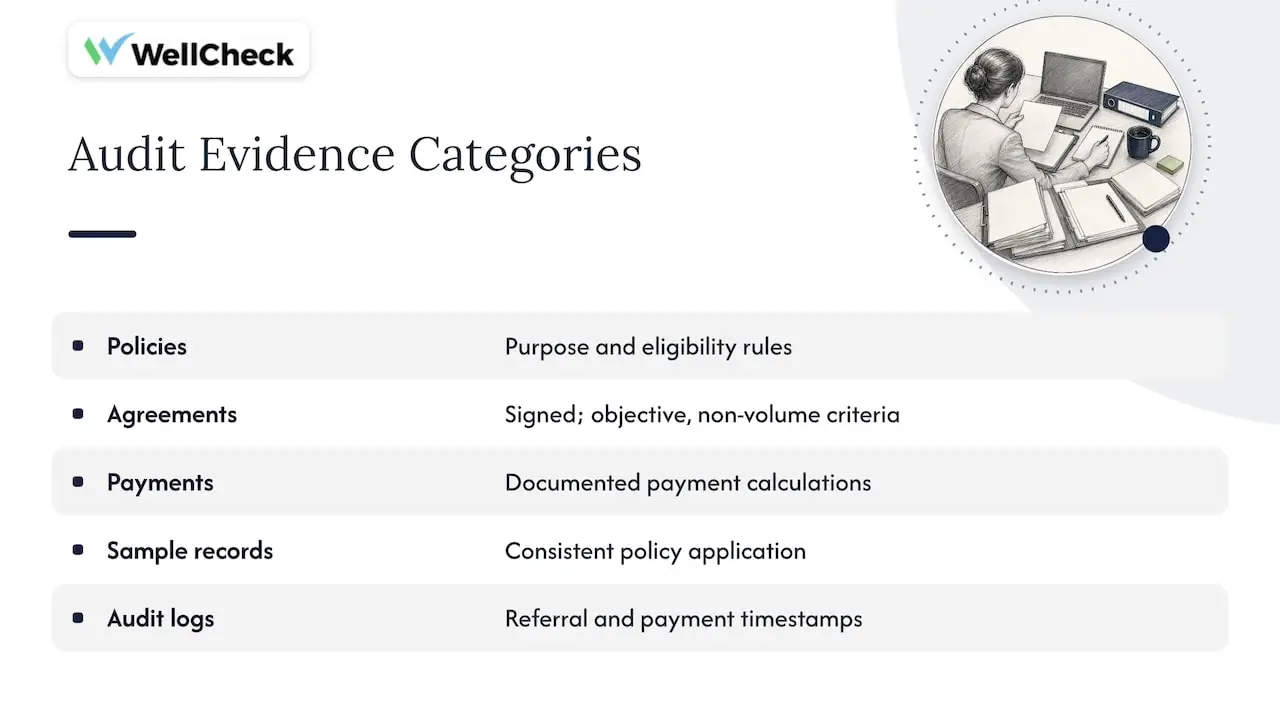
Regulators and auditors expect a specific paper trail: written policies describing the program’s purpose and eligibility rules, signed agreements showing objective, non-volume-based criteria, documented payment calculations, and a sample of records demonstrating the policy was applied consistently. Audit logs showing when referrals occurred and when payments were made matter just as much as the policy language itself.
An OIG advisory opinion offers formal, if narrow, protection. The requesting organization certifies a precise set of facts, and OIG issues a determination limited strictly to that fact pattern. In Advisory Opinion No. 23-15, OIG reviewed a program offering gift cards for recommending consulting services and found no prohibited remuneration under those specific certified facts, a result that would not necessarily extend to a differently structured program.
Closed-loop referral tracking with timestamped status changes gives an organization the evidence base to answer an auditor’s questions quickly or to prepare an accurate advisory opinion request, since the facts certified to OIG must match operational reality exactly.
State laws add another layer beyond federal rules
Federal statutes set the floor, but state law can impose additional restrictions on referral incentives, particularly for non-federal-program patients where AKS and the Beneficiary Inducements CMP do not directly apply. Many states have their own anti-kickback, fee-splitting, or patient brokering statutes that cover commercial insurance patients, self-pay patients, or specific service categories such as substance use treatment and home health referrals.
The AMA Code of Medical Ethics says that payment solely for referring a patient is unethical fee splitting. State rules may differ, so check the rules that apply to your program. A program’s federal-law analysis does not resolve whether state law applies. Ask counsel to review the rules in the states where the program operates.
This can matter for organizations operating across state lines or serving mixed payer populations. Do not assume that a referral incentive structure reviewed in one state is compliant in another. Ask counsel to review the rules that apply in each state. Given this variation, any multi-state program benefits from counsel familiar with each operating state’s specific statutes, rather than a single federal compliance check.
How incentive programs affect patient trust and provider relationships
Beyond legal exposure, referral incentives carry a relationship cost. The AMA Code of Medical Ethics states plainly that physicians must base referral decisions on medical need and quality of care, not financial gain, because incentives to patients for recruiting other patients can compromise the patient-physician relationship and distort the information patients share with their care team.
That concern applies directly to community health settings, where trust is often the determinant of whether a patient follows through on a referral at all. A patient who suspects a provider benefits financially from sending them to a particular specialist or partner organization may discount the recommendation, even when it is clinically sound. The erosion runs in both directions: patients may also feel pressured to refer family members or neighbors for a reward rather than because the service genuinely fits their needs, which can damage trust within tightly connected rural and community networks where word of mouth carries weight.
Transparent, non-coercive communication can help patients understand why a referral is recommended and whether a partner relationship exists. Transparency alone does not establish that an arrangement is lawful. Have counsel review the arrangement and its documentation.
Compliant incentive models used in community and rural health settings
Several incentive structures used in community and rural health programs avoid the legal and ethical pitfalls described above because they reward behavior other than the referral itself. Employee performance bonuses tied to documented care coordination duties may be considered under the bona fide employee exception, depending on the facts and structure.
Some patient incentives may fall within an applicable exception, but the rules and conditions depend on the arrangement. Have counsel review the proposed incentive before offering it. Partner organizations can document referral workflows in written memoranda of understanding. The document alone does not determine whether an arrangement raises remuneration concerns, so have counsel review it. Our guide on in-home geriatric care referrals illustrates how a structured, non-monetary referral relationship between a clinical program and a home care partner can function in practice.
Some value-based arrangements may qualify for a safe harbor when they meet every applicable condition. Have counsel determine whether a particular arrangement qualifies.
Monitoring and auditing a referral incentive program over time
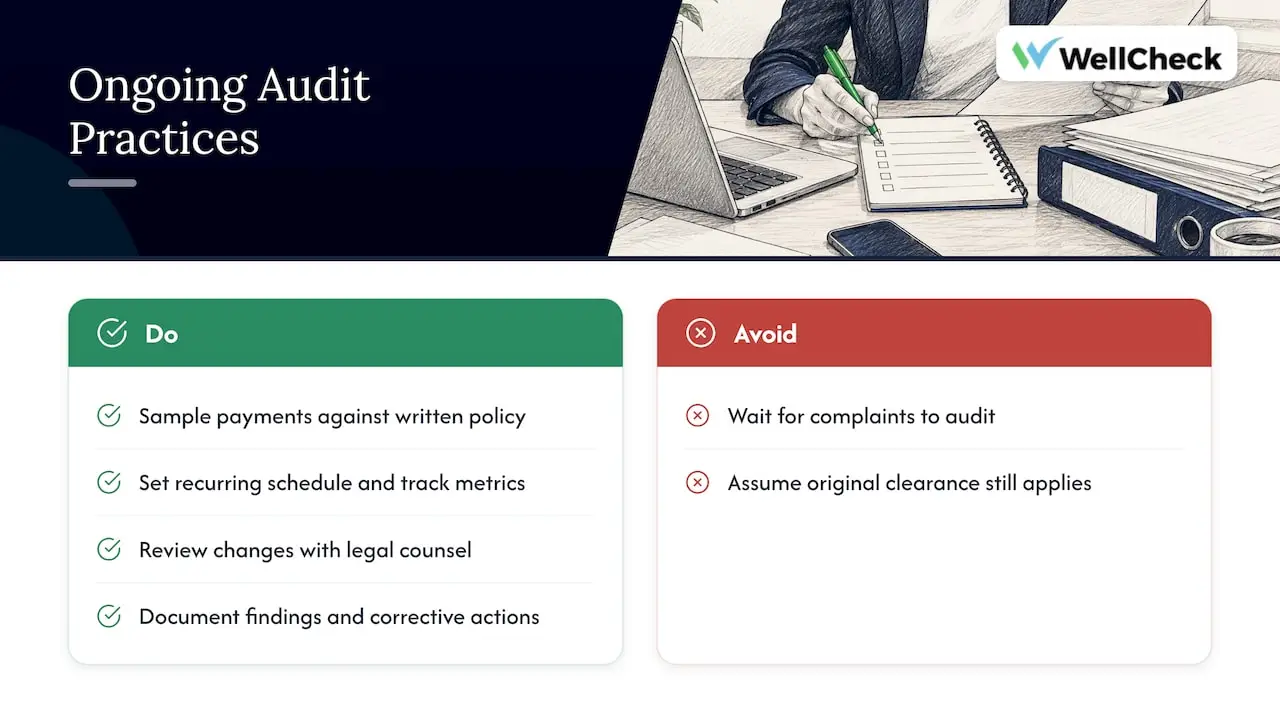
Compliance is not a one-time design exercise. Programs need ongoing monitoring because small drifts, a manager approving an exception, a payment calculation quietly adjusted, accumulate into patterns that look very different from the originally approved design. Routine audits should sample actual payments against the written policy, confirm that eligibility criteria were applied consistently, and flag any payment that appears to track referral volume rather than documented work.
Assign clear ownership for the audit function itself, whether that sits with compliance, legal, or a program director, and set a recurring schedule rather than reviewing only when a complaint arises. Track metrics such as time from referral to payment, frequency of exceptions granted, and consistency of documentation across payment cycles; our metrics guide for closing referral tracking gaps outlines the kind of measurement cadence that supports this review.
Any arrangement that evolves, new payment tiers, new partner organizations, new patient populations, should trigger a fresh legal review rather than an assumption that the original clearance still applies. Audit findings and corrective actions should be documented in writing, since that record becomes the evidence an organization produces if a regulator or funder ever asks how the program was supervised.
How documentation tools support compliance reviews
We cannot tell you whether a specific incentive arrangement is lawful. What we can do is help you capture the records a compliance review or audit will ask for. EquiLoop tracks referral status and outcomes in a configurable workflow, which means the documentation a legal review needs is organized rather than scattered across spreadsheets and email threads.
- Status tracking for every referral, from initial contact through resolution.
- Funder-ready reporting that compiles outcome data.
- Configuration built around the partner network and reporting requirements your organization already has.
This is infrastructure for evidence, not a substitute for legal review. If your team is evaluating or redesigning a referral incentive program and wants to see how closed-loop tracking supports that documentation, schedule a 30-minute demo to walk through it.
FAQ
What companies pay for referrals?
Consumer and retail businesses commonly run referral reward programs, but health care organizations face a different legal standard when a referral involves a Medicare or Medicaid patient. In health care, federal law restricts who can be paid for referrals and under what structure, so a model that works for a retail brand does not transfer directly to a clinical or community health setting.
What are some effective incentives for a referral program?
In health care, the safest incentive models reward documented work rather than the referral itself, such as bona fide employee compensation for care coordination duties or value-based payments tied to a defined patient population. Direct cash rewards for referring a patient carry significant legal risk under the Anti-Kickback Statute and should be reviewed by counsel before implementation.
Which app offers a flat cash payment per referral?
Whether a flat per-referral payment is lawful depends on the facts and applicable rules. Have counsel review the arrangement before implementing it. A referral model used in another industry may not be suitable for health care, especially when federal health care program patients are involved.
Do doctors receive incentives for referrals?
The AMA Code of Medical Ethics says that payment by or to a physician solely for a patient referral is unethical fee splitting. Whether federal law applies depends on the facts and should be reviewed by counsel. Lawful compensation instead comes through bona fide employment arrangements or value-based payment structures tied to documented services, not to the referral itself.
