
Public health grant reporting comes down to three report types: financial, compliance, and project or performance, as Grants. Final reports and closeout actions are subject to the deadlines in the applicable federal rules and award terms. Start by reading your Notice of Award for award-specific forms and due dates, then put every one of them on a shared organizational calendar.
TL;DR:
- Your Notice of Award controls required forms and deadlines; confirm reporting frequency and submission system before adding each obligation to a shared calendar.
- CDC generally requires an annual Federal Financial Report, but your Notice of Award may set quarterly, semiannual, or more frequent submissions.
- Subrecipients must submit reports within 90 calendar days after their subaward ends, before the recipient’s 120 calendar day closeout deadline.
- Keep receipts, payroll records, service logs, effort certifications, and verification notes; follow the award or agency retention schedule before destroying records.
- Record each service alongside its outcome, expense line, and supporting document, then reconcile program counts with financial reports monthly to explain discrepancies.
Table of Contents
- Which reports you will file and the forms behind them
- Deadlines and the systems where you submit
- Records to keep and how long to keep them
- Managing subrecipients and pass-through duties
- Closeout and audits: what to expect
- Tracking templates that produce funder-ready reports
- How we help you produce funder-ready reports
- FAQ
- Sources
Which reports you will file and the forms behind them
Each report answers a different funder question. Financial reports show where the money went. Performance reports show what it achieved. Compliance filings show you followed the rules attached to the award.
For financial reporting, CDC requires the Federal Financial Report (FFR, or SF-425) on an annual basis, except where your Notice of Award calls for more frequent filing. It captures expenditures and any unobligated balance. Performance reporting usually runs through the Research Performance Progress Report (RPPR), the Performance Progress and Monitoring Report (PPMR), or HRSA’s Annual Performance Report (APR). These combine narrative summaries, program indicators, and results tables that funders use to decide on continuation.
Compliance filings depend on your award terms. Subaward disclosures flow through FSRS, property reports use SF-428, and invention reporting goes through iEdison where it applies.
The forms program teams see most often:
- SF-425 (Federal Financial Report) for expenditures and unobligated balances
- RPPR, PPMR, or APR for progress narratives and indicators
- SF-428 and related forms for federally owned or acquired property
- FSRS entries for first-tier subawards
- SF-SAC (Single Audit data collection form) when an audit is required
- Final programmatic and financial reports at closeout
Deadlines and the systems where you submit
Cadence is set by your Notice of Award. Agencies collect financial reports at least annually, and some programs require quarterly or semiannual filing. For many CDC awards, annual FFRs are due according to the deadline specified in the award terms. Final reports follow a separate clock: under 2 CFR 200.344, all financial, performance, and other required reports are due no later than 120 calendar days after the period of performance ends.
Where you file depends on the agency and program:
- HRSA Electronic Handbooks (EHBs) for many HRSA performance reports, including the APR.
- The Payment Management System (PMS) for FFR submission on many HHS awards.
- Grants.gov and GrantSolutions for program-specific reporting.
- FSRS for required subaward reporting, with the data published on USAspending.gov.
Pro Tip: Set calendar reminders well before every deadline, and confirm your SAM.gov and UEI registrations are active well before the first report is due.
If you work with HRSA awards, our guide to HRSA grant reporting checks covers the issues that most often lead to payment holds.
Records to keep and how long to keep them
Auditors and grant officers expect every number you report to trace back to a source document. HHS tells recipients to keep accurate records of transactions made with federal funds and to be ready for audits of the federally funded parts of the organization.
Build your files around these categories:
- Financial backup: receipts, invoices, payroll records, bank statements, and indirect cost rate agreements tied to each SF-425 line
- Programmatic evidence: participant lists, service logs, performance indicator data, and partner confirmations that support your narrative
- Quality checks: notes showing how you verified data before submitting it
- Time-and-effort records: documented effort certifications for every staff member charged to the award
- Correspondence: approvals, prior-approval requests, and agency guidance tied to the award
For retention, follow the period specified in your award terms or agency schedule, and check those requirements before disposing of grant records.
Managing subrecipients and pass-through duties
Passing money down does not pass responsibility down. Primary recipients remain accountable for program oversight and compliance, and federal rules call for reasonable procedures that make sure subrecipients submit timely, accurate financial reports.
Timing matters here. A subrecipient must send its reports to the pass-through entity within 90 calendar days after the subaward period ends, which leaves you a narrow window before your own 120-day deadline. Required first-tier subaward information must be disclosed through FSRS, and CDC guidance explains the reporting requirements.
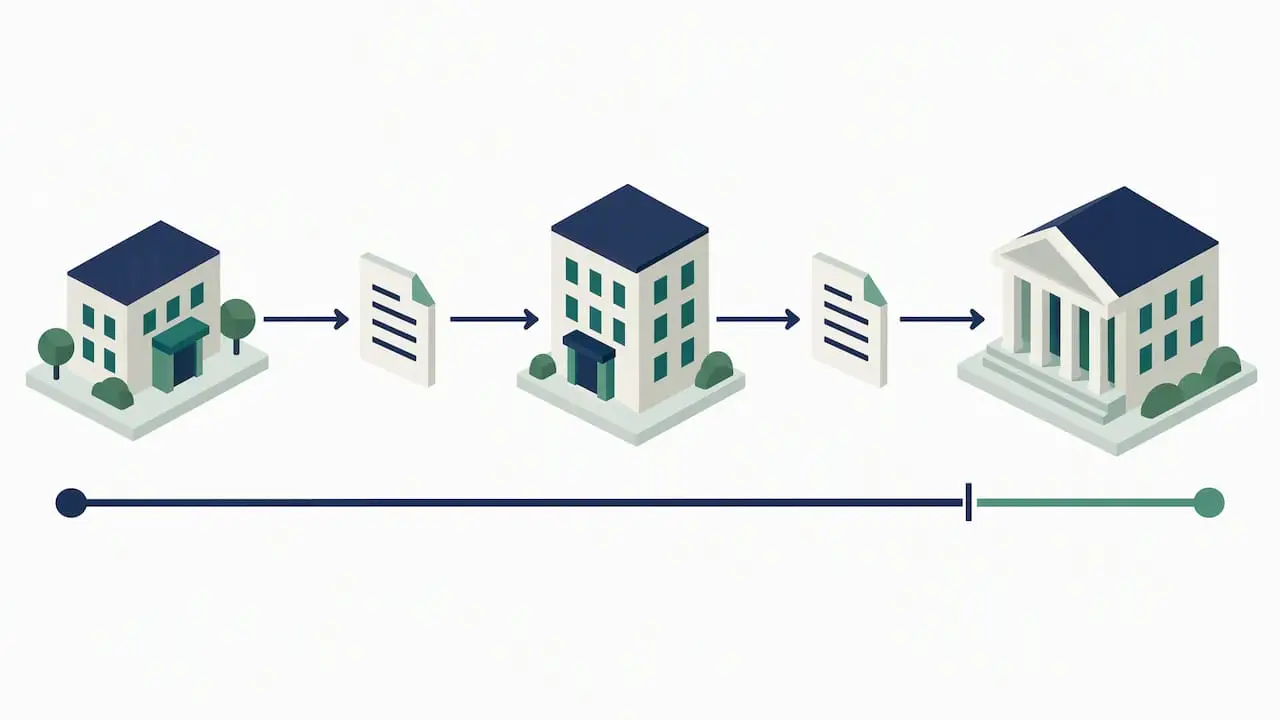
Build monitoring into the routine: a written monitoring plan, periodic remote or onsite reviews, and documented corrective actions. Nurse compliance tracking practices offer a useful parallel for audit-ready monitoring.
At final reporting, request at minimum:
- A financial reconciliation covering the full subaward period
- Program metrics matching the indicators in your own progress report
- Copies of supporting documents for charged costs
Closeout and audits: what to expect
At closeout, submit final financial and performance reports and liquidate obligations according to the deadlines and terms that apply to your award. If final reports are missing, the agency can record a material failure to comply in SAM.gov, which can follow you into future applications.
Whether your organization needs a Single Audit depends on its federal expenditures and the applicable audit requirements. Check the requirements for your organization and award. Findings tend to cluster around missing source documents, unsupported personnel charges, and unresolved procurement weaknesses. The HHS Grants Policy Statement, incorporated into your Notice of Award, spells out the post-award rules.
Closeout checklist:
- Reconcile the final SF-425 to your general ledger
- Assemble property reports (SF-428)
- Collect every subrecipient’s final report
- Document corrective actions and their resolution
Tracking templates that produce funder-ready reports
The reports that read well are built from daily data, not assembled in the last week. Funders increasingly ask for evidence of cost-effectiveness, so track outcomes and unit costs, not only service counts. Then map every budget line to an activity so each SF-425 expense traces to a service record or a staff time record.
A minimal event-level template needs these fields:
- Date of service
- De-identified client ID
- Service provided
- Partner organization
- Outcome or status
- Expense line
- Supporting document ID
Reconcile program counts against financials every month, and keep an issues log so shortfalls in a progress report have a documented explanation. For indicators worth tracking, see our community health outcome metrics, and for moving off manual tracking, read how teams go from spreadsheets to funder-ready reports.
Pro Tip: Ask one question of every field you collect: which report line will this support? If there is no answer, stop collecting it.
How we help you produce funder-ready reports
A referral that is sent but never tracked leaves a gap in your evidence. Our EquiLoop platform closes that gap. It manages SDoH screening, referral routing, follow-up and status tracking, and outcomes dashboards, then exports funder-ready reports. For programs that also track workforce credentials, our Workforce Development Academy handles training and credentialing. Book a 30-minute demo at calendly.com/wellcheck/demo-discuss and we will walk through your reporting requirements.
FAQ
How soon after an award ends is the final report due?
Final financial, performance, and other required reports are due within 120 calendar days after the period of performance ends, under 2 CFR 200.344. Subrecipients must submit reports to the pass-through entity according to the applicable federal requirements and subaward terms.
What three types of reports do public health grants require?
Federal grants generally require financial reports, compliance reports, and project or performance reports, according to Grants.gov. Your Notice of Award names the exact forms and due dates for your program.
Where do I submit grant reports?
It depends on the agency and program. Common systems include HRSA EHBs, the Payment Management System, Grants.gov and GrantSolutions, and FSRS for subaward data, which is then published on USAspending.gov. Your Notice of Award identifies which applies.
Who must complete a Single Audit?
Organizations generally must have a Single Audit if they meet applicable federal expenditure thresholds, and CDC’s reporting and audit guidance notes that program-specific thresholds may apply. Confirm your own obligation against your award terms.
