
Most programs should screen every patient or participant at least once a year, and rescreen sooner when something in the person’s life or care changes. No single national rule sets one interval for every setting. Medicare billing, the MIPS quality measure and clinical guidance each frame frequency differently, so the schedule you adopt should meet the strictest requirement that applies to your program and fit the staff time you actually have.
This article covers what the published guidance says, which events should trigger a rescreen between routine intervals, how billing rules limit repeat assessments, and how to build a schedule that produces data a funder will accept.
TL;DR
- Annual screening is the common baseline in clinical guidance, with extra screens at significant care transitions and other change points.
- MIPS Quality ID #487 requires adults to be screened at least once per performance period. Reviewing a previous standardized screen from that period counts.
- Medicare code G0136 is limited to once every six months and is for suspected or known needs, not routine screening.
- A standardized, system-wide process beats judgment calls about who looks “at risk.”
- A rescreen only matters if the referral that follows it is tracked to resolution.
Table of Contents
- What the guidance says about how often to screen
- What U.S. rules and measures require
- Events that should trigger a rescreen
- How frequency varies by setting and program
- Setting your own schedule: a step-by-step approach
- Why the referral matters more than the interval
- Tracking screening and follow-through in one place
- Reporting what your screening schedule produces
- FAQ
- Sources
What the guidance says about how often to screen
The most directly useful frequency guidance comes from clinical education material for oncology teams, which applies to any setting. NCCN guidance recommends screening annually or during significant care transitions, and it also names specific moments: when new prescriptions or dietary changes are needed, after missed appointments or a disconnected phone number, or when bruises raise a safety concern.
That gives a workable two-part rule:
- A fixed cycle. Everyone is screened on a regular schedule, typically once a year.
- Event-based screens. A defined list of changes prompts an extra screen regardless of where the person is in the annual cycle.
The fixed cycle catches slow drift: a rent increase, a lost job, a car that stops running. The event-based screens catch sudden change. Programs that use only the annual cycle miss the second group, and programs that use only events miss people who never trigger one.
For the definitions behind these screens, including how a social risk differs from a social need, see our social needs definition guide. The short version: social needs are social risks that the individual has prioritized as a current concern, which is why a person can screen positive for a risk and still decline help (research on screening for social needs).
What U.S. rules and measures require
Three frameworks come up most often when program leads ask about interval. They measure different things, so treat them as separate constraints.
| Framework | What it says about frequency | Who it applies to |
|---|---|---|
| MIPS Quality ID #487 (2025 specification) | Patients 18 and older screened at least once per performance period for food insecurity, housing instability, transportation needs, utility difficulties and interpersonal safety | Clinicians reporting this quality measure |
| Medicare code G0136 | Standardized risk assessment, 5 to 15 minutes, not more often than every six months | Billing practitioners, for suspected or known needs |
| Clinical guidance (NCCN) | Annually or at significant care transitions and other change points | Clinical teams setting their own protocols |
MIPS Quality ID #487
The CMS specification for Quality ID #487, Screening for Social Drivers of Health requires that patients 18 and older be screened for five domains at least once per performance period: food insecurity, housing instability, transportation needs, utility difficulties and interpersonal safety. The 2025 specification also accepts review of a previously performed standardized social needs screening during the performance period to meet the numerator.
Two practical points follow. First, “at least once” is a floor. It does not tell you to stop after one screen if the person’s circumstances change. Second, if a patient was screened earlier in the period at another point in your network, documenting a review of that result can satisfy the measure. That only works if the earlier result is stored somewhere your staff can find it, which is a data capture problem more than a screening problem. Our guide to SDOH data capture covers how to collect and code results so they can be reused.
Medicare code G0136
In 2024, CMS finalized G0136 for administering a standardized, evidence-based SDOH risk assessment tool, taking 5 to 15 minutes, and not more often than every six months, according to AAFP’s billing guidance. That guidance describes the code as strictly limited to not more than once every six months and for suspected or known needs rather than routine screening. The same page notes the code may be provided once every six months per beneficiary per physician, when appropriate.
This matters for scheduling. A six-month cap on a billable assessment does not mean you should screen every six months. It means you should not build a program that expects to bill for every rescreen. Decide your clinical interval first, then check what is reimbursable.
If your program reports through the federal health center data system, see UDS SDOH reporting for what health centers must submit and track.
What the rules do not say
None of these frameworks tells you how to run a repeat screen for a person who already has an open referral, or whether to rescreen someone who declined last time. Those are protocol decisions your program makes and documents. Funders and payers will ask what your protocol is, so write it down.
Events that should trigger a rescreen
A rescreen between annual cycles is worth the staff time when a change makes new needs likely. Based on the NCCN list and common care-coordination practice, build triggers around these situations:
- A significant care transition. A hospital discharge, a move from one level of care to another, or a new diagnosis that changes daily life. The NCCN guidance lists these among its screening points. A patient going home with new mobility needs, for example, may suddenly face questions about equipment, transportation and home access. Understanding the full continuum of care equipment a person may need after a transition helps staff decide which social needs questions to ask.
- New prescriptions or dietary changes. Medication costs and food access become immediate problems.
- Missed appointments or a disconnected phone. These are often the first visible sign of a transportation, housing or cost problem. Our no-show follow-up guide describes a 48-hour and 7-day follow-up pattern for rural programs.
- A safety concern. Signs such as unexplained bruising call for a private conversation and a safety screen, not a form handed over in a waiting room.
- A patient report. Anyone who tells staff that something has changed should be offered a screen.
Keep the trigger list short. A list of twelve triggers will not be remembered, and a trigger nobody applies is not a trigger. Five or six, written on a one-page protocol, is a realistic number for a small rural team.
How frequency varies by setting and program
There is no uniform answer across settings, and published practice reflects that. A few patterns are worth knowing.
Primary care. The MIPS measure is written for clinicians and sets a once-per-period floor. Many clinics align their screen with the annual wellness or preventive visit so it happens at a predictable point.
Emergency departments. AHRQ-funded work on a standardized social needs process in an emergency department found that screening all patients the same way helped address stigma and removed the guesswork about who needed screening. Because ED visits are episodic and unpredictable, the visit itself becomes the trigger.
Community-based programs. Community health worker programs, AHEC-run outreach, navigator programs and mobile clinics often see people at irregular intervals. For these programs, the practical unit is the encounter: screen at enrollment, rescreen at a set follow-up point, and rescreen at any contact where something has changed. Our page on mobile clinic referral tracking describes how that works when the clinic does not return to the same place every week.
Health departments and grant-funded programs. Frequency here is often set by the grant. Check the award terms and the reporting template before you set an internal interval, because a funder may require a baseline and a follow-up screen to show change over time.
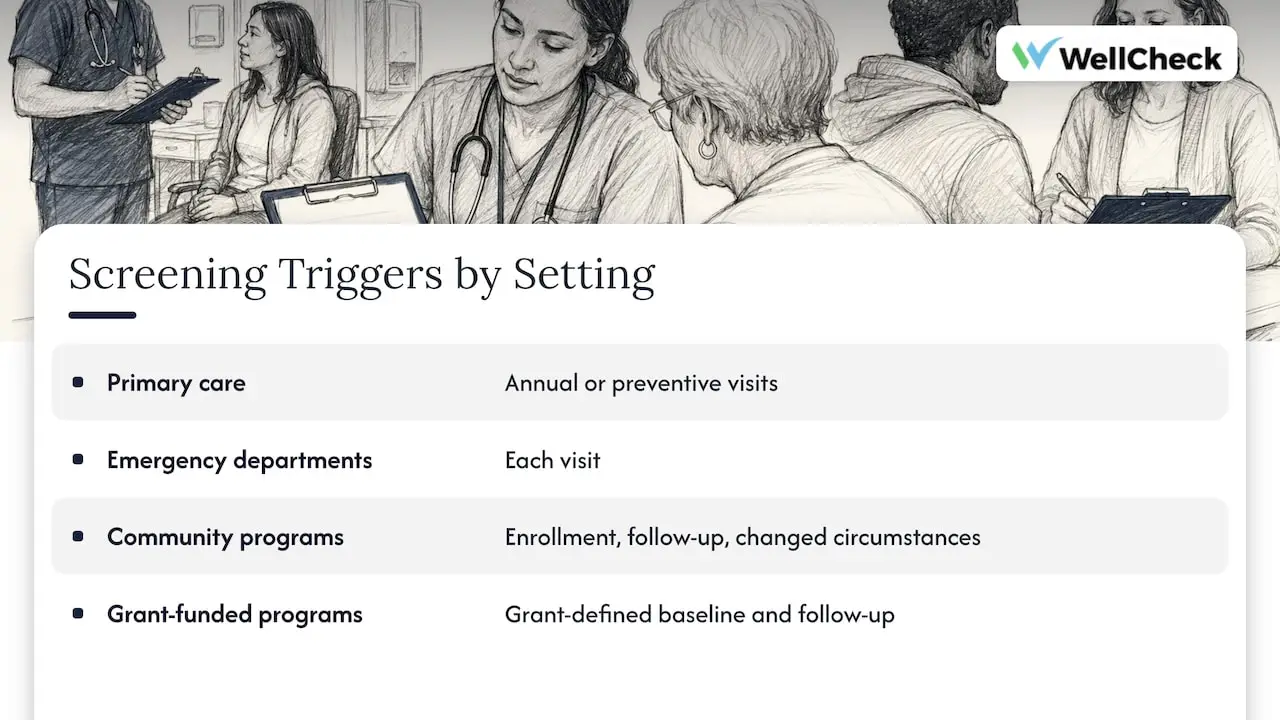
The rule across all of these: the interval should follow how and when you actually reach people.
Setting your own schedule: a step-by-step approach
1. Start with the strictest requirement
List every requirement that applies to your program: quality measures, payer contracts, grant terms, accreditation or reporting systems. Take the most frequent interval as your minimum. If one funder wants an annual screen and another wants a baseline and a six-month follow-up, your protocol needs the six-month follow-up.
2. Count the staff time
The NCCN guidance says organizations should consider the staff, time and space needed, and decide when and how often screening occurs. Time is the barrier people raise first. A systematic review in the Journal of the American Board of Family Medicine found time was the most cited barrier, and two studies reported that screening typically added less than 2 to 5 minutes to visits.
So estimate your screening load honestly. If you have 1,000 active patients and screen annually, that is 1,000 screens a year, plus event-based rescreens. At 5 minutes each, that is roughly 83 staff hours before any referral work. Whether that fits depends on who does the screening, which brings up the next step.
3. Decide who screens
AAFP guidance describes screening as a team-based effort, not solely the physician’s job. Nurses, medical assistants or community health workers can perform the assessment. The same source lists workflow options: patient self-assessment while waiting, staff-administered screening, or screening by nonclinical staff before or after the visit.
For rural programs with thin staffing, moving the screen to a community health worker or navigator is often what makes an annual cycle possible. If that is your plan, training matters. The systematic review above found that workforce education and dedicated quality improvement projects were facilitators that increased adoption of social screening. Our Workforce Development Academy is a white-labeled learning platform for community health worker and navigator training and credentialing.
4. Screen everyone the same way
When staff choose who to screen by appearance or assumption, they miss people and they make some patients feel singled out. Standardized, system-wide screening helps reduce stigma by asking all patients the same questions regardless of perceived risk, per the AHRQ-funded project. Use the same tool and the same script, and let people decline.
Common standardized tools include PRAPARE, the AAFP screening tool and the Accountable Health Communities tool, as listed in the AAFP billing guidance. Pick one and keep it. Changing tools between screens makes year-over-year comparison unreliable.
5. Define what “done” means for a rescreen
A rescreen should end in one of four recorded outcomes: no need identified, need identified and referral made, need identified and person declined help, or need identified and already being addressed. If your staff cannot record those four states, you cannot tell whether a repeat screen added anything.
6. Write the protocol on one page
Include the tool, the annual cycle, the trigger list, who screens, where results are stored, and what happens after a positive screen. Our SDOH screening workflow guide is written for program leads building this kind of protocol.
Why the referral matters more than the interval
Debating six months versus twelve months can hide the real weak point. Screening finds needs. It resolves none of them. Screening may start linkages to community-based support programs or social services, but the screen only creates the opportunity.
In many community settings, a referral is sent and no one tracks whether it was accepted, delivered or resolved. When that is the case, a rescreen produces a second list of needs on top of the first, with no record of what happened to the earlier referral. Staff then repeat the same referral for the same person, and funders see service volume without follow-through.
Before you increase screening frequency, check three things:
- Can you tell which referrals from the last screen were completed?
- Can you tell which were declined, and why?
- Can staff see the earlier result before they start the new screen?
If the answer to any of these is no, fixing the follow-up will improve your outcomes more than shortening the interval. Our guide to referral workflows for rural teams covers a seven-step approach to tracking referrals to a result, and community health outcome metrics explains how to pick two to four measures you can report.
Tracking screening and follow-through in one place
EquiLoop is WellCheck’s closed-loop SDoH referral and care coordination platform. It manages SDoH screening and intake, referral routing to clinical and community partners, follow-up and status tracking, outcomes dashboards and funder-ready reporting. Each deployment is configured around the partner network, referral pathways and reporting requirements the organization already has, and it is designed to complement existing systems of record rather than replace them.
For a screening schedule, that means a program lead can see who is due for a rescreen, what happened to each earlier referral, and what the program can report to a funder. EquiLoop is not a resource directory. Its purpose is workflow and accountability: tracking what happened after the referral was made. You can read how it works on the closed-loop referral workflow page or see the EquiLoop product page.
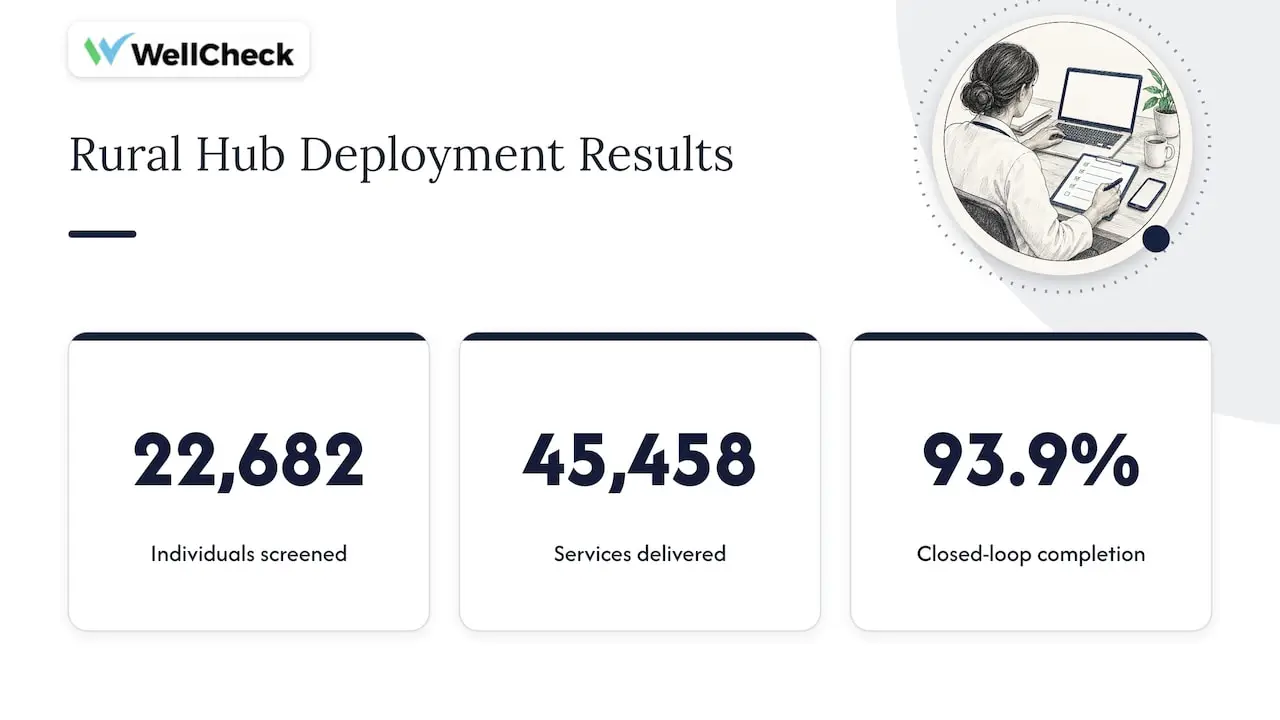
In one rural health hub deployment with a multi-partner ecosystem, the platform recorded 22,682 individuals screened, 45,458 services delivered and a 93.9% closed-loop completion rate.* If you want to see how a screening schedule and referral tracking would run for your program, book a 30-minute demo.
*Rural health hub deployment with a multi-partner ecosystem. Includes both clinical and social services referrals.
Reporting what your screening schedule produces
A schedule is only useful to a funder if you can report it. Plan the numbers before the first screen:
- Screened: how many unique people were screened in the period.
- Positive: how many screened positive for at least one need.
- Referred: how many received a referral for each need.
- Closed: how many referrals reached a recorded outcome.
- Rescreened: how many were screened again, and what changed.
The fourth number is the one most programs cannot produce. For a practical path from spreadsheets to reports, see our guide to funder-ready reporting. For the wider policy picture, our guide to social drivers of health is written for public health leaders.
FAQ
How often should SDOH screening be done?
Annually is the common baseline, with additional screens at significant care transitions and other change points such as new prescriptions, missed appointments or a safety concern, per NCCN guidance. If you report MIPS Quality ID #487, at least one screen per performance period is the floor. Check your grant and payer terms for anything stricter.
Can you bill for SDOH screening, and how often?
Medicare code G0136 covers a standardized SDOH risk assessment of 5 to 15 minutes, and it is limited to once every six months. AAFP’s guidance says it is for suspected or known needs rather than routine screening. Confirm current coverage details with your billing lead and payer.
Does a screening from earlier in the year count for MIPS?
For Quality ID #487 in the 2025 specification, reviewing a previously performed standardized social needs screening during the performance period is acceptable to meet the numerator. The result has to be documented and retrievable. See the CMS measure specification for the full criteria.
What do SDOH screenings assess?
Commonly assessed needs include food insecurity, housing, economic stability, social and community context, utilities, transportation and interpersonal safety, as described in this review of screening for social needs. The tool you choose determines the exact questions.
Who should do the screening?
It does not have to be a physician. AAFP guidance describes screening as a team effort, with nurses, medical assistants or community health workers performing the assessment. Patient self-assessment while waiting is another option.
Sources
- Health-Related Social Needs (NCCN, 2024)
- The what and how of screening for social needs (PMC)
- Quality ID #487: Screening for Social Drivers of Health (CMS, 2025)
- Code G0136 for Social Determinants of Health Risk Assessment (AAFP)
- A Practical Approach to Screening for Social Determinants of Health (AAFP)
- From Emergency to Community: Implementing a Social Needs Assessment and Referral (AHRQ)
- Assessing Implementation of Social Screening Within US Health Care Settings (JABFM)
- Continuum of care equipment
