
USCDI SDOH data is the set of social determinants of health data elements defined in the United States Core Data for Interoperability: SDOH Assessment, SDOH Problems/Health Concerns, SDOH Goals, and SDOH Interventions. They give electronic health systems a shared structure for recording social risks such as food, housing, and transportation needs, and for exchanging that information with other organizations. USCDI defines how the data is structured. It does not track whether a referral for those needs was ever completed. That second job belongs to your workflow.
TL;DR
- USCDI SDOH data consists of four data elements: Assessment, Problems/Health Concerns, Goals, and Interventions.
- Certified health IT developers must support the USCDI v3 SDOH elements. That is a requirement on the software, not a mandate that every provider screen every patient.
- In FHIR, the four elements map to Observation, Condition, Goal, and Procedure or ServiceRequest resources.
- Standardized data makes exchange possible. Follow-through on referrals still needs a tracked workflow with statuses and outcomes.
- Programs should plan for newer USCDI versions, including v7, published in July 2026.
Table of Contents
- What USCDI is, in plain terms
- The four USCDI SDOH data elements
- Which USCDI version includes SDOH data
- What USCDI requires and what it does not
- How USCDI SDOH data is exchanged: HL7 and FHIR
- From USCDI data to care coordination
- How EquiLoop fits
- A short checklist for your program
- FAQ
- Sources
What USCDI is, in plain terms
USCDI is a standardized set of health data classes and data elements for nationwide, interoperable health information exchange, as described on the ONC Interoperability Standards Platform. Two terms matter:
- A data class groups data elements by a common theme or use case, such as Problems, Goals, or Procedures.
- A data element is a granular piece of information defined for access, exchange, or use of electronic health information, according to the USCDI v6 document.
USCDI is a floor, not a ceiling. Organizations can exchange more than USCDI lists. The point is that every certified system can send and receive at least the same core set in the same form. NCQA describes the move to USCDI as addressing the need for a standardized framework for consistent exchange of health information and coordinated care.
The four USCDI SDOH data elements
SDOH elements are not a separate data class. Each sits inside an existing class, which is deliberate. The Federal Register rule that adopted USCDI v3 lists them as SDOH Assessment in Assessment and Plan of Treatment, SDOH Goals in Goals, SDOH Interventions in Procedures, and SDOH Problems/Health Concerns in Problems.
| Data element | Parent data class | What it records |
|---|---|---|
| SDOH Assessment | Assessment and Plan of Treatment | A structured, questionnaire-based evaluation of an SDOH-related risk |
| SDOH Problems/Health Concerns | Problems | A social condition or concern identified for a person |
| SDOH Goals | Goals | A desired outcome for addressing a social need |
| SDOH Interventions | Procedures | An action or service taken to address the need |
The USCDI v6 definitions describe SDOH Assessment as a screening questionnaire-based, structured evaluation for an SDOH-related risk, with examples including food, housing, transportation security, and health literacy. Problems/Health Concerns capture the related conditions or diagnoses. Goals capture future care goals. Interventions capture the actions or services taken to address those needs.
How the four elements work together
Think of them as one chain for a single patient:
- A screening produces an Assessment (for example, a positive food insecurity result).
- The care team records a Problem/Health Concern based on that result.
- The patient and team set a Goal, such as getting enrolled in a food assistance program.
- Someone performs an Intervention, such as a referral to a food pantry.
The chain stops being useful if the last step has no outcome. USCDI gives you a place to record that an intervention happened. It does not tell you whether the pantry accepted the person or whether they received food. This is the gap closed-loop referral tracking addresses, covered below.
Which USCDI version includes SDOH data
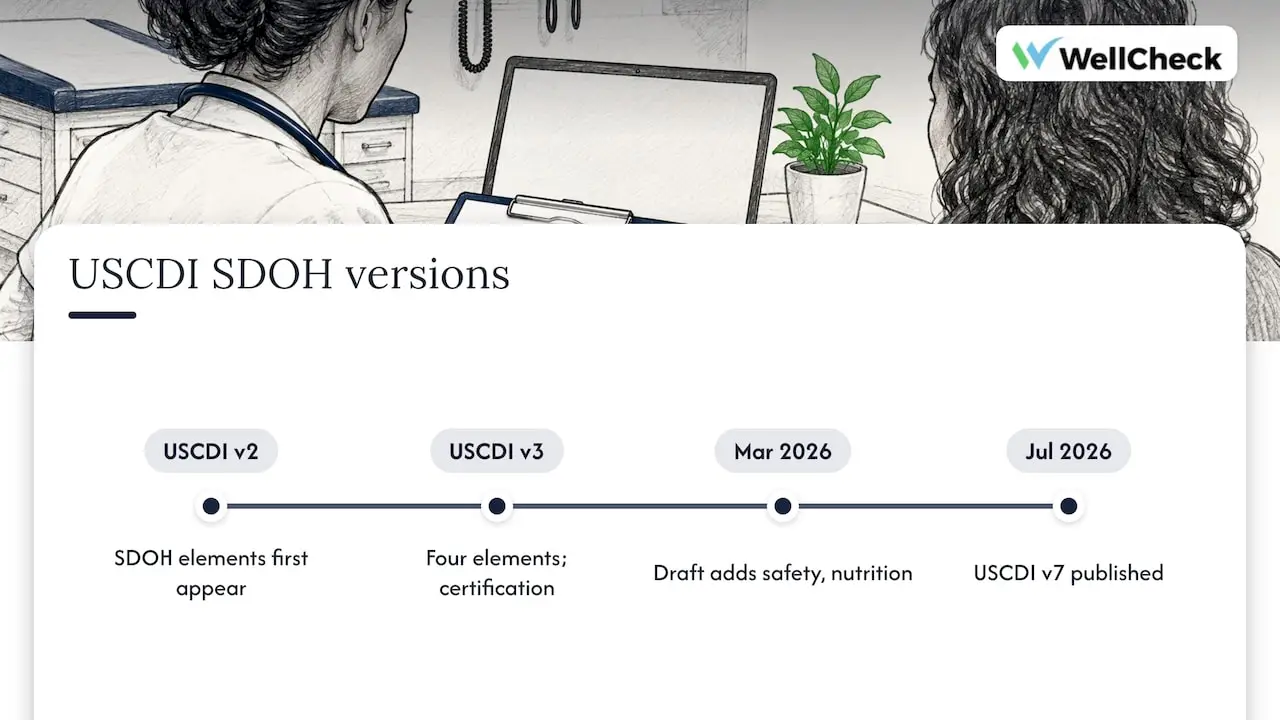
The SDOH elements first appeared in USCDI v2, and the Gravity Project’s July 2021 presentation to ONC identified them there and laid out v3 domains and a standards-development roadmap. USCDI v3 carries all four elements, and that is the version the certification program references for SDOH.
Versions keep moving. USCDI v7 was published in July 2026. In March 2026, ASTP/ONC said the draft of v7 strengthens support for patient safety and nutrition care, which matters to programs working on food and nutrition referrals.
For a program director, the practical takeaway is simple: the four SDOH elements are established and will stay part of the standard. Ask whether your systems can export them in a structured way, and which USCDI version your electronic health record vendor has certified against.
What USCDI requires and what it does not
This is the most common point of confusion, so it is worth being precise.
What it requires. Under the ONC certification program, developers whose Health IT Modules are certified to specific criteria must support all USCDI v3 data elements, including the four SDOH elements. The ONC also notes that USCDI v1 expires at the start of 2026, with some certification requirements tied to that date.
What it does not. The requirement is on software capability. It is not a rule that a clinic, health department, or community-based organization must screen patients or report SDOH data. Commenters on the rule raised a related point, asking ONC to explain that USCDI v3 does not require sharing of sensitive information. Collecting and sharing remain governed by your program, payer, and funder requirements, plus privacy law.
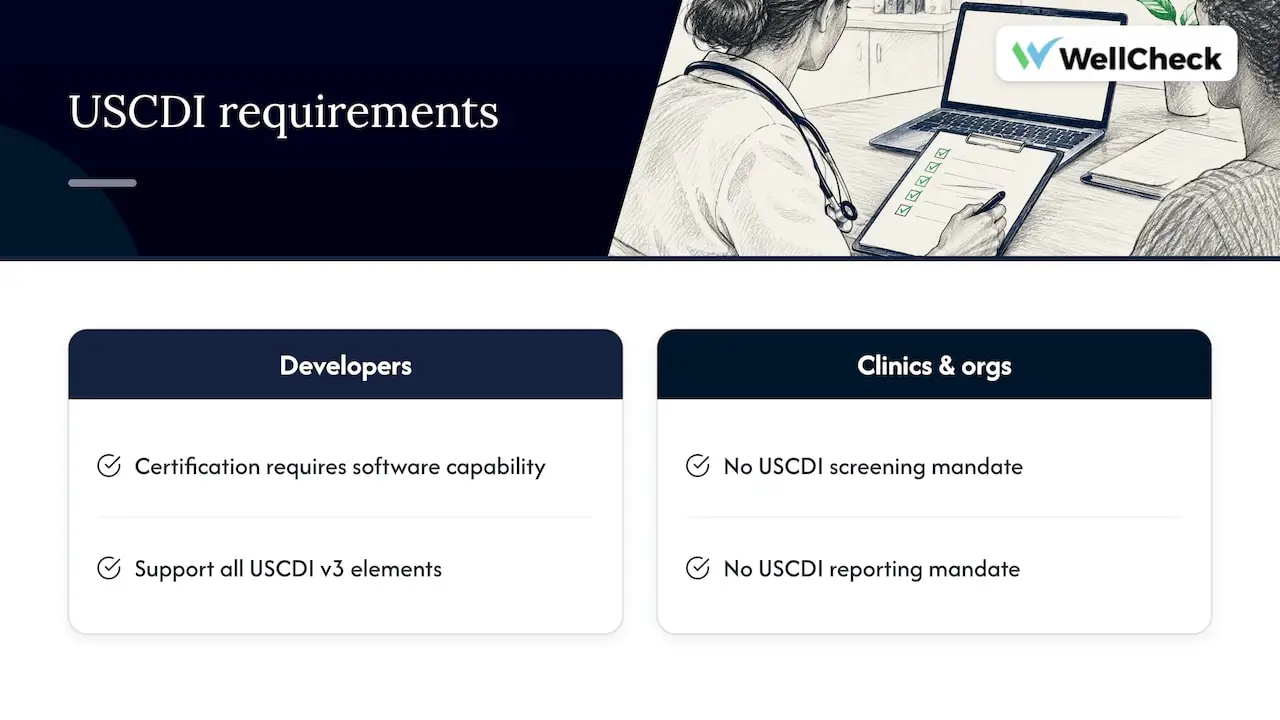
Screening and reporting obligations come from other places: quality programs, grant terms, and for health centers, annual reporting. Our guides on SDOH screening mandates and UDS SDOH reporting for FQHCs cover those separately from USCDI.
How USCDI SDOH data is exchanged: HL7 and FHIR
USCDI defines what to exchange. HL7 FHIR defines how. In US Core FHIR implementations, one vendor’s mapping documentation shows the pattern: SDOH Assessments are Observation resources, Problems/Health Concerns are Condition resources, Goals are Goal resources, and Interventions are Procedure or ServiceRequest resources.
What that means for you:
- A screening tool that writes answers as free text or a PDF cannot feed these resources.
- A tool that captures answers with standard codes can pass them to the record as Observations.
- A referral that is a ServiceRequest can carry a status, which is what makes follow-up measurable.
Standard vocabularies do the heavy lifting. The Gravity Project develops SDOH value sets and domains for addition to USCDI, and it argues that SDOH elements belong inside clinical workflows rather than as custom fields if exchange is to work across health and human services. Our Gravity Project SDOH guide and SDOH Z codes guide show how those codes appear in practice.
From USCDI data to care coordination
Standardized SDOH data supports care coordination, population health management, outcome measurement, and reporting. Documentation and communication of SDOH data matter across providers, payers, and community-based organizations, because each holds a piece of the person’s story.
The common failure is in the middle. A screening is recorded, a referral is sent, and then nothing is tracked. The Intervention element may say “referred to transportation assistance,” but no one knows if the ride was scheduled. To close that gap, a program needs to track, for every referral:
- Whether it was sent and to whom
- Whether the receiving organization accepted it
- Whether the service was delivered
- Whether the need was resolved, and when
Teams that document desired outcomes and services such as food pantry or transportation referrals clearly also make coding and billing easier, a point explored in this clinical documentation improvement guide.
For metrics built on these statuses, see our guides to community health outcome metrics and referral tracking.
Privacy and data quality
Social needs data is sensitive. The Gravity Project urged equitable data use to avoid harm, discrimination, or profiling. Practical steps for program leads:
- Collect only the domains you act on, and tell patients why you ask.
- Limit who can see screening answers, and set sharing rules with each partner in writing.
- Use consistent question sets and codes so that results are comparable across sites.
- Audit for blanks and “declined” values, which distort population-level counts.
Our SDOH data capture guide and digital SDOH assessment page go deeper on collection, and our social needs definition guide clarifies terminology.
How EquiLoop fits
EquiLoop is WellCheck’s closed-loop SDoH referral and care coordination platform. It covers SDoH screening and intake, referral routing to clinical and community partners, follow-up and status tracking, outcomes dashboards, and funder-ready reporting. Each deployment is configured around the partner network, referral pathways, and reporting requirements the organization already has, and it is built to complement existing systems of record rather than replace them. It is not a resource directory. Its purpose is tracking what happened after the referral was made.
One rural health hub deployment with a multi-partner ecosystem reports 22,682 individuals screened, 45,458 services delivered, and a 93.9% closed-loop completion rate.¹ To see how EquiLoop would map to your screening, referral, and reporting setup, book a 30-minute demo.
¹ Rural health hub deployment with a multi-partner ecosystem. Includes both clinical and social services referrals.
A short checklist for your program
- Identify your record’s USCDI version. Ask your EHR vendor which version it is certified to and whether SDOH elements can be exported.
- Choose a screening instrument and code it. Pick one question set, and make sure answers carry standard codes.
- Define referral statuses. Sent, accepted, delivered, resolved, and declined cover most needs.
- Assign ownership. Name who checks open referrals and how often.
- Match reporting to the requirement. Map each funder or payer measure to a field you already capture. Our funder-ready reporting guide shows the approach.
- Train the people doing the screening. Consistent data depends on consistent practice, which is where workforce training matters for community health worker programs.
FAQ
What does USCDI SDOH data include?
Four data elements: SDOH Assessment, SDOH Problems/Health Concerns, SDOH Goals, and SDOH Interventions. Together they record a screening result, the resulting social concern, the goal for addressing it, and the action taken.
Does USCDI require my organization to screen for social needs?
No. USCDI sets the data standard that certified health IT must support. Screening duties come from payer programs, grants, and reporting rules that apply to your organization, so check those directly.
How do FHIR resources relate to USCDI SDOH data?
USCDI names the data; FHIR carries it. SDOH Assessments map to Observation, Problems/Health Concerns to Condition, Goals to Goal, and Interventions to Procedure or ServiceRequest.
Does USCDI track whether a referral was completed?
USCDI lets you record that an intervention occurred. Tracking acceptance, delivery, and resolution takes a workflow with statuses and follow-up, which is the role of a closed-loop referral platform.
Sources
- United States Core Data for Interoperability (USCDI), Interoperability Standards Platform
- USCDI Version 6, July 2025 (healthit.gov)
- USCDI Version 6, July 2025 (ISP)
- USCDI Version 7 Standard Document
- ASTP/ONC Developer Roundtable, March 2026
- Introduction to USCDI, NCQA
- Federal Register: HTI-1 final rule
- ONC Certification Program Resource Guide: Decision Support
- Gravity Project presentation to ONC USCDI Task Force, July 2021
- FHIR R4 mapping documentation
- Problems/Health Concerns, Interoperability Standards Platform
